Choosing to partner with a minority owned food company is more than a social good—it’s a powerful business strategy that drives innovation, strengthens supply chains, and creates authentic community impact. However, unlocking this potential requires more than just good intentions. It demands a partner with deep expertise, proven operational muscle, and a clear understanding of the procurement landscape.
As a minority-owned business ourselves, Umoja was founded to bridge the gap between large-scale procurement needs and the specialized capabilities of diverse suppliers. We’ve lived the challenges and pioneered the solutions. This guide shares our unique perspective, offering an insider's view on building partnerships that are not just transactional, but transformational.
The Strategic Advantage of Supplier Diversity: An Insider's View
For organizations in government, healthcare, and the nonprofit sector, every partnership decision has a ripple effect, influencing budgets, compliance, and the health outcomes of the communities you serve. Partnering with a minority owned food company injects fresh perspectives and agility into your supply chain, offering a unique window into underserved markets and culturally connected foods that truly resonate with diverse populations.

This is not just a theory for us at Umoja; it’s our origin story. We built this company because we saw a critical need for a partner who could speak the language of both large-scale procurement and community-focused service. Our firsthand experience informs every solution we build, ensuring that our partnerships are designed for maximum impact from day one.
Sector Trend Analysis: Why Supplier Diversity is a Core Strategy
Today’s supply chains demand resilience, adaptability, and deep community connection. Supplier diversity has evolved from a "nice-to-have" checkbox into a core component of any effective procurement strategy. The trend is clear: organizations that embrace diversity are better positioned for success.
Here's our analysis of the key benefits:
- Enhanced Innovation: Diverse suppliers often bring new products and creative solutions—like culturally relevant meal kits or specialized packaging—that larger, more monolithic companies overlook.
- Increased Resilience: A varied supplier network reduces dependence on a single source, making your entire supply chain less vulnerable to disruption—a critical lesson from recent global events.
- Authentic Community Impact: Investing in minority-owned businesses directly fuels local economic growth, creates jobs, and builds wealth in historically underserved communities, a key metric for many funders.
This guide provides actionable insights to build these high-impact partnerships. To explore more of our analysis on community-focused programs, you can find additional expert analysis in our thought leadership articles. We are here to help you transform your supply chain from a cost center into a measurable strategic asset.
Decoding Minority Owned Business Certifications
Diving into the world of business certifications can feel complex, but for any procurement professional, understanding these credentials is the critical first step to forging a successful and compliant partnership with a minority owned food company.
A certification is the official verification that a business is at least 51% owned, operated, and controlled by individuals from a designated minority group. This isn’t just about checking a box; it’s about ensuring legitimacy and accountability, so your diversity spend reaches its intended communities. The verification process is rigorous, involving deep dives into legal, financial, and operational structures. For a buyer, this third-party validation slashes risk and simplifies vetting.
Procurement Opportunity: The Strategic Role of Certifications
Working with a certified Minority Business Enterprise (MBE) provides a clear strategic edge. It streamlines compliance for public programs, unlocks access to contracts with set-aside requirements, and adds a crucial layer of trust to your supply chain. You gain the assurance of partnering with a legitimate, thoroughly vetted business.
The growth in this sector points to a massive opportunity. For instance, the number of majority Black-owned businesses in the U.S. shot up from 124,004 in 2017 to 194,585 in 2022—an incredible 57% jump. While their total revenue also surged by 66% to $211.8 billion, these firms still only make up about 3% of all U.S. businesses. This data highlights the significant untapped potential and the ongoing need for programs that create equitable growth. You can dig into more of this data and see the full research from Pew Research Center.
Key Minority Owned Business Certifications at a Glance
While numerous organizations offer certifications, a few are considered the gold standard. Familiarizing yourself with them will help you quickly identify qualified partners.
Here's a breakdown of the key players and what their certifications mean for procurement.
| Certification Acronym | Certifying Body | Primary Purpose and Benefit for Buyers |
|---|---|---|
| MBE | National Minority Supplier Development Council (NMSDC) | Connects corporate America with certified MBEs. NMSDC certification is widely seen as the premier credential, guaranteeing a supplier has passed a tough vetting process. |
| 8(a) Business Development | U.S. Small Business Administration (SBA) | Helps small, disadvantaged businesses get a foothold in the federal marketplace. This certification unlocks access to government set-aside contracts and sole-source awards. |
| DBE | U.S. Department of Transportation (DOT) | A program for Disadvantaged Business Enterprises focused on boosting participation of minority- and women-owned businesses in state and local transportation projects. |
These certifications are your assurance that you're engaging with partners who have been rigorously evaluated and are ready to deliver.
By prioritizing certified partners, you are not just meeting a quota. You are investing in a system designed to ensure accountability, quality, and genuine economic impact, making your procurement strategy more resilient and effective.
As an NMSDC-certified company ourselves, we at Umoja know this landscape inside and out. We’ve navigated the process and understand how to help our partners seamlessly meet their compliance goals, ensuring every partnership rests on a solid foundation of trust and verified excellence.
Mastering Procurement and Compliance Requirements
Bringing a **minority owned food company** into your supply chain is a smart, strategic decision, but success hinges on mastering procurement and compliance. This isn’t just about avoiding penalties; it’s about building solid, auditable partnerships that create the impact you’re aiming for.
For government agencies, healthcare systems, and non-profits, the stakes are high. You're juggling federal grant requirements, internal diversity spending goals, or mandates like the Buy American Act. That’s where a partner who is also a compliance expert becomes invaluable. At Umoja, we function as your compliance guide, cutting through the complexity so you can focus on your mission.
Navigating Key Regulations and Mandates
The compliance landscape is a maze of rules that vary by sector and funding source. A misstep with federal funds, for example, could jeopardize your funding and create significant administrative burdens.
Here are key areas where compliance is non-negotiable:
- Supplier Diversity Goals: Many large organizations have internal targets for spending with minority-owned businesses. Achieving these goals requires certified partners and meticulous record-keeping.
- Government Set-Asides: Federal, state, and local governments often "set aside" a percentage of contracts for small or disadvantaged businesses, including MBEs.
- Grant and Funding Requirements: Non-profits and healthcare providers frequently operate under grants with specific stipulations, such as purchasing from diverse or local suppliers to ensure funds benefit the community directly.
The graphic below shows the basic steps a minority owned food company goes through to get officially certified, which is the key to proving they are ready to meet these compliance demands.
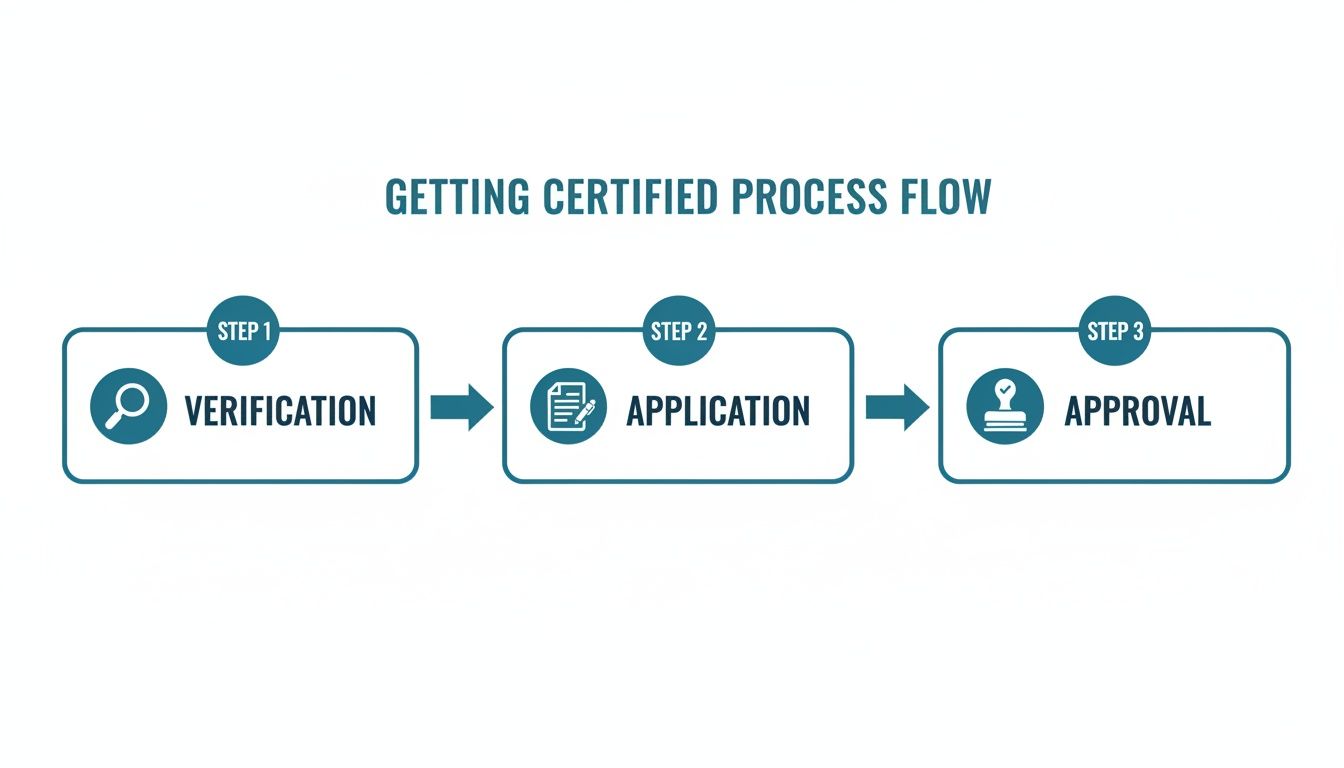
This formal certification process gives you, the buyer, total confidence that a supplier's status has been officially and rigorously checked out.
Strengthening Contracts with Clear Language
One of the best ways to ensure compliance is to write it directly into your contracts. Clear, specific language eliminates confusion and holds both parties accountable. Vague goals lead to vague results.
Consider adding clauses that explicitly outline your supplier diversity expectations. This does more than state a commitment; it creates a measurable standard. For a deeper dive into how companies approach buying goods and services, check out this an expert guide to mastering the process of procurement.
Sample Contract Clause Example
"Vendor acknowledges that Buyer has a commitment to supplier diversity. Vendor agrees to provide quarterly reports detailing all expenditures with certified Minority Business Enterprises (MBEs), Women Business Enterprises (WBEs), and other diverse suppliers related to the fulfillment of this contract. These reports shall be submitted to the Buyer's Supplier Diversity Office no later than 30 days after the end of each calendar quarter."
A clause like this transforms an intention into a contractual duty, making tracking straightforward. It also signals to partners that supplier diversity is a key performance indicator. As an experienced minority owned food company, Umoja understands these requirements and is prepared to deliver all necessary documentation without a hitch.
Your Checklist for Evaluating Vendor Capabilities
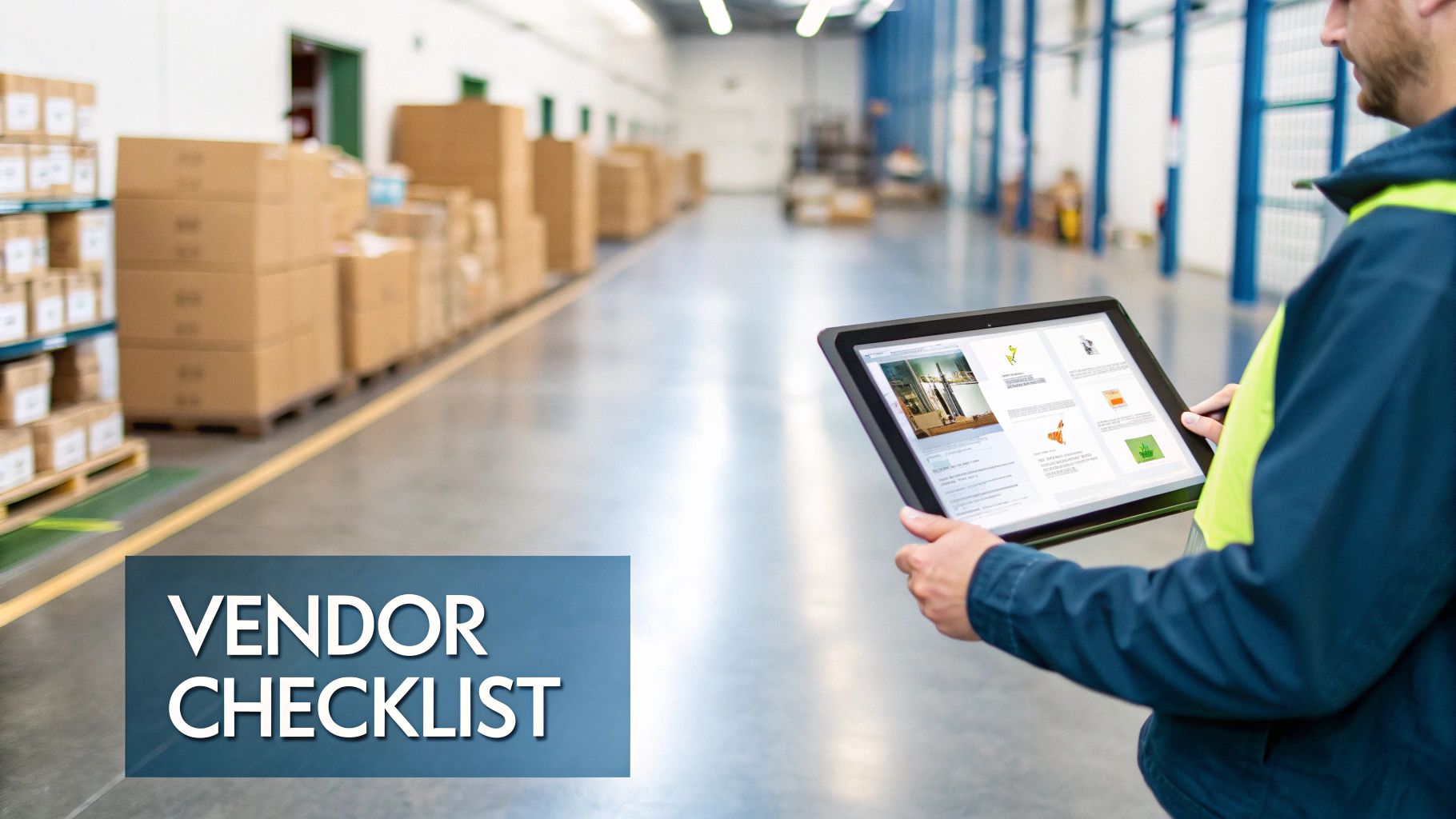
Choosing the right partner goes far beyond certification. While credentials confirm a company’s status as a minority‑owned food company, they don't reveal its operational strength. You need a partner who can handle the real-world pressures of your supply chain, which means assessing their logistics and technology infrastructure.
This checklist is a guide to asking the tough questions that separate contenders from pretenders. It’s designed to help you find a partner who can not only meet your logistical demands but also make your operations more efficient.
Assessing Logistics and Scalability
A vendor’s true strength lies in their inventory and transportation management. A great product is useless if it can’t get where it needs to go on time and in perfect condition.
Start by examining their warehousing and distribution network. Do they own their facilities or work with a Third-Party Logistics (3PL) provider? A strong 3PL partnership can offer incredible flexibility, but you must verify the relationship and the provider's reputation.
Key questions to ask:
- Warehousing: What’s your total square footage for food-grade storage? Do you have temperature-controlled or allergen-segregated zones?
- 3PL Partnerships: Can you walk me through your relationship with your 3PL provider? What’s their track record for on-time delivery and order accuracy?
- Scalability: How do you handle a sudden spike in order volume, like during an emergency or a seasonal rush?
This inquiry quickly reveals whether a minority owned food company has the infrastructure and agility to scale with your programs.
Verifying Technology Integration
In today's supply chain, data must flow as smoothly as products. Manual processes lead to delays, errors, and administrative headaches. A tech-savvy vendor uses integrated systems to create a seamless link between their operation and yours.
The two most critical systems are Electronic Data Interchange (EDI) and a Warehouse Management System (WMS). EDI automates the exchange of documents like purchase orders, while a WMS provides real-time visibility into inventory and order status.
A vendor without solid EDI and WMS capabilities is like a delivery truck without a GPS. They might get there eventually, but the journey will be inefficient, unpredictable, and full of unnecessary risks. True partners invest in technology because it builds transparency and reliability.
The global ethnic food market, often pioneered by minority-owned businesses, was valued at $48.6 billion and is expected to hit $78.1 billion by 2030. This explosive growth—with a 7.8% CAGR predicted in the U.S. alone—means scalable technology isn't a "nice-to-have." It's essential for survival and growth. You can discover more insights from the full market analysis on Grand View Research.
Evaluating Complex Kitting and Assembly Experience
Many programs, especially in healthcare and emergency response, require custom kits—like patient discharge nutrition packs or family meal boxes—assembled with absolute precision. This is a specialized skill that not every food vendor possesses.
Kitting and assembly demand an obsessive attention to detail. A vendor’s experience here reveals their operational maturity and quality control. For a deeper dive, check out our guide on private label packaging setup to see the complexities involved.
Ask for specific examples of their kitting projects:
- Past Projects: Can you share a case study of a complex kitting project you’ve managed? What were the components, and what was the volume?
- Quality Control: What’s your process for ensuring every kit is accurate and preventing errors?
- Customization: How do you handle substitutions or changes to kit contents in the middle of a program?
A partner with proven kitting experience, like Umoja, can turn a logistical nightmare into a streamlined solution. By asking these targeted questions, you can confidently choose a minority owned food company that truly has the operational muscle to deliver.
Unlocking Value with Advanced Logistics and Kitting
A truly valuable partner delivers end-to-end solutions, not just products. For a minority owned food company to excel in high-stakes sectors like government, healthcare, and non-profits, operational excellence is non-negotiable. This is where advanced logistics and specialized kitting capabilities create a decisive advantage.
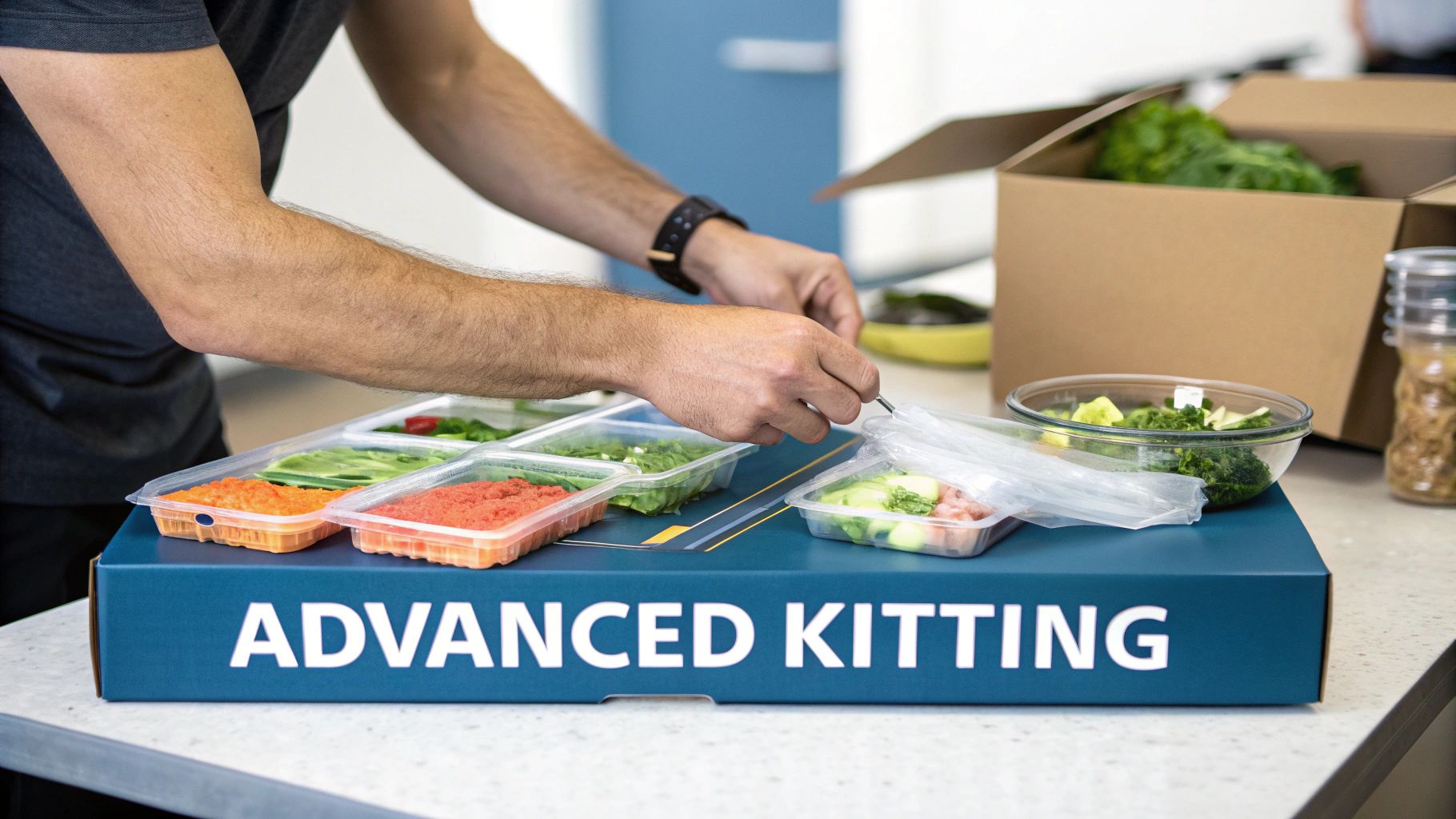
Many programs require carefully assembled kits designed for specific populations. Executing these multi-item projects demands absolute precision. One small error can jeopardize an entire shipment and fail the very people you’re trying to help.
Precision in Practice: Custom Kitting Examples
Specialized kitting is the true test of a vendor’s operational maturity. It’s one thing to ship a pallet of canned goods; it's another challenge entirely to assemble thousands of identical kits, each containing a dozen different items, without a single error.
Consider these real-world scenarios where precision is critical:
- Emergency Response Food Box: After a disaster, families need immediate access to ready-to-eat meals, water, and hygiene items. A reliable partner can assemble and deploy thousands of these kits rapidly, ensuring every box contains the correct, life-sustaining contents.
- Patient Discharge Nutrition Pack: A hospital can send a patient with diabetes or hypertension home with a kit full of medically tailored groceries. This requires unwavering adherence to nutritional guidelines and allergen protocols.
- Rural Non-Congregate Meal Kits: Summer feeding programs in remote areas might provide kids with a multi-day box of breakfasts, lunches, and snacks that must meet strict USDA meal pattern requirements—a complex job demanding intense quality control.
At Umoja, we have built our reputation on flawlessly executing these complex projects. Our expertise in managing intricate assemblies means your beneficiaries get exactly what they need, every time. You can see how these programs come to life by learning more about our custom kitting programs for nutrition security.
The Power of an Integrated Supply Chain
This level of precision is powered by an interconnected technology stack that creates a transparent and efficient supply chain. Think of it as the central nervous system of our logistics operation.
Our integrated systems are built on three pillars:
- Third-Party Logistics (3PL): We run our own FDA-registered 3PL, Unidad Logistics. This gives us direct control over food-grade storage, inventory, and fulfillment, eliminating communication gaps and ensuring our high standards are consistently met.
- Electronic Data Interchange (EDI): This technology automates the exchange of crucial documents like purchase orders and invoices. It slashes manual errors, freeing up your team to focus on mission-critical work.
- Warehouse Management System (WMS): Our WMS provides a real-time window into inventory levels, order status, and shipment tracking, giving you complete transparency from our warehouse to the final destination.
Together, these systems forge a reliable supply chain that simplifies your operations. To dig deeper into how these components work together, check out this overview of kitting and assembly services and their impact on modern logistics.
Case Study: Solving a Complex Logistical Challenge
A state agency faced a huge challenge: deliver 50,000 multi-day meal kits to rural families across a wide area within a tight two-week deadline. Their previous vendor had failed, struggling with accuracy and late deliveries that threw the program into chaos.
Our mission was to restore reliability. By integrating our WMS with their ordering system and using EDI to automate shipment notifications, we created a seamless workflow from day one.
Our team designed a custom kitting line to assemble the boxes with 99.9% accuracy. We then worked with our freight partners to map out the most efficient delivery routes. The results were immediate and powerful.
- Result: The agency saw a 40% reduction in administrative overhead tied to order tracking and fixing errors.
- Result: Delivery times improved by an average of two days per shipment, getting food to families when they expected it.
This success story shows how partnering with a capable minority owned food company delivers operational excellence and measurable results.
Measuring the Real-World Impact of Your Partnership
Ultimately, the true measure of a partnership is its real-world impact. Working with a minority owned food company should deliver tangible results that strengthen your organization and lift up the communities you serve. At Umoja, we are built to deliver outcomes you can see and measure. We provide the concrete proof that the right partnership is an engine for efficiency, compliance, and genuine social good.
From Metrics to Mission Success
The data from our partnerships tells a powerful story. By focusing on operational excellence, we help organizations achieve significant gains where it matters most. These are not abstract goals; they are hard numbers from our work with government, non-profit, and healthcare partners.
Here are anonymized examples of the results we consistently help our partners achieve:
- Financial Efficiency: Clients report up to a 40% reduction in administrative hours previously spent on order management after implementing our EDI and WMS solutions. This frees up valuable staff to focus on mission-critical work.
- Supplier Diversity Goals: We’ve helped government and healthcare partners boost their Tier 1 diversity spend by an average of 15-20% in the first year, ensuring they meet and often exceed compliance targets.
- Community Reach and Reliability: For one large-scale rural feeding program, our streamlined kitting and distribution network pushed on-time delivery rates to over 98%, helping them reach thousands more families and restoring trust in the program.
These numbers clarify that choosing a capable minority owned food company is a strategic decision with a clear return on investment.
The Umoja Difference: A Case Study in Impact
A state-level health agency needed to launch a Food is Medicine program for diabetic patients in underserved communities, but past attempts had failed due to inaccurate kits and unreliable deliveries, jeopardizing their funding.
We didn’t just offer products; we offered a complete program architecture. Our solution integrated medically tailored food kitting, automated EDI ordering, and a robust reporting system to track patient engagement and health indicators.
The change was immediate. Within six months, the agency was running a fully compliant, high-functioning program delivering measurable benefits.
The Outcomes:
| Metric | Result Achieved with Umoja |
|---|---|
| Program Administrative Costs | Decreased by 25% due to automated workflows. |
| Patient Kit Accuracy | Achieved a 99.9% accuracy rate, eliminating health risks. |
| Community Impact | Successfully served 5,000+ individuals with medically tailored meals. |
| Compliance Reporting | Generated automated quarterly reports, securing program funding. |
This success story is a testament to what happens when operational expertise meets a mission-driven approach. It’s the kind of concrete, measurable impact we aim to create for every single partner. When you choose Umoja, you’re not just sourcing food—you’re investing in a partnership that guarantees compliance, boosts efficiency, and leaves a lasting positive mark on the communities that count on you.
Got Questions? We’ve Got Answers.
When you're bringing a new minority-owned food partner into the fold, a few practical questions are bound to come up. Here are some of the things procurement managers often ask us, with straightforward answers to help you see the path forward.
How Does Partnering with an MBE Help Us Meet Federal Funding Rules?
Working with a certified Minority Business Enterprise (MBE) is a direct strategic move to secure your funding. Many federal grants and regulations, like the Buy American Act, have provisions that require or strongly encourage sourcing from diverse suppliers. The goal is to ensure public funds are reinvested into underserved communities. When you partner with a certified MBE like Umoja, every dollar spent is tracked and auditable, giving you rock-solid proof of compliance.
What Are the First Steps to Integrate a New Diverse Vendor?
Onboarding a new vendor shouldn't be a headache. We believe in a clear, structured process. The best place to start is with a kickoff call to assign a main point of contact and discuss expectations.
After that, we get into the technical details:
- Sharing Specs: You’ll provide the technical details for your Electronic Data Interchange (EDI) and Warehouse Management System (WMS).
- Setting Timelines: We’ll map out clear milestones for testing and going live.
- Defining Reporting: Let us know what compliance and performance data you need, and we’ll build it into the process.
This simple roadmap ensures a smooth integration and a partnership built to last.
What Value-Added Services Should We Look For Beyond Just the Products?
A true partner delivers solutions, not just boxes of food. You should look for a minority-owned food company that offers services designed to make your programs more effective.
The best suppliers become an extension of your own team. They're the ones who see a logistical challenge coming and solve it before it ever becomes your problem. That level of specialized service is a tell-tale sign of their operational maturity and genuine commitment to your mission.
Look for critical capabilities like custom kitting for specialized meal boxes, fully integrated 3PL logistics to handle distribution, and detailed compliance reporting that makes your grant management a breeze. These aren't just add-ons; they're proof that a vendor can manage a complex, end-to-end project with the precision you need.
At Umoja Health, we bring the operational muscle and deep compliance expertise to make your procurement goals a reality. Start building a partnership that delivers real impact.