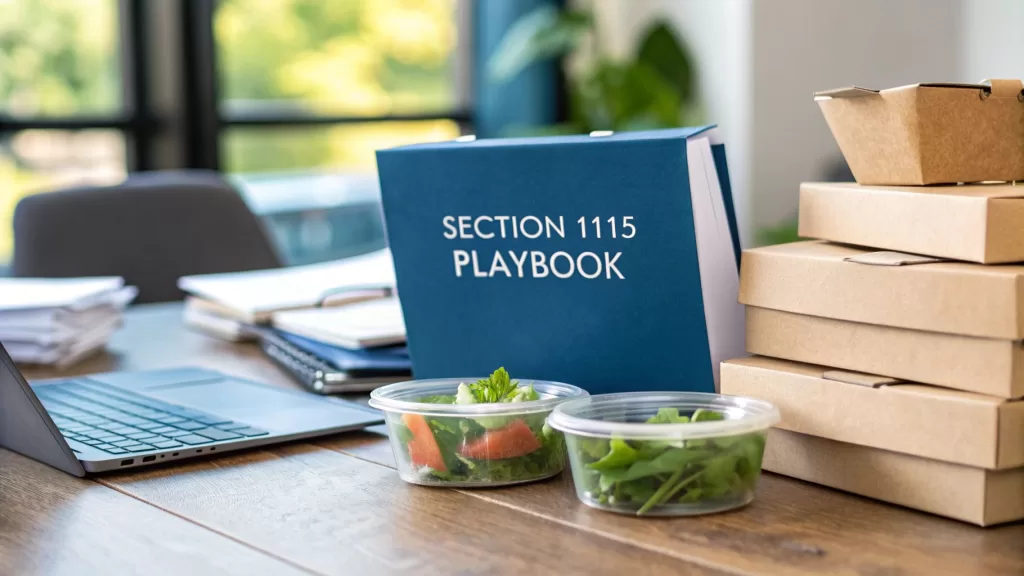
Section 1115 demonstration food programs are a powerful tool states can use to funnel Medicaid funds into innovative nutrition services that directly combat food insecurity. These waivers are specifically designed for high-need populations, aiming to improve health outcomes for people with diet-sensitive conditions like diabetes or heart disease.
The Strategic Value of Section 1115 Food Programs
States are increasingly looking past traditional clinical care to get at the root causes of poor health, and it's impossible to ignore the role of food insecurity. Section 1115 demonstration food programs open up a formal pathway to test how targeted nutrition interventions can improve health while actually reducing healthcare costs. You can think of it as a state-level laboratory for healthcare innovation, fully sanctioned and funded through Medicaid.
But let's be clear: these waivers are not broad-based food assistance programs like the Supplemental Nutrition Assistance Program (SNAP). They aren't entitlements. Instead, they are highly targeted, time-bound experiments focused on specific Medicaid populations who have documented health needs.
The entire point is to generate evidence. Can providing medically tailored meals to someone just discharged from the hospital for heart failure slash their risk of readmission? Can a produce prescription program help a child with asthma manage their condition better? These are exactly the kinds of questions these demonstrations are designed to answer.
Understanding the Legal Framework and Goals
At its core, a Section 1115 waiver gives a state permission to bypass certain Medicaid rules to test new approaches that are "likely to assist in promoting the objectives of the Medicaid program." When it comes to food programs, this means drawing a straight line from nutrition services to better health outcomes and potential cost savings.
The strategic value for a state is huge:
- Targeting High-Cost Populations: Waivers let you concentrate resources on members who frequently use expensive services like emergency rooms, helping manage chronic conditions before they spiral out of control.
- Testing New Care Models: States get to pilot interventions like home-delivered meals, grocery provisions, or intensive nutrition counseling—services that Medicaid wouldn't normally cover.
- Building a Case for Policy Change: A successful demonstration provides the hard data needed to justify bigger, more permanent changes in how a state tackles health-related social needs.
By directly linking food to medicine, these programs shift the paradigm from reactive sickness care to proactive wellness support. The aim is to prove that an investment in healthy food can yield significant returns in reduced hospitalizations and better chronic disease management.
The Growing Momentum Behind Nutrition Waivers
This isn't just a niche idea anymore; it's rapidly gaining traction. An analysis of state applications found 19 approved or pending waivers that explicitly address nutrition through July 2023. What's remarkable is that over half of these were initiated between 2021 and mid-2023, signaling a major acceleration.
States are getting creative, too, layering multiple strategies—like combining food insecurity screenings with nutrition education and direct food provision—to build more comprehensive support systems. This momentum reflects a growing consensus that addressing social determinants of health is absolutely critical for an effective and sustainable healthcare system.
As your state considers this path, a clear strategy is essential. This guide is your playbook, offering insights on everything from data collection to compliance, so you can design a program that is both impactful and sustainable. Learn more about how Umoja Health contributes to improving nutrition security for communities.
Navigating CMS Rules and Approved Services
Launching a successful section 1115 demonstration food program means getting inside the minds of the folks at the Centers for Medicare & Medicaid Services (CMS). While these waivers offer incredible flexibility, they still operate within a clear framework. The goal for any state is to design a program that’s both a game-changer for residents and completely buttoned-up from a compliance standpoint.
The best place to start is by looking at what’s already gotten the green light. CMS has consistently approved a core set of nutrition services, which gives program designers a reliable roadmap. These aren't just about handing out food; they're meant to be therapeutic parts of a member's overall care plan.
Core Approved Nutrition Services
If you dig into CMS guidance and the waiver applications from other states, you'll see five common nutrition interventions that form the backbone of most programs. These are typically aimed at people with diet-sensitive health conditions—like diabetes or heart disease—where the right food can directly improve health and drive down healthcare costs.
Here are the most common services getting approved:
- Food and Nutrition Case Management: Think of this as dedicated support to help members navigate food resources, build a realistic nutrition plan, and stay connected with their healthcare providers.
- Nutrition Counseling and Education: This allows states to fund registered dietitians or nutritionists for one-on-one or group sessions, helping members learn how to manage their conditions through diet.
- Home-Delivered Meals or Pantry Restocking: A direct service that provides meals—often medically tailored—to members who are homebound or just got out of the hospital.
- Nutrition Prescriptions: You’ve probably heard these called "produce prescriptions." A doctor can literally prescribe fresh fruits and vegetables, which members can get from partner grocery stores or local food hubs.
- Grocery Provisions: Similar to home-delivered meals, this service provides boxes of healthy groceries, sometimes customized for a specific health need, right to a member's door.
Crucially, these interventions aren’t meant to be standalone offerings. They work best when they're woven into a member's broader healthcare journey. For example, a state might pair nutrition counseling with a 12-week grocery program to give members both the knowledge and the food they need to make lasting changes.
Understanding Service Limits and Justifications
While CMS gives the thumbs-up to these services, they also put some important guardrails in place. This ensures the programs stay focused on demonstrating health outcomes. The biggest one to know is the cap on direct food provision, like meals or groceries.
Under current CMS guidance, the direct provision of meals or groceries is generally limited to three meals per day for up to six months. This rule really highlights the "demonstration" nature of these programs—they're intended as targeted, time-bound interventions, not permanent entitlements.
That six-month limit isn't set in stone, though. States can—and often do—ask for extensions for individuals who are still eligible and have a clear medical need. To get an extension approved, you need to build a strong, data-backed case. This usually means showing that cutting off the service would likely cause the member's health to decline, leading to more expensive care like ER visits or hospital stays.
Expanding Services with Strong Evidence
Beyond the core list, some innovative states have successfully made the case for funding other related supports. How? By proving a direct link to health outcomes. For instance, both Massachusetts and New York got approval to cover things like cooking supplies (think small appliances, pots, and pans) for members who were getting groceries but didn't have the basic tools to cook a healthy meal.
The secret to getting these kinds of add-ons approved is a compelling story backed by solid evidence. The state has to show that the extra support isn't just a nice-to-have, but a necessary piece of the puzzle that makes the main nutrition service effective.
This is particularly important when you're designing programs for specific groups with unique needs, like pregnant and postpartum people or young children. In fact, eleven states have specifically used 1115 demonstrations to provide nutrition services for these very groups, showing just how concerned states are about food insecurity’s impact on maternal and child health. For a deeper look at services for this demographic, check out our guide on WIC mobile shopping and home delivery.
At the end of the day, CMS wants to see that every single funded service, from a medically tailored meal down to a blender, serves the demonstration's core goal of advancing Medicaid's objectives. You can learn more about state strategies for pregnant and postpartum people in this analysis from Georgetown University CCF.
Your Playbook for Program Design and Implementation
Launching a successful Section 1115 demonstration food program requires a disciplined, data-driven strategy that prioritizes compliance at every stage. This playbook outlines the actionable steps states can take to design and implement an effective program that is both impactful for members and fully defensible to CMS.
Step 1: Pinpoint Your Target Population with Data
Your first move must be data-driven. Before drafting any waiver language, you need to identify precisely who to serve and why a food-based intervention is the right solution.
- Actionable Step: Analyze your state’s Medicaid claims data to identify hotspots for diet-sensitive conditions like diabetes, hypertension, or congestive heart failure. Look for high rates of emergency room visits or hospital readmissions linked to these conditions.
- Actionable Step: Overlay this clinical data with public health data on food insecurity rates, mapping it down to the county or zip code level. This process will reveal the specific high-need, high-cost populations where a food program can deliver the greatest clinical and financial impact.
The key is to draw a direct, evidence-based line from the population’s health condition to the proposed nutrition service. This data-driven rationale becomes the cornerstone of your entire waiver application.
Step 2: Design the Intervention and Build the Budget
With your target population defined, select the most appropriate intervention and build a rock-solid budget.
- Actionable Step: Choose a CMS-approved service that directly addresses the needs of your population. For example, a six-month medically tailored meal program is ideal for recently discharged hospital patients, while a produce prescription program may be better for families managing childhood asthma.
- Actionable Step: Craft precise waiver language that outlines your program's goals, the evidence backing your intervention, and the specific metrics you will use to track success.
- Actionable Step: Develop a detailed cost model that covers food, administration, vendor management, and data infrastructure. A common mistake is underfunding data collection and reporting. Remember, budget neutrality is a core requirement; you must project how program spending will be offset by medical cost savings.
The flow is often quite logical, starting with foundational support and moving toward more intensive services for those who need them most.
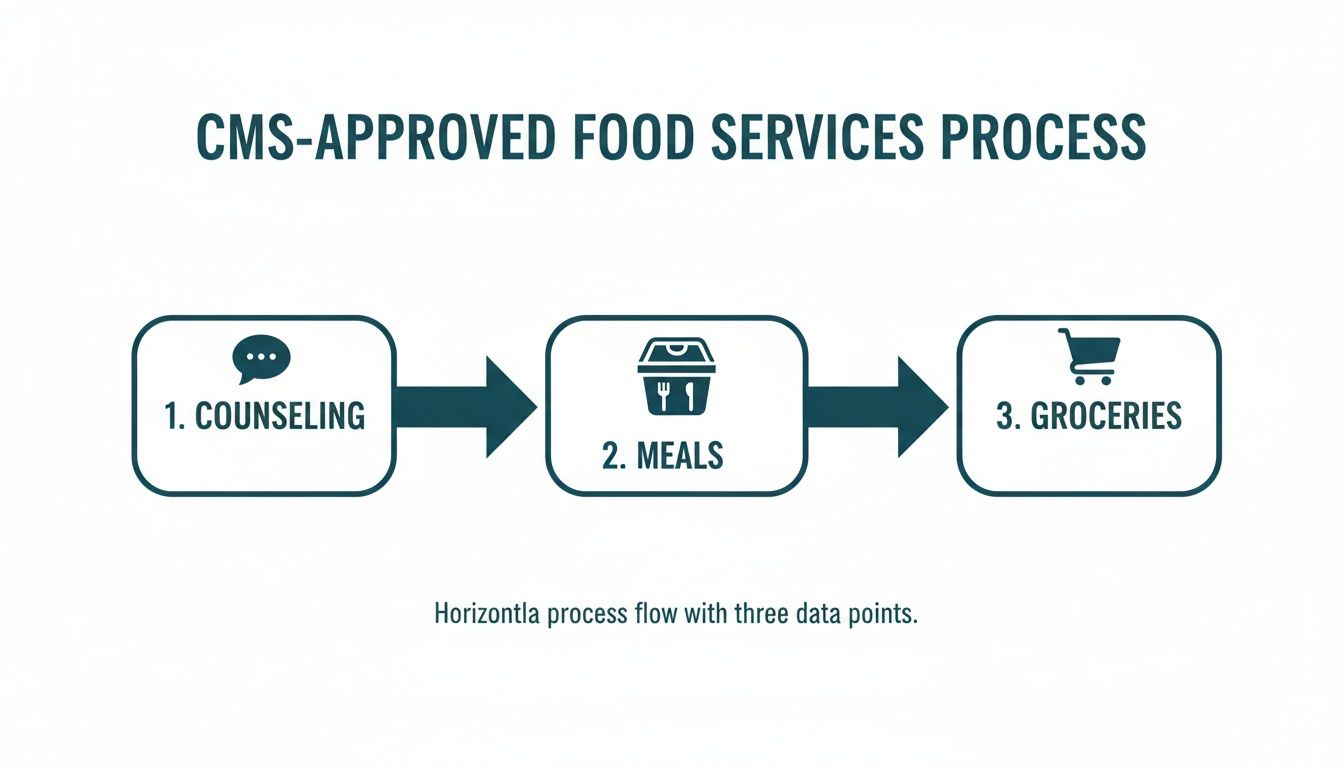
This process shows how states can layer interventions—starting with counseling and education, then adding direct support like meals or groceries for individuals with the highest needs.
Step 3: Establish a Compliant Vendor Network and Data Systems
Your program is only as good as the partners delivering the food and the systems tracking the data. Building a compliant infrastructure is a critical operational lift.
- Actionable Step: Initiate a formal procurement process to vet vendors. Evaluate them on critical requirements, including food safety certifications, cold-chain logistics, HIPAA-compliant data security protocols, and the ability to scale operations.
- Actionable Step: Embed clear performance metrics, data reporting frequency, and audit rights directly into vendor contracts. Proactive contract management is essential for oversight.
- Actionable Step: Before launch, rigorously test all data exchange protocols with your vendors. Confirm that systems for enrollment, service delivery confirmation, and encounter data are secure and function seamlessly.
For states looking to implement direct food services, exploring pre-packaged solutions can be a huge asset. Learn more about how Umoja Health designs and implements compliant kitting programs for nutrition security.
Step 4: Implement and Monitor with a Focus on Compliance
Once the program launches, your focus must shift to meticulous monitoring and ongoing compliance.
- Actionable Step: Implement a robust process for continuous data collection. Track key process metrics like screening rates, enrollment numbers, and service utilization to monitor operational health in real-time.
- Actionable Step: Conduct regular audits of your vendors to ensure they are adhering to all contractual obligations, including food safety and data privacy standards.
- Actionable Step: Prepare and submit timely quarterly and annual reports to CMS as required by your waiver's terms and conditions. This reporting is non-negotiable for maintaining federal approval.
Following these sequential steps ensures that from day one, your program is built on a foundation of data integrity and regulatory compliance, setting you up for a successful and sustainable demonstration.
Measuring Success with the Right Metrics

At its heart, every Section 1115 demonstration food program is an experiment. To justify its existence—and to keep the funding flowing—you have to prove its value. This means telling a compelling data story that speaks directly to CMS and state stakeholders. You’re not just trying to show you’re busy; you’re out to prove you’re making a real, measurable dent in clinical outcomes and healthcare spending.
Building this narrative means focusing on two things at once: the "what" and the "so what." The "what" covers your process metrics—all the operational data that shows your program is running smoothly. The "so what" is where the magic happens; it’s the outcome metrics that reveal how your program is actually changing lives and saving money.
Distinguishing Process from Outcome Metrics
Getting your metrics right from day one is non-negotiable. Think of process metrics as your program's pulse, giving you real-time insight into how implementation is going. They’re essential for day-to-day management and for demonstrating to CMS that you’re delivering on your operational promises.
Key process metrics you'll likely track include:
- Screening Rates: What percentage of your target population are you successfully screening for food insecurity?
- Enrollment Numbers: How many eligible members are actually signing up for the program?
- Meals Delivered or Prescriptions Filled: This is your raw output—the pure count of services provided that confirms program activity.
- Member Engagement: Are participants consistently using the services you offer, or are they dropping off?
While these numbers are vital, they don't tell the full story. To truly make your case, you have to connect these activities to meaningful health and financial outcomes.
Outcome metrics are the core of your value proposition. These are the data points that prove a return on investment and justify the waiver itself. Let me put it this way: delivering 10,000 medically tailored meals is a process metric. A 15% reduction in hospital readmissions for the members who got those meals? That’s an outcome metric.
The end game here is to build an evidence-based case that your food program isn't just another line item on the budget. It's a strategic investment that pays real dividends in both health improvements and financial savings.
Constructing a Rigorous Evaluation Plan
Since there’s no single, standardized reporting framework for these waivers, your evaluation plan has to be airtight from the get-go. You need to nail down your key performance indicators (KPIs) before a single meal goes out the door. A strong plan draws a straight line from your intervention to the clinical and financial changes you’re aiming for.
Let's say you're running a program for members with diabetes. Your outcome metrics might include:
- Changes in A1c levels among participants.
- Reductions in emergency department visits for hyperglycemia.
- Lower per-member per-month (PMPM) costs when compared to a similar group not in the program.
This level of specificity is critical. The "Food Is Medicine" landscape is still new territory. While everyone agrees the goals are to improve clinical outcomes and lower healthcare costs, the published data is still limited and methodologies are all over the map. We need robust evaluations to build a stronger evidence base. You can get a sense of the current state of these evaluations in this detailed analysis from Health Affairs.
Your evaluation design needs to clearly spell out how you’ll collect, analyze, and report this data. This includes identifying a comparison group—a similar population that isn't receiving the food benefit—to help isolate your program's true impact. By building a rigorous and transparent evaluation framework, you create a powerful narrative that not only satisfies federal requirements but also builds the case for continuing your vital work.
Avoiding Common Pitfalls and Compliance Traps
Section 1115 demonstration food programs are an incredible tool for tackling health-related social needs, but they aren't without their risks. The very flexibility that makes these waivers so powerful also brings intense scrutiny from CMS. From my experience, the states that truly succeed are the ones that see the challenges coming and build solid systems to manage them from day one.
If you ignore these risks, you're setting yourself up for serious headaches down the line—think audit findings, disallowed costs, or even having your program shut down early. The key is to move forward with a clear-eyed view of what can go wrong and a proactive plan to keep everything on the rails.
The Danger of Shaky Data Infrastructure
If you want to see a program fail fast, build it on a weak data infrastructure. CMS sees these demonstrations as experiments, and you can't prove your hypothesis without rock-solid data. It’s a common mistake for states to underestimate the technical lift needed to collect, manage, and report on program metrics the right way.
Imagine launching a medically tailored meals program for 5,000 people, only to find out six months later that your vendors are all submitting enrollment and delivery data in mismatched, unusable formats. This isn't just an administrative nightmare; it's a massive compliance failure that guts your ability to run the required federal evaluation. You have to invest in systems that can seamlessly track everything from the first screening to the final clinical outcome.
Poor Vendor Management and Oversight
Your vendors aren't just suppliers; they are a direct extension of your state Medicaid agency, and believe me, CMS will hold you accountable for their performance. Dropping the ball on rigorous vendor oversight is a common and costly error. Without it, you’re opening the door to everything from food safety issues to serious HIPAA breaches involving protected health information.
Think about it: what happens when a vendor handling your grocery delivery program consistently misses delivery windows, leaving medically fragile participants without food? Your best defense is a strong offense. That means ironclad contracts with crystal-clear performance metrics, regular audits, and real penalties for non-compliance. These are your essential risk-mitigation tools.
You can't just "set and forget" your vendor relationships. Active, ongoing management is non-negotiable. It's the only way to ensure taxpayer dollars are being spent wisely and that participants are getting the high-quality services they were promised.
The Slippery Slope of Scope Creep
Scope creep is what happens when a program slowly expands beyond its approved authority. It almost always starts with the best intentions—a desire to help more people or add a useful new service. But any change to the target population, the services offered, or the length of service that isn't explicitly green-lit in your waiver agreement is a compliance violation. Period.
For example, if your waiver authorizes six months of medically tailored meals for individuals with diabetes, extending that to twelve months without formal CMS approval is textbook scope creep. To steer clear of this, program leaders must stick to the approved waiver documents like glue and go through the formal amendment process for any proposed changes.
Miscalculating Budget Neutrality
This one is the big one. Maybe the most significant financial risk you'll face is a miscalculation of budget neutrality. Every single Section 1115 waiver has to prove that it won't cost the federal government more than it would have without the waiver. This means you have to accurately project how your program's costs will be balanced by savings in other areas, like fewer hospitalizations.
If your costs run hotter than expected or those anticipated savings don't show up, you risk blowing up this core principle. That can lead to some very tough conversations with CMS and could even force the state to repay federal funds. Diligent financial modeling and constant monitoring of both your costs and your savings are absolutely critical to keeping your program fiscally sound and compliant for the long haul.
Answering Your Key Program Questions
When state leaders start digging into the details of a Section 1115 demonstration food program, a few critical operational questions always surface. These aren't just minor details; they're the practical, on-the-ground concerns that can make or break an initiative. Getting clear, direct answers is the first step toward building confidence and steering your program in the right direction.
Let’s tackle some of the most common questions head-on to help you navigate these complex decisions.
How Do These Programs Work With SNAP or WIC?
This is easily the most frequent—and important—question we hear. Section 1115 food programs are designed to supplement, not replace, foundational support like the Supplemental Nutrition Assistance Program (SNAP) or the Special Supplemental Nutrition Program for Women, Infants, and Children (WIC). CMS is crystal clear on this: waiver-funded services cannot duplicate benefits that are already available through other federal programs.
So, what does that look like in practice? It means states have to design a sharp coordination strategy. A common workflow involves caseworkers first screening potential participants for SNAP or WIC eligibility and actively helping them enroll. Only then does the Section 1115 service step in to provide a targeted, therapeutic benefit that SNAP simply can't offer.
Imagine a member with congestive heart failure. They might use their SNAP benefits for their family's general groceries. At the same time, the 1115 waiver would fund the delivery of specific, low-sodium medically tailored meals designed to manage their condition and prevent a costly hospital readmission. The two programs work in tandem, each filling a distinct and vital need.
What Is the Real Timeline for Getting a Waiver Approved?
This is a marathon, not a sprint. Patience and long-term planning are absolutely essential. While the exact timeline can shift depending on your proposal's complexity and CMS's own bandwidth, state leaders should realistically plan for a multi-year process.
Here's a general breakdown of what to expect:
- State-Level Development (6-12 months): This is your foundational work. It includes digging into the data, engaging stakeholders, drafting the waiver application itself, and navigating any internal state approval hoops.
- Federal Review and Negotiation (12-18 months): Once you submit your application to CMS, a meticulous review process kicks off. This phase includes a federal public comment window and a lot of back-and-forth between your team and CMS to hammer out the final details on the program’s design, budget, and evaluation plan.
A realistic total timeline often lands somewhere between 18 and 30 months from initial concept to final green light. Kicking off the process with a clear, evidence-based proposal and a well-defined target population can definitely help streamline the federal review, but it will always be a thorough and deliberate process.
Can We Use Managed Care Organizations to Deliver These Services?
Yes, absolutely. In fact, leveraging Managed Care Organizations (MCOs) is a very common and often preferred model for getting these services to the people who need them. States can authorize MCOs to provide nutrition support as an "In Lieu of Service" (ILOS) or as another value-added benefit that aligns with the demonstration’s goals.
This approach is popular because it taps into the MCOs' existing infrastructure. You're using their provider networks and care management teams instead of forcing the state to build a brand-new administrative system from the ground up.
A word of caution, however: the state Medicaid agency always remains the entity ultimately on the hook for waiver compliance. This means you need strong guardrails in place. Your contracts with MCOs must spell out robust reporting requirements, clear performance metrics, and provisions for regular audits to ensure every single rule is being followed to the letter, just as CMS approved it.
At Umoja Health, we specialize in designing and deploying compliant, culturally connected food programs that meet the rigorous standards of state and federal agencies. Whether you are building a Food is Medicine grocery program or need a partner for WIC home delivery, our team has the expertise to help you succeed. Explore our solutions at https://umojahealth.com.