
Think of CalAIM medically supportive food services as a prescription for food. It’s a game-changing way to treat, manage, or even prevent chronic health issues for eligible Medi-Cal members by integrating specialized nutrition support directly into their healthcare plan. This whole "Food is Medicine" idea isn't just a catchy phrase; it's about tackling social needs, like food insecurity, head-on to improve people's health and ultimately cut down on more expensive medical care down the road.
What's Driving CalAIM Food Services?
California's CalAIM (California Advancing and Innovating Medi-Cal) initiative is fundamentally reshaping how we think about healthcare. It's built on a simple yet powerful principle: giving someone the right food at the right time can be just as potent as traditional medicine, especially for those juggling complex health problems.
This isn't some fringe concept. It’s a central piece of CalAIM's Community Supports program, which offers a menu of 14 services that Managed Care Plans (MCPs) can choose to provide. Known in the industry as in-lieu-of-services (ILOS), they are designed to be smarter, more cost-effective alternatives to costly interventions like hospital stays or ER visits. By getting to the root causes of poor health—like not having access to nutritious food—the program builds a more proactive and sustainable system.
The results speak for themselves. Since launching, CalAIM has delivered over 494,000 Community Supports services to more than 252,000 Medi-Cal members. And what’s the most-used service category? Medically Tailored Meals and Medically Supportive Food, reaching over 156,000 members. That’s a clear signal of the massive need for weaving nutrition into healthcare. You can learn more about the effectiveness of CalAIM's Community Supports here.
The Three Flavors of Nutrition Support
CalAIM delivers medically supportive food through three distinct services, each tailored to meet different needs and circumstances. These components are designed to work together flexibly, creating a person-centered nutrition plan.
- Medically Tailored Meals (MTM): These are fully cooked, ready-to-eat meals designed and approved by a Registered Dietitian Nutritionist (RDN). Think low-sodium meals for someone with congestive heart failure or carb-controlled options for a person managing diabetes. MTMs are perfect for members who can't cook for themselves due to physical challenges or highly specific dietary restrictions.
- Medically Supportive Groceries (MSG): For members who can cook but struggle to get the right ingredients, this service provides boxes of uncooked groceries that fit their prescribed diet. Someone with hypertension, for instance, might get a box packed with fresh vegetables, lean proteins, whole grains, and a few heart-healthy recipes to go along with them.
- Nutrition Education and Counseling: This piece is all about empowerment. Often offered with meals or groceries, it gives members the knowledge to make healthy choices for the long haul. This could be one-on-one counseling with a dietitian, a virtual cooking class, or easy-to-read materials explaining their nutritional needs.
Together, these services are a huge step toward improving nutrition security—making sure people don't just have any food, but the right food for their health.
CalAIM is about much more than just filling empty stomachs. It's about nourishing people back to health, preventing disease, and arming them with the tools to effectively manage their chronic conditions. This is the Food is Medicine movement in action.
This flexible approach allows providers and MCPs to create a truly person-centered plan. Imagine a patient recovering from surgery. They might start with Medically Tailored Meals when their energy is low and then switch to Medically Supportive Groceries and nutrition counseling as they get stronger and feel up to cooking again. That adaptability is exactly why the program is working.
Here’s a quick look at some common situations where these services might be prescribed.
Common Conditions Eligible for Food Services
This table outlines common conditions and circumstances that often qualify a Medi-Cal member for these crucial nutrition services under CalAIM.
| Qualifying Condition or Circumstance | Common Nutritional Need | Example Service |
|---|---|---|
| Congestive Heart Failure (CHF) | Low-sodium, fluid-restricted diet | Medically Tailored Meals (MTM) |
| Diabetes (Type 1 or 2) | Carbohydrate-controlled, high-fiber diet | Medically Supportive Groceries (MSG) with recipes |
| Chronic Kidney Disease (CKD) | Low-potassium, low-phosphorus, low-sodium | Medically Tailored Meals (MTM) |
| Post-Discharge from Hospital | Nutrient-dense foods to support recovery | Medically Tailored Meals (MTM) |
| High-Risk Pregnancy | Increased need for specific nutrients like folic acid and iron | Medically Supportive Groceries (MSG) & Nutrition Counseling |
| Uncontrolled Hypertension | Low-sodium diet (DASH diet) | Medically Supportive Groceries (MSG) |
This is just a snapshot, of course. The goal is always to match the service to the individual’s specific diagnosis and life situation, ensuring they get the targeted support they need to thrive.
How to Access CalAIM Food Services
Getting medically supportive food services through CalAIM follows a structured enrollment process that begins with identifying a need and ends with service delivery. Whether you're a provider, a caregiver, or a member, understanding the path from referral to authorization is key.
It all starts when a need is identified. A referral can be initiated by a doctor, a hospital discharge planner, a social worker, or an Enhanced Care Management (ECM) provider. This is a critical point: enrollment requires documented medical necessity, so a member cannot self-refer without clinical support.
The program is designed as a simple, three-part structure, starting with prepared meals, then moving to groceries, and finally adding educational support to help people sustain their progress.
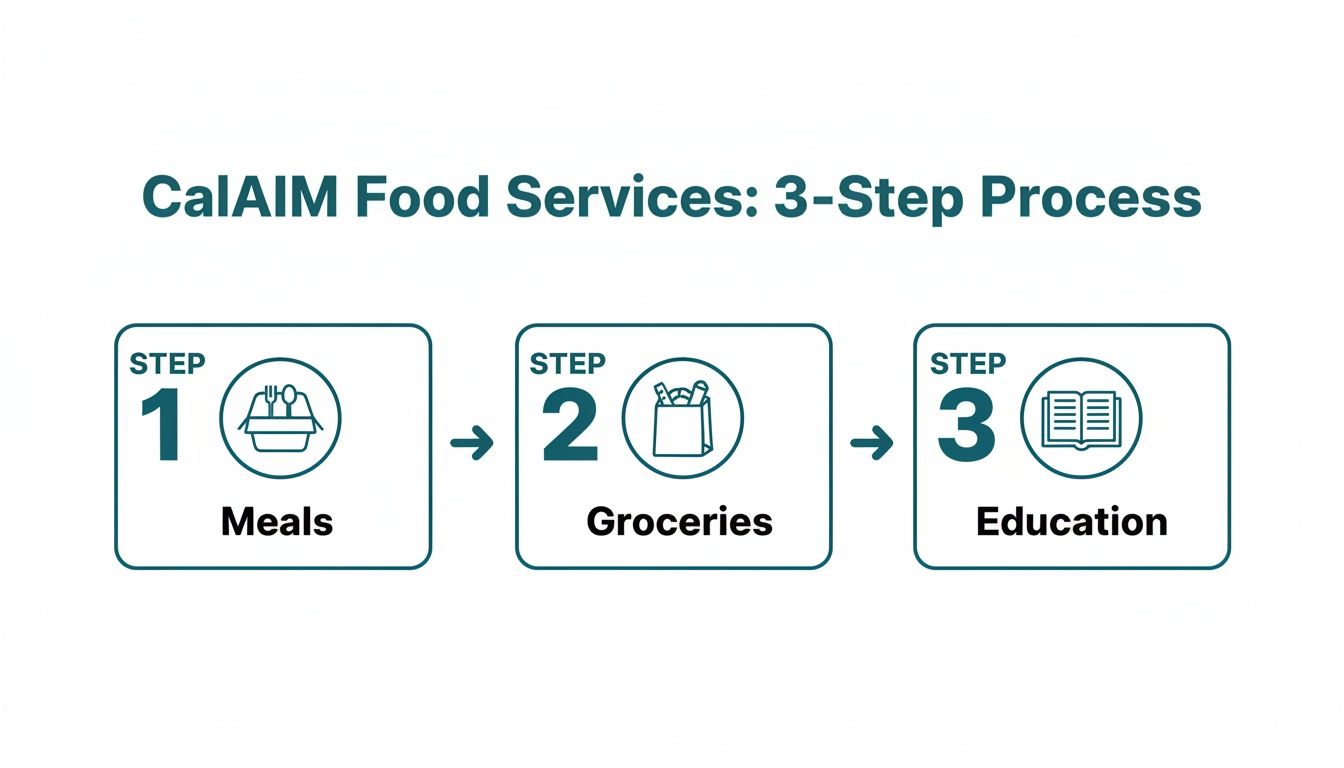
This flow shows how flexible the support can be. It adapts from addressing immediate, intensive needs (like providing meals right after a hospital stay) to empowering people with the tools for long-term self-management, like groceries and nutrition education.
The Referral and Authorization Journey
Once a potential need is flagged, the person or organization making the referral submits a request to the member’s Managed Care Plan (MCP). This is the crucial step where the MCP reviews the case to determine if the member meets the criteria for the service. While core eligibility requirements are consistent, specific documentation needs may vary by plan.
Often, a Letter of Medical Necessity is the central piece of the puzzle. This document, completed by a clinician, must clearly link the member's diagnosis—such as uncontrolled diabetes or a recent heart surgery—to the specific dietary plan that meals or groceries will provide.
The best referrals do more than just prove a diagnosis; they tell a story. A strong referral clearly shows how food services will prevent a much costlier outcome, like a hospital readmission or another ER visit. It makes the business case for the intervention.
After the MCP receives the referral, they review it for approval. If authorized, the MCP connects the member with a contracted food vendor or a Community-Based Organization (CBO) to begin services. This is a critical point: members don’t get to pick their own vendor. They’re assigned one from their MCP's approved network, which can sometimes be a barrier if the network doesn't have a provider that fits a member's specific cultural or dietary preferences.
Lessons Learned from Umoja’s Pilot Program Experience
From our experience with early pilot programs, we've identified key integration barriers and effective steps for smoother implementation. A major hurdle is the administrative burden placed on referring clinicians. Most physicians are overloaded and lack the time to complete complex referral paperwork, creating bottlenecks that can delay or prevent members from receiving care.
To overcome this, successful pilot programs have implemented these key steps:
- Dedicated Care Coordinators: Assigning a specific person to manage referrals from start to finish is a game-changer. This role takes the administrative burden off clinicians, ensuring paperwork is completed accurately and submitted promptly.
- Streamlined Referral Forms: Collaborating with MCPs to simplify referral templates has proven effective. Reducing the number of fields and providing clear, concise instructions significantly speeds up the process.
- Proactive Member Education and Outreach: Many eligible members are unaware these benefits exist. Using ECM providers and community health workers for outreach is essential to identify potential candidates and help them start the conversation with their doctors.
These pilots also highlighted the importance of integrating food services with other benefits. For instance, while a member receives medically supportive groceries, they can also be connected with broader community resources. Linking families to programs like child nutrition programs complements the effort to achieve household food security. This holistic approach builds a stronger support system, addressing a member’s needs from multiple angles and leading to more sustainable health outcomes.
Real-World Implementation Challenges and Solutions
Getting a CalAIM medically supportive food service off the ground is about so much more than just logistics. It’s really about building a brand-new ecosystem where healthcare and community-based food systems learn to speak the same language. The pioneers who have already walked this path have hit some significant hurdles, giving us invaluable lessons to learn from.
From forging real referral networks to managing a dizzying amount of data, the road is paved with practical challenges that call for some creative problem-solving.

One of the very first barriers is simply building that bridge between the clinical world and the folks on the ground providing the food. It's one thing for a doctor to identify a need; it's another thing entirely to create a seamless handoff to a food vendor. That requires trust, clear communication, and often, shared tech platforms—three things that rarely exist from the start.
This is where rock-solid partnerships between Managed Care Plans (MCPs) and Community-Based Organizations (CBOs) become the absolute cornerstone of a successful program.
Navigating Contracts and Referral Networks
For many CBOs, becoming a contracted provider for a massive MCP is a baptism by fire. The procurement process is no joke—it involves intense vetting, complicated data security requirements, and getting up to speed on specific billing codes and reporting templates. It’s a huge administrative lift that can easily overwhelm smaller, community-focused organizations.
So, how have successful programs gotten over this hump?
- Forming CBO Coalitions: We've seen smaller food banks and local meal delivery services team up to bid on MCP contracts. This smart move allows them to pool their resources, share the administrative headache, and offer the MCP much wider geographic coverage.
- Staggered Onboarding: MCPs that take a phased approach—maybe starting with a small pilot before going full-scale—give CBOs the breathing room they need to build up their internal capacity for billing, data management, and compliance.
- Clarifying Referral Pathways: Nothing stalls progress like a messy referral process. The best systems establish a single point of contact or a dedicated care coordinator to manage referrals. This ensures that when a referral comes through, the food provider has every piece of crucial info, like dietary needs and delivery notes, right from day one.
A major friction point we see time and again is the data disconnect. A hospital's EHR system doesn't naturally talk to the software a food vendor uses. The fix often involves a third-party data intermediary or a custom API to get information flowing securely and efficiently, protecting member privacy while actually getting them the food they need.
Pushing through these integration headaches is absolutely worth the effort. The results speak for themselves. Data from the California Department of Health Care Services shows that CalAIM's Medically Supportive Food services are driving incredible reductions in healthcare costs.
In just the six months after receiving services, members saw 21.4% fewer inpatient admissions and a 22% decrease in emergency department visits. These numbers are huge, positioning food services as one of the most cost-effective Community Supports out there.
Tackling Operational and Logistical Hurdles
Once you get past the paperwork, the actual, physical act of getting the right food to the right person brings its own set of challenges. This is where the nitty-gritty operational details can make or break a program.
Culturally Relevant Menus
A one-size-fits-all menu is a recipe for failure. A diet plan for a diabetic member must also respect their cultural traditions and personal tastes if you want them to actually eat the food. This means CBOs have to invest in recipe development, source diverse ingredients, and constantly gather feedback from the communities they’re serving.
Think about it: offering a heart-healthy pozole or a low-sodium curry can make a world of difference in a member’s engagement and, ultimately, their health outcomes.
Cold-Chain Management and Delivery Logistics
A massive piece of this puzzle is delivering perishable items safely. This requires a deep understanding of what's known as the "cold chain"—keeping refrigerated and frozen foods at a stable, safe temperature from the warehouse all the way to a member's front door. This is a major operational lift, especially in rural areas with long delivery routes. Check out this guide to shipping perishable food safely for a good overview.
Organizations are getting creative to solve this:
- Temperature-Controlled Packaging: Using insulated boxes, gel packs, and even dry ice for those longer hauls.
- Route Optimization Software: Planning the most efficient delivery routes to cut down on time in transit.
- Partnerships with Local Couriers: Tapping into existing delivery networks to reach members in more remote or hard-to-reach locations.
When you look at the lessons from early pilots, it's clear that success in CalAIM food services demands a mix of high-level strategy and boots-on-the-ground execution. It’s about building strong referral pipelines, mastering the art of cold-chain logistics, and never forgetting the individual member’s cultural and dietary needs.
Mastering the Billing and Documentation Process
Delivering CalAIM medically supportive food services is one thing; getting paid for them is another. Mastering the financial and administrative side of the program is absolutely essential for any provider or community-based organization looking to build a sustainable service.
Think of it this way: accurate billing and rock-solid documentation are the bridge that connects your hard work to the reimbursement you need from Managed Care Plans (MCPs). Without that bridge, even the most life-changing programs can run into serious cash flow problems and fizzle out. Let's walk through what you need to know to make sure every meal delivered and grocery box packed is properly accounted for.
Decoding Billing and Authorizations
The whole process starts with a referral and an authorization. Before you deliver a single meal, the MCP has to give you the green light. Typically, this initial authorization covers a set period, like 12 weeks after a hospital discharge, and it’s based on a clinician’s assessment of medical necessity.
If a member needs support beyond that initial window, you can’t just keep the meals coming. You have to go back to the MCP with updated documentation showing a continued need and get a formal extension. This is your first and most important checkpoint.
Success in CalAIM billing isn’t about just submitting claims; it's about submitting clean claims. That means every single service is pre-authorized, coded correctly, and backed by meticulous documentation that tells a clear story of why it was medically necessary.
Once services are authorized and delivered, you'll use specific Healthcare Common Procedure Coding System (HCPCS) codes to bill for them. These codes are the language MCPs speak—they tell them exactly what you did. Getting them right is non-negotiable.
CalAIM Food Services Billing Code Overview
While codes can sometimes vary by plan, a few common ones form the backbone of billing for these services. Here's a quick look at the codes you'll be working with most often.
| HCPCS Code | Service Description | Common Use Case |
|---|---|---|
| S9445 | Patient education, not otherwise classified, non-physician provider, group, per session | Used for billing group nutrition education sessions that often accompany meal or grocery services. |
| S9470 | Nutritional counseling, dietitian | Applied for one-on-one counseling with a Registered Dietitian, a key component of the nutrition education service. |
| T2033 | Residential care, not otherwise specified (NOS), waiver; per diem | Often used by MCPs as a per-diem rate for Medically Tailored Meals, covering the cost of food, preparation, and delivery for one day. |
Knowing these codes inside and out is fundamental. They are how you translate your services into revenue that keeps your program running.
Bulletproof Documentation and Reporting
If billing codes are the language, your documentation is the evidence. It’s the proof that justifies every single code you submit on a claim. In the event of an audit, this paperwork needs to be detailed, accurate, and easy to pull up. Each member's file should tell their complete story, from the day they were referred to the final meal delivery.
So, what does that look like in practice? At a minimum, each file should contain:
- Initial Referral and Authorization: Keep the original referral form and the official authorization letter or number from the MCP.
- Service Delivery Logs: This is your proof of performance. Keep precise records of every meal or grocery box delivered, including dates, times, and some form of member confirmation.
- Member Progress Notes: Briefly document interactions, feedback from the member, or any observed changes in their condition or how they're engaging with the program.
It’s not just about individual files, either. MCPs and the Department of Health Care Services (DHCS) will ask for regular reports to see how the program is doing. These are often standardized templates asking for metrics on member satisfaction, service utilization, and health outcomes. Using a good medical documentation software can make this record-keeping and reporting process much less painful.
For organizations that handle the logistics of assembling grocery boxes, having strong internal procedures is also part of your documentation trail. Developing standard operating procedures for things like your kitting programs is crucial. It shows that every box you send out meets specific dietary and quality standards.
This level of detail isn't just about compliance—it's about building a resilient program that can confidently prove its value and secure the funding it needs to keep doing its vital work.
Stories of Impact from CalAIM Members
It’s one thing to talk about policies, data, and billing codes. It’s another thing entirely to see how medically supportive food services actually change lives. These are the real stories that show what happens when healthcare thinks beyond the clinic and starts addressing one of the most fundamental drivers of health: nutrition.
When you connect people with the right food at the right time, you see tangible improvements in their health and a genuine boost in their quality of life. Let's look at a few examples of the program's true impact on the ground.

Preventing Hospital Readmission for Congestive Heart Failure
Let's start with Maria, a 68-year-old Medi-Cal member just discharged from the hospital after a serious bout of congestive heart failure (CHF). Her discharge plan was clear and strict: an extremely low-sodium diet, a complex medication schedule, and very little physical activity. Since she lived alone and had limited mobility, cooking wasn't just a chore—it was a real hazard.
Before CalAIM, this was a classic recipe for a quick readmission. Maria would have almost certainly struggled to prepare meals that met her strict dietary needs, likely leading to fluid retention and another expensive trip to the hospital.
But this time was different. Her discharge planner put in a referral for Medically Tailored Meals (MTM). Within just a few days, a local CBO started delivering fully prepared, low-sodium meals right to her door. This single intervention was a game-changer.
- Immediate Health Impact: With consistent, appropriate nutrition, Maria’s fluid levels stabilized and her blood pressure improved. She completely avoided the common complications that so often lead to readmission.
- Reduced Healthcare Costs: By preventing a single hospitalization, the MTM service saved the healthcare system thousands. The cost of 12 weeks of meals was just a tiny fraction of what one night in the hospital would have cost.
- Member Empowerment: The service gave Maria the space she needed to recover her strength without the stress of cooking. After the initial MTM period, she smoothly transitioned to receiving Medically Supportive Groceries and nutrition counseling, empowering her to manage her own diet for the long haul.
Maria's story isn't an outlier. It's a perfect illustration of how a focused, short-term nutrition intervention can shatter the costly cycle of hospital readmissions for patients managing chronic conditions.
Gaining Control Over Type 2 Diabetes
Now, consider David, a 45-year-old truck driver with uncontrolled Type 2 diabetes. His A1c levels were dangerously high, and his doctor was rightly concerned about the long-term complications. His job made healthy eating feel impossible, and frankly, he didn't know where to start with preparing diabetes-friendly meals.
Through his Enhanced Care Management (ECM) provider, David got connected to the Medically Supportive Groceries (MSG) program. Soon, he was receiving weekly boxes packed with fresh produce, lean proteins, whole grains, and simple recipes designed for a carbohydrate-controlled diet.
The effect on his life was profound.
"For the first time, I felt like I had a roadmap. The grocery boxes took the guesswork out of shopping, and the recipes taught me how to cook meals that were both delicious and good for my blood sugar. It put me back in the driver's seat of my own health."
Here’s exactly how the service moved the needle for David:
- Improved Clinical Outcomes: In just three months, David's A1c dropped by two full points, pulling him out of the high-risk category.
- Sustainable Behavioral Change: The nutrition counseling that came with the groceries taught him essential skills like portion control and how to read food labels—skills he could use for the rest of his life, even out on the road.
- Increased Engagement: Getting a tangible benefit delivered to his home kept David connected to his care team. He was far more motivated to attend follow-up appointments and track his blood sugar because he felt truly supported.
David's experience shows that CalAIM's food services aren't just about handing out food; they're about building health literacy and sparking lasting, positive changes.
Supporting a High-Risk Pregnancy
Finally, there’s Sofia, a pregnant Medi-Cal member who was diagnosed with both gestational diabetes and anemia. Her obstetrician knew that getting her nutrition right was absolutely critical for her health and her baby’s development. A referral was made for both Medically Supportive Groceries and nutrition counseling.
Sofia started receiving groceries packed with iron, folic acid, and fiber, along with one-on-one guidance from a registered dietitian. This support helped her manage her blood sugar primarily through diet, which reduced her need for medication. The result? She delivered a healthy, full-term baby and avoided many of the complications that often come with her conditions.
These stories are the real heart of CalAIM. They show us that investing in nutrition isn't an expense—it's a direct investment in better health, greater equity, and a more resilient healthcare system for every Californian.
Answering Your Top Questions About CalAIM Food Services
When you're dealing with CalAIM, it's easy to get bogged down in the details. Members, providers, and even health plan staff have plenty of questions about how these food services actually work on the ground. Let's clear up some of the most common ones.
How Long Can a Member Receive Food Services?
CalAIM medically supportive food services are a targeted intervention, not a lifelong benefit. Think of it as a short-term therapeutic tool.
Typically, a member's Managed Care Plan (MCP) will authorize services for a set period—often around 12 weeks, particularly right after a hospital stay. The goal is to stabilize someone's health during a crucial recovery window. If the healthcare provider believes there's a continued medical need, they can absolutely request an extension from the MCP. The key is that a transition plan to a more permanent solution, like CalFresh, should always be part of the conversation from the start.
What Is the Difference Between Medically Tailored Meals and Medically Supportive Groceries?
While both fall under the "Food is Medicine" umbrella, they're designed for very different situations and levels of member capability.
-
Medically Tailored Meals (MTM) are fully prepared, ready-to-eat meals. A Registered Dietitian prescribes these for a specific health condition, like a perfectly portioned, low-sodium meal for someone with congestive heart failure. MTM is the go-to for members who can't cook for themselves due to physical limits or extremely complex dietary needs.
-
Medically Supportive Groceries (MSG) are boxes of uncooked ingredients, all chosen to fit a member's dietary plan. This option is great for members who can and want to cook but just need help getting the right kinds of food. These grocery kits often include recipes and nutrition tips, providing both the food and the know-how.
Deciding between them comes down to a simple question: what does the individual member truly need to succeed?
Can Members Choose Their Own Food Vendor?
The short answer is no, not really. Members can't just pick any grocery store or meal delivery service they want.
Instead, they have to use a Community-Based Organization (CBO) or food vendor that has a direct contract with their MCP. Each health plan is responsible for building its own network of approved providers for CalAIM medically supportive food services. When a member gets the green light, their MCP will refer them to an in-network vendor.
A major hurdle in the early days was a mismatch between the CBOs in a plan's network and the actual needs of the members. The most successful programs now actively recruit partners who reflect the cultural and linguistic makeup of their communities. This ensures the food isn't just medically sound, but also something people recognize and want to eat.
Are These Services Available in Every California County?
CalAIM is a statewide program, but the specific Community Supports offered—including food services—can differ from one county and MCP to another. Health plans have the flexibility to offer services based on local population needs and the capacity of CBOs in the area.
The good news? Medically supportive food has become one of the most widely adopted Community Supports across California. Still, it's always smart for members and providers to check with the member’s specific MCP to confirm what’s available. The Department of Health Care Services (DHCS) website is a great resource for seeing which services are active in your region. It’s a quick step that manages expectations and makes sure referrals are sent to the right place.
At Umoja Health, we get it. We specialize in creating and delivering culturally connected, shelf-stable food kits designed for programs just like CalAIM. Whether you're running a pilot for diabetes-friendly groceries, need senior nutrition kits, or are scaling up for disaster response, we provide the compliant, reliable support you need to make your program a success. Find out how we can help you tackle nutrition security in your community at https://umojahealth.com.