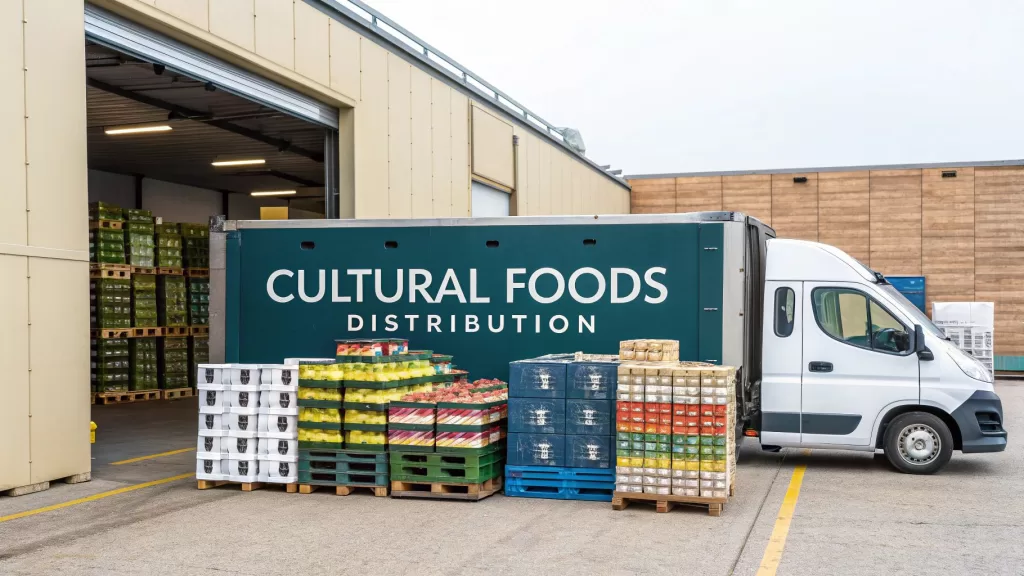
Providing nutritious meals is about more than just calories; it's about dignity, connection, and health equity. For government agencies, food banks, and healthcare plans, delivering culturally appropriate foods is essential for program success and participant engagement. But navigating the complex landscape of sourcing, certification, and compliant delivery can be a significant challenge. This guide breaks down the critical components of successful cultural foods distribution services, offering a clear roadmap for institutional buyers. We will demystify the process, from sourcing and certifying specific cultural food items to managing their compliant delivery in institutional settings.
This listicle is designed to help you find the best platforms and partners for your specific needs. We will explore regulatory hurdles like the Buy American provision, the logistics of cold-chain management for programs like CACFP, and how specialized vendors build scalable, auditable solutions. Importing diverse ingredients from around the globe often involves intricate supply chains; to streamline these complex logistics, considering the support of specialized freight forwarding services can be invaluable for ensuring timely and compliant international shipments.
Using real-world case vignettes and sourcing tips from industry leaders like Umoja Health, this article will equip you with the knowledge to evaluate and select the right partner. Each entry includes detailed analysis, screenshots, and direct links to help you make an informed decision. We provide actionable takeaways and strategic breakdowns to move you from planning to procurement, whether you're managing a WIC mobile shopping pilot, an OAA-compliant senior meal program, or a Food-is-Medicine initiative.
1. Umoja Health
Umoja Health stands out as a premier, mission-driven partner for organizations requiring large-scale, compliance-first cultural foods distribution services. It has built a comprehensive ecosystem designed specifically for government agencies, food banks, healthcare plans, and emergency managers who need more than just a supplier; they need a strategic logistics and program-management partner. The platform excels in delivering turnkey meal kits and grocery programs that are not only culturally appropriate but also meticulously aligned with complex federal and state regulations.
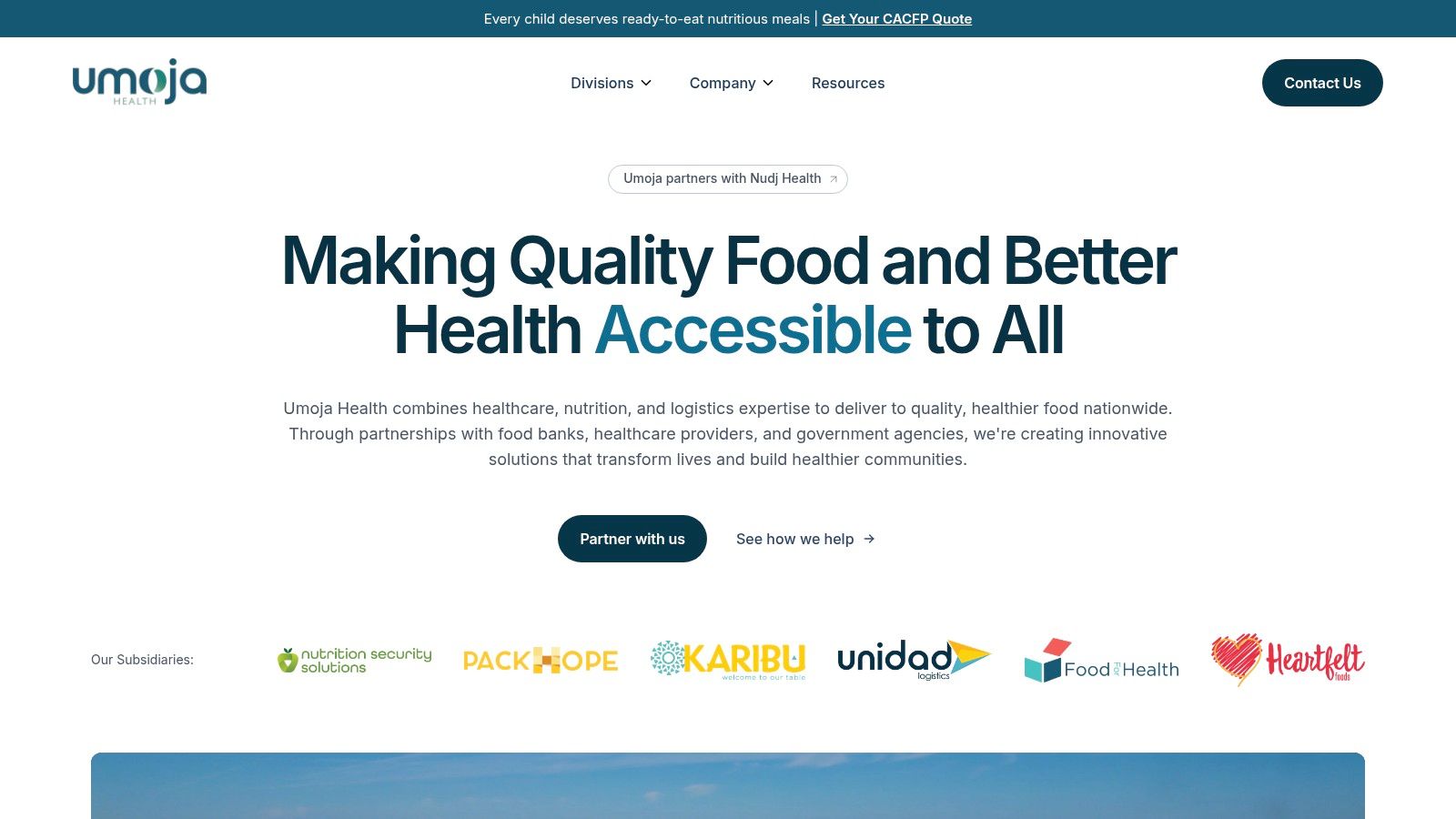
What truly differentiates Umoja Health is its end-to-end management of the entire supply chain, from sourcing culturally relevant foods to ensuring auditable, last-mile delivery. This integrated approach solves significant pain points for program administrators who often struggle to piece together vendors for sourcing, kitting, warehousing, and distribution while navigating stringent compliance mandates like Buy American or CACFP meal patterns.
Strategic Analysis: The Compliance-First Logistics Engine
Umoja’s core strength lies in its subsidiary, Unidad Logistics, an FDA-registered 3PL (Third-Party Logistics) provider. This isn't just a warehouse; it's a sophisticated logistics backbone that powers every program with precision and accountability.
- Robust Infrastructure: With hubs in Houston, TX, and Woodland, CA, Unidad provides national reach. Its facilities are food-grade and feature critical capabilities like allergen segregation, cold-chain management, and advanced Warehouse Management Systems (WMS) with EDI integration.
- Program-Specific Kitting: The team excels at creating custom, multi-day meal kits compliant with SFSP, CACFP, and OAA requirements. This includes complex assemblies like adding fluid milk to childcare kits or creating volunteer-friendly packing SOPs for food banks.
- Disaster Response Ready: For emergency managers, Unidad maintains ready-to-deploy stock of ready-to-eat and self-heating meals, capable of deploying mixed-truckload shipments within the critical first 72 hours of a disaster.
Key Insight: By owning and operating its own logistics, Umoja Health de-risks the supply chain for its partners. Program managers are not left coordinating multiple vendors; instead, they gain a single point of accountability for sourcing, compliance, assembly, and delivery, ensuring programs run smoothly and meet all reporting requirements.
Use Case Spotlight: Sourcing, Certifying, and Delivering Cultural Foods
Sourcing authentic, culturally relevant foods for institutional programs is a significant challenge. Umoja Health addresses this through a dedicated and strategic methodology focused on sourcing, certification, and delivery.
Case Vignette: Sourcing Halal Protein for a Senior Meal Program
A state agency needed to provide OAA-compliant meals to a growing community of Somali seniors. Generic protein sources were leading to low participation. Umoja Health's sourcing team initiated a multi-step process:
- Source: They engaged directly with community leaders to identify preferred Halal-certified poultry and beef suppliers. Instead of sourcing from a mainstream distributor, they partnered with a certified minority-owned Halal meat processor.
- Certify: The team vetted the supplier’s Halal certification, ensuring it was recognized by the community's religious authorities. They also verified the processor’s USDA inspection records and ensured all products met Buy American requirements.
- Deliver: The certified protein was integrated into Unidad Logistics' cold chain, kitted with other culturally specific ingredients like basmati rice and lentils, and delivered in compliant, temperature-controlled vehicles to congregate meal sites.
This detailed approach ensures that "culturally appropriate" is not just a buzzword but a tangible, executed strategy that enhances participant dignity and program uptake.
Umoja Sourcing Tip: For institutional programs, always start with certification. Before committing to a supplier for items like Halal meat or organic produce, obtain and verify all certification documents. This includes not just the product certification (e.g., Halal, Kosher) but also facility certifications (e.g., FDA, USDA) and compliance with program mandates like Buy American. This front-end diligence prevents costly procurement errors and audit findings down the line.
Key Features & Capabilities
| Feature | Description & Benefit | Ideal For |
|---|---|---|
| Turnkey Program Compliance | Pre-built meal and grocery kits meeting SFSP, CACFP, WIC, and OAA standards, including menus, pack lists, and documentation. | CACFP sponsors, WIC pilots, and senior nutrition program managers. |
| Food-as-Medicine Models | Structured 12-week Diabetes and Hypertension grocery programs with integrated nutrition education and outcome reporting templates. | Managed Medicaid plans and population health teams seeking scalable, non-pharmaceutical interventions. |
| U-Cloud Technology Platform | Inventory-aware software enabling compliant substitutions, no-fee home delivery workflows, and detailed reporting for audits. | State agencies and large non-profits managing complex, multi-site distribution pilots. |
| FDA-Registered 3PL | The Unidad Logistics arm provides food-grade warehousing, kitting, national parcel/freight shipping, and disaster response. | Emergency managers and CPG brands needing a reliable, food-safe logistics partner. |
Practical Takeaways
- For Program Administrators: Umoja Health is an ideal partner when you need a scalable, turnkey solution that guarantees compliance. Engage them early in the program design phase to leverage their expertise in menu planning and logistics for initiatives like Rural Non-Congregate SFSP or new WIC delivery pilots.
- For Healthcare Payers: If you are exploring "Food is Medicine" interventions, Umoja’s structured grocery programs offer a scalable "grocery, not MTM" model with built-in reporting to measure health outcomes effectively.
- Pricing and Engagement: Umoja does not publish pricing online, as all programs are custom-quoted. Initiate contact through their website by requesting a program-specific quote (e.g., "Get Your CACFP Quote") to begin the consultation process.
Bottom Line: Umoja Health is a formidable force in the cultural foods distribution services landscape, combining deep regulatory expertise with a powerful, integrated logistics infrastructure. It is the go-to partner for organizations that require auditable, scalable, and culturally responsive nutrition programs without the logistical headaches of managing a fragmented supply chain.
| Pros | Cons |
|---|---|
| Turnkey, compliance-focused programs for federal nutrition initiatives. | No public pricing; custom quotes are required, which can add time to procurement. |
| In-house, FDA-registered 3PL with robust WMS/EDI technology. | Primarily B2G/B2B focused; not a direct-to-consumer service for individual orders. |
| Scalable Food-as-Medicine programs with reporting and education. | |
| NMSDC-certified minority-owned business with proven scale (100M+ meals). |
Website: https://umojahealth.com
2. KeHE Distributors
KeHE Distributors operates as a major B2B distributor in the natural, organic, specialty, and fresh food sectors across North America. For program operators managing institutional settings like CACFP, SFSP, or senior nutrition programs, KeHE provides a robust framework for sourcing and delivering a diverse array of cultural foods. Their extensive network of distribution centers and sophisticated logistics capabilities make them a vital partner for organizations requiring reliable, large-scale food procurement and replenishment.
The platform is designed exclusively for wholesale accounts, including supermarkets, independent retailers, and large-scale food service operators. This B2B focus means individual consumers cannot purchase directly, but it provides significant advantages for organizations. Approved partners gain access to a deep catalog of specialty and multicultural items that go far beyond mainstream suppliers, enabling the creation of authentic, culturally relevant meal kits and menus.
Strategic Analysis: Sourcing and Program Integration
KeHE’s primary strength lies in its ability to connect institutional buyers with a diverse supply chain. Their DIVERSE Trade™ program is a standout feature, actively identifying and promoting brands owned by women, minorities, veterans, and LGBTQ+ individuals. This program directly addresses the sourcing challenges faced by organizations needing to provide culturally connected SKUs for programs like OAA-compliant senior meals or WIC packages.
Key Takeaway: Program managers can leverage KeHE's DIVERSE Trade™ program to meet supplier diversity goals and source authentic ingredients. This simplifies the process of finding certified, culturally appropriate products that align with participant preferences and program requirements, such as Buy American provisions.
Tactical Breakdown: Capabilities for Institutional Programs
| Capability | Tactical Application for Program Operators |
|---|---|
| Nationwide DC Network | Supports multi-site programs like CACFP by ensuring consistent and timely replenishment across geographically dispersed childcare centers. |
| Broad Multicultural Catalog | Allows food bank procurement managers to source specific items for culturally tailored food boxes, improving client satisfaction and reducing waste. |
| B2B Ordering Platform | Enables procurement leads to manage inventory, place bulk orders, and access promotions, streamlining the forward-buy process for emergency food programs. |
| ESG & LEED Certification | Helps organizations meet their own sustainability and environmental, social, and governance (ESG) goals by partnering with a distributor committed to these principles. |
Practical Application and Onboarding
Accessing KeHE requires establishing a wholesale account, which involves a verification process. Pricing and real-time inventory are not publicly visible, a common practice in B2B distribution to protect wholesale pricing structures.
Pro Tips for Effective Use:
- For WIC Managers: When piloting online ordering, inquire about KeHE’s EDI/WMS integration capabilities to ensure seamless inventory data flow for approved product lists and substitutions.
- For CACFP Sponsors: Use KeHE’s catalog to build multi-day, non-perishable kit menus that meet nutritional guidelines while offering variety and cultural appeal.
- For "Food is Medicine" Directors: Partner with KeHE to source specific ingredients for medically tailored grocery boxes, such as low-sodium Hispanic staples or nutrient-dense items for diabetic-friendly Asian cuisine.
By leveraging its vast distribution infrastructure and specialized sourcing programs, KeHE serves as a critical link in the supply chain for organizations committed to providing high-quality cultural foods distribution services.
Website: https://www.kehe.com
3. JFC International
JFC International stands as a cornerstone importer and distributor of Japanese and pan-Asian foods, serving North America. For program operators in institutional settings, JFC provides direct access to authentic food products essential for creating culturally appropriate meals. As a subsidiary of Kikkoman, the company leverages a stable, high-quality import pipeline and an extensive U.S. distribution network, making it a reliable partner for organizations needing consistent access to specific Asian staples.
The platform is built exclusively for B2B wholesale accounts, catering to Asian grocers, restaurants, and mainstream retailers. This business-to-business model prevents direct consumer sales but offers immense value for institutional programs. Approved partners can procure a wide variety of authentic items like specific rice varietals, noodles, sauces, and snacks that are difficult to find through general-line distributors. This access is critical for assembling meal kits and menus that truly resonate with Asian and Pacific Islander communities.
Strategic Analysis: Sourcing and Program Integration
JFC's core strength is its specialized, deep-rooted supply chain for Asian food products. For a food bank serving a large Japanese-American senior population or a CACFP program in a community with many recent immigrants from Southeast Asia, JFC offers the specific, trusted brands that define cultural cuisine. Their long-standing relationships with manufacturers in Asia ensure a level of authenticity and consistency that is challenging for non-specialized distributors to replicate. This makes them a key player in the cultural foods distribution services ecosystem.
Key Takeaway: Program managers can partner with JFC to source brand-specific, authentic ingredients that are central to participant acceptance. This eliminates guesswork and ensures that items provided in senior meal boxes or WIC packages are the actual products used in the home, increasing consumption and reducing food waste.
Tactical Breakdown: Capabilities for Institutional Programs
| Capability | Tactical Application for Program Operators |
|---|---|
| Extensive U.S. Distribution Footprint | Supports Rural Non-Congregate SFSP programs by enabling reliable delivery of non-perishable Asian staples to regional hubs for final kit assembly. |
| Broad Pan-Asian Catalog | Allows "Food is Medicine" programs to build medically tailored grocery boxes with familiar items, such as low-sodium soy sauce or brown rice vermicelli. |
| Established Import Pipeline | Provides food bank procurement managers with confidence in forward-buys, ensuring items like bulk rice and condiments comply with Buy American exceptions for non-availability. |
| Brand Authenticity | Enables WIC managers to include culturally significant, EBT-approved brands in their mobile shopping pilots, improving program equity and access. |
Practical Application and Onboarding
To purchase from JFC, an organization must set up a wholesale account, which includes a business verification process. Pricing, catalog access, and ordering are restricted to approved account holders. This B2B structure protects wholesale pricing and ensures partners are qualified commercial or institutional buyers.
Pro Tips for Effective Use:
- For OAA Program Directors: Use JFC to source shelf-stable components like miso paste, udon noodles, and nori to create culturally relevant, OAA-compliant senior meal boxes that increase participant satisfaction.
- For Emergency Management Chiefs: When planning for diverse populations, incorporate JFC's shelf-stable items like retort pouches of rice and ready-to-use sauces into first-72-hours load plans.
- For CACFP Sponsors: Diversify snack menus by sourcing popular Asian snacks and beverages, ensuring children from various backgrounds see their food cultures represented and valued.
By providing unparalleled access to an authentic Asian food supply chain, JFC International empowers organizations to deliver truly meaningful cultural foods distribution services.
Website: https://www.jfc.com
4. The Chefs’ Warehouse
The Chefs’ Warehouse is a premier B2B distributor of specialty and gourmet foods, serving an elite clientele of independent restaurants, hotels, and fine food retailers across North America. For program operators seeking high-quality, chef-curated ingredients for specialized nutrition programs, it offers an exceptional catalog of imported cheeses, charcuterie, oils, and other multicultural items. While primarily a B2B platform, its occasional direct-to-consumer (DTC) programs provide a unique model for sourcing premium components for culturally specific meal kits.
The platform’s core strength is its focus on professional-grade products, which translates to superior quality and authenticity for institutional buyers. This B2B model ensures a consistent supply chain for its partners, while its periodic consumer-facing sales offer a glimpse into sourcing strategies for home delivery and non-congregate meal programs. Organizations can leverage its vast specialty assortment to elevate their menus beyond standard commodity items.
Strategic Analysis: Sourcing and Program Integration
The Chefs’ Warehouse excels at providing access to niche, high-end global ingredients that are often difficult to source through mainstream distributors. This makes it an invaluable partner for "Food is Medicine" programs and other health-focused initiatives that require specific, high-quality foods to meet dietary and cultural needs. Their selection enables the creation of meals that are not only medically appropriate but also highly appealing to participants, which can improve program adherence and health outcomes.
Key Takeaway: Program managers can use The Chefs' Warehouse to source premium, hard-to-find ingredients for medically tailored grocery boxes or culturally specific senior meal programs. This access to chef-quality products directly supports the creation of highly desirable, nutrient-dense meals that meet both OAA and population health requirements.
Tactical Breakdown: Capabilities for Institutional Programs
| Capability | Tactical Application for Program Operators |
|---|---|
| Chef-Driven Curation | "Food is Medicine" directors can develop authentic, appealing menus for participants with specific dietary needs, such as creating Mediterranean diet boxes with high-quality imported olive oils and cheeses. |
| Large Specialty SKU Assortment | CACFP sponsors can source unique regional and international items to introduce diverse flavors in multi-day kits, enhancing the cultural relevance of meals served to children. |
| Robust B2B E-commerce Tools | Procurement managers for emergency food programs can efficiently place bulk orders for shelf-stable gourmet items, ensuring a supply of high-quality, morale-boosting foods during a crisis. |
| Occasional DTC Programs | WIC managers can study these direct-to-consumer models to inform the development of their own online ordering and home-delivery pilots, gaining insights into logistics and customer experience. |
Practical Application and Onboarding
Engaging with The Chefs’ Warehouse typically requires setting up a wholesale account, a process designed for professional food service operators. Their online platform and mobile apps streamline ordering and account management for approved B2B clients. While consumer access is limited to specific promotions, these events offer valuable insights into their product catalog and delivery capabilities.
Pro Tips for Effective Use:
- For "Food is Medicine" Directors: Collaborate with dietitians and chefs to select specific SKUs for 12-week diabetes-friendly or heart-healthy grocery boxes, leveraging the platform's premium ingredients.
- For Senior Nutrition Managers: Enhance OAA-compliant meal kits by incorporating specialty items like low-sodium European cheeses or artisanal crackers to improve participant satisfaction.
- For WIC Pilot Coordinators: Analyze the user experience and delivery logistics of their DTC programs to identify best practices for implementing inventory-aware online shopping for participants.
By providing access to an unparalleled selection of gourmet and specialty items, The Chefs' Warehouse empowers organizations to deliver exceptional cultural foods distribution services that meet the highest standards of quality and authenticity.
Website: https://www.chefswarehouse.com
5. Restaurant Depot
Restaurant Depot functions as a members-only, cash-and-carry warehouse chain catering to the foodservice industry, including restaurants, caterers, and nonprofit organizations. For program operators in institutional settings, it provides immediate, in-person access to a vast array of wholesale-priced cultural foods. Its nationwide network of warehouses makes it a highly accessible option for organizations that need to procure specific ethnic ingredients quickly and without the lead times associated with traditional distributors.
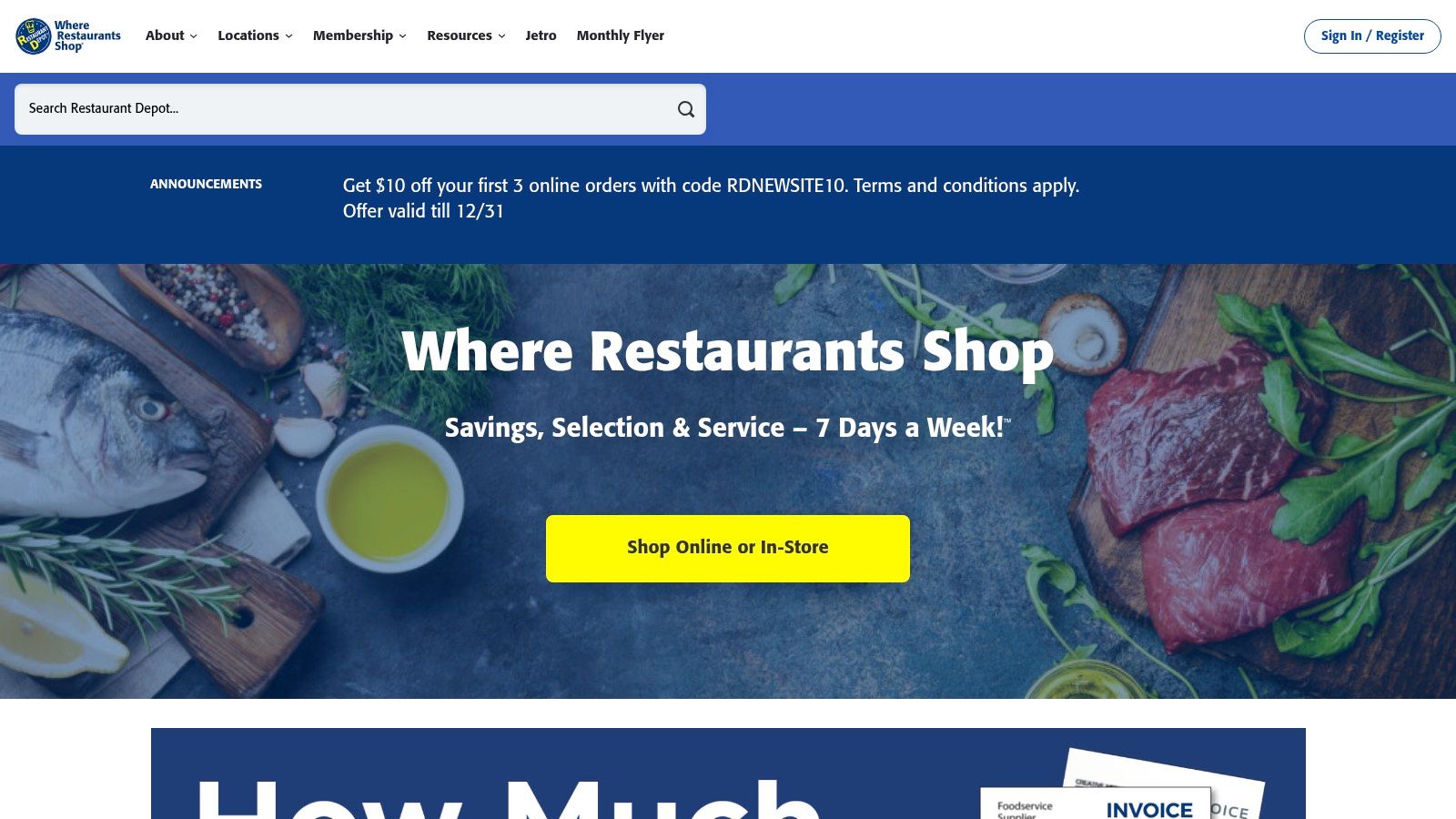
The platform operates on a free business membership model, requiring verification of a valid business or nonprofit status. While this B2B focus restricts direct consumer access, it allows qualified organizations to bypass conventional supply chains for urgent or specialized needs. The extensive inventory includes bulk sizes of spices, sauces, grains, and produce essential for preparing authentic Latin, Asian, Middle Eastern, and Caribbean meals, making it an invaluable resource for creating culturally relevant menus.
Strategic Analysis: Sourcing and Program Integration
Restaurant Depot’s primary advantage is its agility. Unlike large-scale distributors requiring advance orders and minimums, it allows program managers to perform "just-in-time" procurement. This is particularly useful for smaller-scale programs or for supplementing inventory between larger deliveries. The physical warehouse model allows for direct inspection of products, ensuring quality and authenticity for culturally specific items that may be unfamiliar to procurement staff.
Key Takeaway: Program managers can use Restaurant Depot to fill critical inventory gaps and test new culturally specific menu items with minimal commitment. This model is ideal for piloting "Food is Medicine" grocery boxes or sourcing unique ingredients for OAA-compliant senior meal programs without being locked into large pallet buys.
Tactical Breakdown: Capabilities for Institutional Programs
| Capability | Tactical Application for Program Operators |
|---|---|
| In-Person Shopping | Allows CACFP sponsors to immediately procure specialty items needed for a last-minute menu change, ensuring cultural appropriateness and compliance. |
| Broad Ethnic Inventory | Enables food bank managers to source bulk items like halal meats or specific types of rice and beans for culturally tailored emergency food boxes. |
| No Minimum Order Size | Supports WIC program pilots by allowing for the purchase of small quantities of new, culturally relevant products for participant testing. |
| Free Business Membership | Provides cost-effective access for nonprofits and emergency food programs, eliminating subscription fees and lowering the barrier to wholesale purchasing. |
Practical Application and Onboarding
Gaining access to Restaurant Depot requires completing a free membership application in-store with proof of business or nonprofit status (e.g., a tax ID number). While some locations offer online "Click & Carry" services and Instacart delivery, the full product selection is typically found in the physical warehouses. The initial purchase must often be made in-store before online features are fully activated for an account.
Pro Tips for Effective Use:
- For Rural Non-Congregate SFSP: Use local Restaurant Depot locations as a primary source for shelf-stable items when creating multi-day kits, supplementing with produce from local farms to meet Buy American provisions.
- For Emergency Food Planners: Establish memberships at multiple locations within a region to create redundancy in your supply chain for the first 72 hours of a response.
- For Food Bank Procurement Leads: Visit the warehouse to identify new, value-focused SKUs for culturally diverse populations, then use this market intelligence to inform larger forward-buys from primary distributors.
Restaurant Depot serves as a flexible and immediate partner for organizations seeking to enhance their cultural foods distribution services with authentic, wholesale-priced ingredients.
Website: https://www.restaurantdepot.com
6. Weee!
Weee! operates as a prominent direct-to-consumer (DTC) ethnic e-grocer, delivering fresh Asian and Hispanic groceries to major U.S. metropolitan areas and shipping shelf-stable items nationwide. While primarily a consumer platform, its unique model offers valuable insights and sourcing capabilities for program operators, especially those piloting smaller-scale, participant-choice initiatives like WIC mobile shopping or "Food is Medicine" programs where direct delivery to households is a key component.
The platform’s strength lies in its discovery-driven catalog, which is finely segmented by regional cuisines such as Japanese, Korean, Chinese, Filipino, and Mexican. A significant advantage for certain programs is Weee!'s acceptance of SNAP/EBT benefits online in many of its service areas, facilitated through a USDA-approved third-party processor. This feature makes it a practical model for understanding how to provide culturally relevant groceries to low-income households.
Strategic Analysis: Sourcing and Program Integration
Weee!'s primary value for institutional programs is as a model for participant-choice and direct-to-home delivery, rather than as a bulk B2B distributor. Its extensive, culturally specific catalog serves as an excellent sourcing guide for procurement managers trying to identify authentic, in-demand products for diverse populations. The platform's successful implementation of online SNAP/EBT provides a case study for state WIC agencies and food banks exploring similar digital-first redemption models.
Key Takeaway: Program managers can use Weee!'s platform as a research tool to build culturally responsive food lists and as a proof-of-concept for direct-to-participant delivery models. The online EBT functionality demonstrates a viable workflow for reducing access barriers in urban and suburban areas.
Tactical Breakdown: Capabilities for Institutional Programs
| Capability | Tactical Application for Program Operators |
|---|---|
| Broad Cultural Catalog | Helps food bank procurement teams identify specific brands and products (e.g., specific soy milk, rice noodles) for creating culturally tailored food boxes. |
| Online SNAP/EBT Acceptance | Provides WIC state vendor managers a case study for piloting online benefits, including workflows for inventory-aware substitutions and no-fee delivery options. |
| Direct-to-Home Delivery | Offers a model for Rural Non-Congregate SFSP sponsors designing home-delivery kits and managing parent pick-up logistics. |
| Regional Cuisine Subcategories | Allows "Food is Medicine" directors to easily source specific ingredients for medically tailored meals, like low-sodium sauces for Asian diets or specific herbs for Hispanic dishes. |
Practical Application and Onboarding
As a consumer-facing platform, accessing Weee! is as simple as creating a free account. Availability of fresh delivery and EBT payment options is determined by the user's ZIP code. While not designed for institutional procurement, smaller non-profits or childcare centers in their delivery zones could use the service for supplemental or specialty item purchasing.
Pro Tips for Effective Use:
- For WIC Managers: Analyze the Weee! checkout and EBT integration process as a template when developing requirements for your state's online ordering pilot. Note their handling of EBT-ineligible items like hot foods.
- For "Food is Medicine" Directors: Use the platform to build culturally specific, condition-appropriate grocery lists (e.g., a "diabetic-friendly Vietnamese grocery list") that can be replicated with a larger distributor.
- For CACFP Sponsors: When planning menus, browse Weee! to identify shelf-stable, culturally relevant snacks and pantry items that can be incorporated into multi-day kits to increase child participation and appeal.
By demonstrating a successful DTC model for ethnic grocery delivery, Weee! offers a valuable blueprint for organizations looking to modernize their cultural foods distribution services and meet participants where they are.
Website: https://www.sayweee.com
7. Kalustyan’s (Foods of Nations)
Kalustyan’s, operating online as Foods of Nations, is a legendary New York City-based institution renowned for its incredibly deep and authentic catalog of global ingredients. While primarily a B2C e-commerce platform and iconic physical retailer, it serves as an invaluable resource for smaller organizations, caterers, and program pilots needing hard-to-find, culturally specific pantry items. Its vast, curated selection of spices, grains, legumes, and condiments from over 80 countries makes it a go-to for developing authentic menu components.
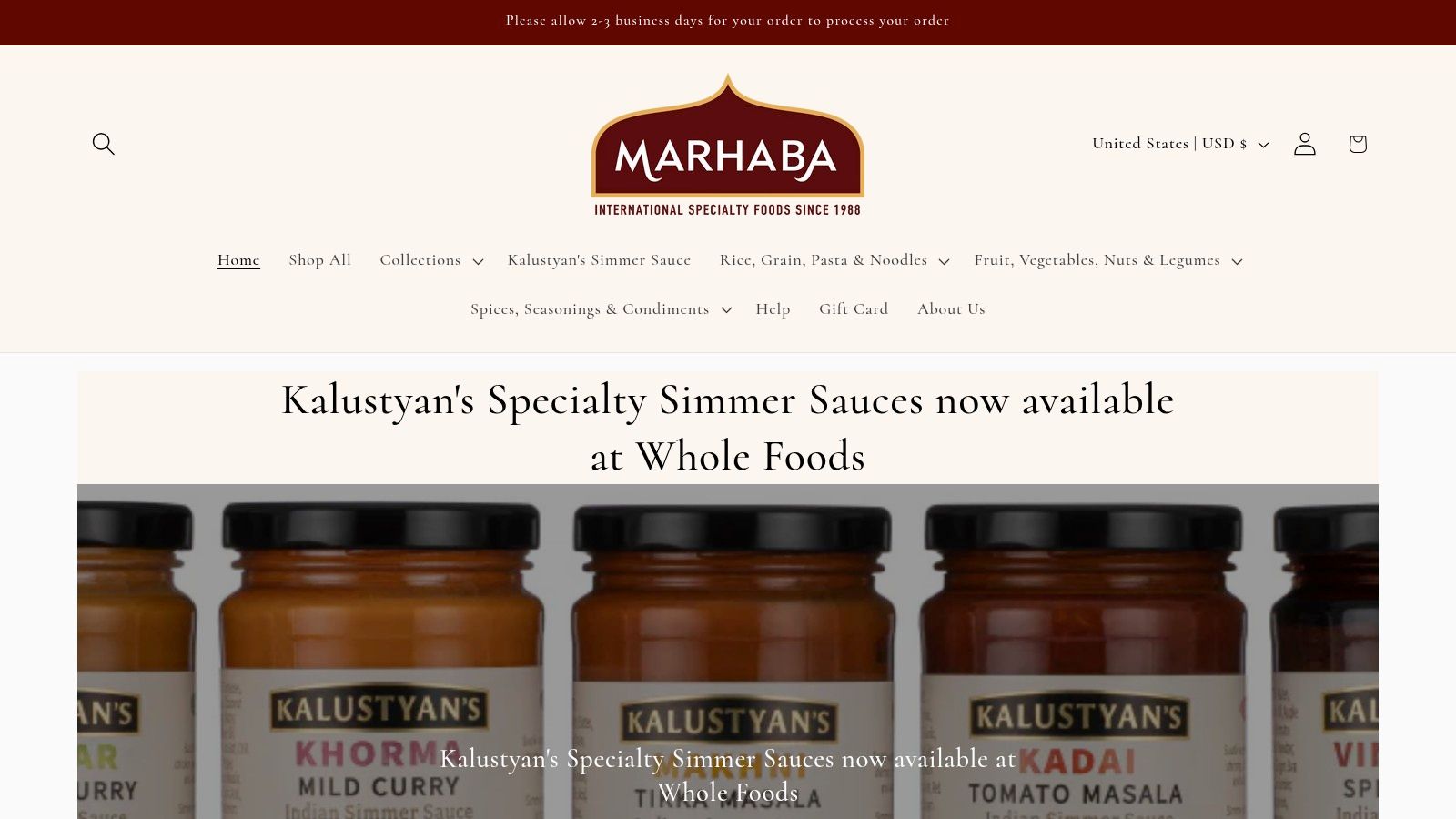
The platform’s strength lies in its specialization and authenticity, offering items rarely stocked by broadline distributors. For a "Food is Medicine" pilot program developing a culturally tailored diabetic-friendly kit, or a CACFP sponsor testing a new menu, Kalustyan’s provides access to the precise ingredients needed for success. Its direct-to-consumer model, with nationwide shipping for shelf-stable goods, allows for flexible, small-quantity procurement that is ideal for testing and validation phases.
Strategic Analysis: Sourcing and Program Integration
Kalustyan’s excels as a sourcing tool for ingredient-level authenticity, a critical factor when designing culturally responsive meals. Program managers can use the platform to identify and procure specific items like whole fenugreek seeds for an Indian-inspired senior meal or authentic berbere spice for an Ethiopian dish in a congregate setting. This precision sourcing ensures that meals are not just nutritionally compliant but also genuinely resonant with the target community.
Key Takeaway: Kalustyan’s is the ideal partner for the research and development phase of culturally specific meal programs. Use its extensive catalog to pilot menus, source authentic sample ingredients for taste-testing with community members, and create accurate procurement specifications before scaling up with a larger B2B distributor.
Tactical Breakdown: Capabilities for Institutional Programs
| Capability | Tactical Application for Program Operators |
|---|---|
| Deep Niche Catalog | Enables "Food is Medicine" directors to source specific, low-sodium spices or high-fiber ancient grains for medically tailored grocery boxes that respect patient heritage. |
| Nationwide Parcel Shipping | Allows SFSP sponsors in rural areas to procure non-perishable ingredients for Rural Non‑Congregate meal kits, supplementing items from larger distributors. |
| Transparent E-commerce | Provides clear pricing and shipping information, helping small program operators budget effectively for pilot projects or special dietary accommodations without needing a wholesale account. |
| Renowned Ingredient Quality | Ensures that items sourced for menu development or community focus groups are of high quality, providing a true representation of the intended flavor profile. |
Practical Application and Onboarding
Operating as a standard e-commerce site, Kalustyan’s requires no special account setup for placing orders. This accessibility is a major advantage for organizations needing to make quick, ad-hoc purchases. Note that perishable and frozen items are limited to local NYC delivery, so national procurement must focus on their extensive selection of dry and shelf-stable goods.
Pro Tips for Effective Use:
- For Menu Planners: Use Kalustyan's to build an "authenticity kit" for your culinary team, allowing them to test and perfect recipes before finalizing a large-scale menu.
- For Procurement Managers: When struggling to find a specific ingredient to meet Buy American provisions, cross-reference Kalustyan’s to identify potential domestic sources or suitable alternatives for non-compliant items.
- For WIC Pilot Programs: Source shelf-stable, culturally relevant items like specific lentils, flours, or spices to supplement standard WIC food packages and enhance participant engagement.
Kalustyan’s fills a unique and vital niche in the cultural foods distribution services ecosystem, providing the granular authenticity needed to design and launch truly resonant food programs.
Website: https://foodsofnations.com
Top 7 Cultural Foods Distributors Comparison
| Provider | Implementation complexity | Resource requirements | Expected outcomes | Ideal use cases | Key advantages |
|---|---|---|---|---|---|
| Umoja Health | High — requires program integration and compliance workflows | Custom procurement, coordination with agencies, 3PL and tech integration (U‑Cloud/EDI/WMS) | Auditable, program‑compliant meal/grocery programs with measurable health reporting | State agencies, WIC pilots, managed Medicaid, food banks, emergency logistics | Turnkey compliance, FDA‑registered 3PL, scalable Food‑as‑Medicine programs, inventory-aware tech |
| KeHE Distributors | Medium — onboarding and wholesale account setup | Nationwide DC network, retailer systems integration, replenishment ops | Fast national replenishment and broadened multicultural assortment for retailers | Supermarkets, independent retailers, multicultural brands seeking scale | Deep multicultural catalog, national fulfillment, DIVERSE Trade program |
| JFC International | Medium — import coordination and wholesale distribution | Import pipeline, regional branches, established supplier relationships | Reliable supply of Japanese and pan‑Asian staples at scale | Asian grocers, restaurants, mainstream retailers needing Asian inventory | Authentic brand portfolio, stable imports backed by Kikkoman, regional fulfillment |
| The Chefs’ Warehouse | Medium — B2B systems with occasional DTC promos | Specialty sourcing, chef curation, B2B e‑commerce tools | High‑quality, chef‑curated specialty assortment; limited consumer access during promos | Independent restaurants, hotels, gourmet retailers; occasional consumers during programs | Chef-driven curation, broad specialty SKUs, robust B2B ordering tools |
| Restaurant Depot | Low — cash‑and‑carry model with membership requirements | Physical warehouse access, business credentials, in‑store pickup logistics | Immediate wholesale access to multicultural ingredients and bulk items | Restaurants, nonprofits, caterers needing bulk/rapid pickup | Nationwide warehouses, wholesale pricing, extensive ethnic aisles, free business membership |
| Weee! | Low–Medium — consumer e‑commerce with variable delivery coverage | Metro fresh delivery networks, nationwide parcel for pantry items, EBT processor in supported areas | Consumer access to fresh and shelf‑stable cultural groceries; EBT-enabled purchases where supported | Home cooks, small operators in metros, shoppers needing ethnic groceries online | Large cultural assortment, SNAP/EBT acceptance in supported areas, fresh local delivery |
| Kalustyan’s (Foods of Nations) | Low — straightforward e‑commerce for shelf‑stable; higher for cold local delivery | Curated global sourcing, NYC cold‑chain for perishables, U.S. parcel shipping for dry goods | Nationwide access to hard‑to‑find spices and regional pantry staples (dry goods) | Home cooks, small restaurants, caterers seeking specialty spices and regional condiments | Deep, curated catalog across 80+ countries, transparent shipping/processing info |
Putting It All Together: Your Action Plan for Sourcing Cultural Foods
Navigating the landscape of cultural foods distribution services can feel complex, but it's a critical step toward building more inclusive, effective, and dignified food programs. Throughout this guide, we've dissected the capabilities of various partners, from hyper-specialized government contractors like Umoja Health to broadline distributors such as KeHE and The Chefs’ Warehouse. The central lesson is clear: there is no one-size-fits-all solution. Your success hinges on meticulously aligning a vendor's core strengths with your program's specific operational, regulatory, and cultural requirements.
The journey from concept to delivery is paved with crucial decision points. We've explored the intricate compliance webs of programs like SFSP Rural Non-Congregate, CACFP, and WIC, where adherence to Buy American provisions, OAA guidelines, and cold-chain exceptions is non-negotiable. We've also delved into the operational mechanics that separate a good partner from a great one: robust EDI/WMS systems, certified allergen segregation protocols, and sophisticated kitting and multi-day packing capabilities. These aren't just logistical details; they are the bedrock of a reliable and safe food supply chain.
Key Insights and Strategic Takeaways
As you move forward, keep these core principles at the forefront of your planning. They represent the synthesis of our analysis across all featured vendors and program examples.
-
Compliance is the Foundation: For government and healthcare programs, compliance is not an add-on; it's the prerequisite. A partner's deep, demonstrable experience with regulations like Buy American, OAA, and CACFP meal patterns is your primary filter. Ask for specific case studies and documentation of their compliance workflows.
-
Operational Excellence Drives Success: A vendor’s ability to manage complex logistics is paramount. Look for FDA-registered facilities, advanced Warehouse Management Systems (WMS), and clear Standard Operating Procedures (SOPs) for everything from receiving to kitting. This operational backbone ensures consistency, safety, and scalability.
-
Cultural Competency is Not Optional: True success in cultural food distribution means more than just sourcing diverse products. It requires a partner who understands the nuances of community preferences, dietary restrictions, and the importance of dignity in food access. As highlighted in the Umoja Health case vignettes, sourcing culturally connected SKUs builds trust and improves participant outcomes.
-
Define Your Needs Before You Source: Before issuing an RFP or contacting vendors, use the checklists and templates provided in this article. Clearly articulate your requirements for kitting, delivery windows, reporting, and specific program constraints. A well-defined scope of work empowers you to ask the right questions and evaluate potential partners effectively.
Your Actionable Next Steps
Armed with this knowledge, your next steps should be strategic and deliberate. Transition from learning to doing with this structured action plan.
-
Assemble Your Internal Team: Bring together key stakeholders from procurement, operations, compliance, and program management. A cross-functional team ensures all critical perspectives are considered from the outset.
-
Complete a Needs Assessment: Use the evaluation checklists from this article to conduct a thorough internal audit. What are your must-have capabilities versus your nice-to-haves? What are your biggest pain points with your current system?
-
Develop a Targeted Request for Information (RFI): Before a formal RFP, send a targeted RFI to a shortlist of potential partners identified in this guide. Ask them to provide evidence of their experience with programs similar to yours, focusing on compliance, logistics, and reporting.
-
Conduct Rigorous Vendor Vetting: Once you receive RFI responses, schedule deep-dive calls. Request a tour of their facilities (virtual or in-person) and ask for references from organizations with comparable program models. Probe their expertise on challenges like inventory-aware substitutions for WIC programs or sourcing OAA-compliant components for senior meal boxes.
Choosing the right partner for cultural foods distribution services is a transformative decision. It can elevate your program from a simple logistical operation to a powerful engine for health equity, community connection, and improved well-being. By taking a methodical, informed approach, you can build a resilient and impactful food distribution system that truly serves the diverse needs of your community.
Ready to partner with a specialist in compliant, culturally responsive food distribution? Umoja Health designs and manages turnkey food-as-medicine and government meal programs, handling everything from compliant sourcing and kitting to home delivery. Visit Umoja Health to see how their end-to-end cultural foods distribution services can help you achieve your program goals.