When disaster strikes, emergency food programs from the government become a critical lifeline for individuals and families, ensuring everyone has access to vital nutrition. These programs, run at both the federal and state levels, are built for rapid deployment in a crisis.
Their core mission is simple but crucial: to maintain food security when the normal supply chains have been completely upended.
Navigating Government Emergency Food Programs
Government-funded emergency food programs are the backbone of disaster response in the United States, providing a structured way to support affected communities. For any state or local official tasked with putting these programs into action, understanding the key federal and state options is non-negotiable.
This isn't just about handing out meals. It's a complex world of logistics, participation requirements, and specific procedures for reimbursement.
Two of the most important federal programs you'll encounter are:
- The Disaster Supplemental Nutrition Assistance Program (D-SNAP): This program provides temporary food benefits to households that don't normally qualify for SNAP but have suffered a direct loss because of a disaster.
- The Emergency Food Assistance Program (TEFAP): This initiative helps supplement the diets of low-income Americans by giving them emergency food assistance at no cost.
Key Operational Components
Getting these programs off the ground successfully means having a firm grip on their operational logistics. This often involves coordinating with multiple state agencies, local food banks, and community organizations to get aid out the door effectively.
For instance, D-SNAP participation logistics revolve around an electronic benefit transfer (EBT) system, which has its own set of operational hurdles. Meanwhile, TEFAP distributes USDA-sourced foods through a vast network of food banks.
Reimbursement is another huge piece of the puzzle. States must meticulously follow federal guidelines to recover the administrative costs tied to running these programs. Every single step, from sourcing the food to the final distribution, needs careful management to stay compliant and effective.
A well-executed response can mean the difference between stability and chaos for a community in crisis. The ability to quickly connect people with the right program is paramount.
To help with this incredibly complex process, Umoja has developed a comprehensive lookup resource specifically for government agencies and their partners. Our process is designed to quickly connect people with the right aid, streamlining the search and application process to ensure assistance reaches those who need it most without any unnecessary delays, ultimately building a more resilient community in the toughest of times.
Comparing Key Federal and State Food Programs
When disaster strikes, state and federal governments have powerful tools to rush food assistance to affected communities. But knowing which program to use, and when, is absolutely critical for an effective response. Two of the most important programs in the arsenal are the Disaster Supplemental Nutrition Assistance Program (D-SNAP) and The Emergency Food Assistance Program (TEFAP).
Think of them as two different solutions for two different, though sometimes overlapping, problems. D-SNAP is a rapid-response financial tool activated by a Presidential Disaster Declaration, while TEFAP is a steady, ongoing program that provides actual food commodities and can be scaled up during emergencies.
Disaster Supplemental Nutrition Assistance Program (D-SNAP)
At its core, D-SNAP provides short-term food benefits directly to households reeling from a disaster, especially those who wouldn't normally qualify for regular SNAP. Instead of physical food, it provides funds on an Electronic Benefit Transfer (EBT) card, giving families the dignity and flexibility to buy the specific groceries that fit their cultural and dietary needs from local stores.
Eligibility for D-SNAP is specifically tied to the disaster's impact. A household might qualify if it has faced:
- Disaster-related expenses, like paying for home repairs, temporary lodging, or evacuation costs.
- A loss or interruption of income because of the disaster.
- Inaccessible resources, such as frozen bank accounts.
The benefit amount is set at the maximum monthly allotment for a household's size. States must have a pre-approved D-SNAP plan ready to go, allowing them to roll out the program immediately after a disaster declaration and get aid into people's hands with minimal delay.
The Emergency Food Assistance Program (TEFAP)
TEFAP works on a completely different model. It doesn't provide money; it provides food. The USDA buys high-quality, American-grown foods and distributes them to state agencies. Those agencies, in turn, get the food to local partners like food banks, pantries, and soup kitchens who serve the public directly.
This structure serves a dual purpose: it shores up American agriculture while delivering essential nutrition to low-income families. While TEFAP is a year-round lifeline for many, its role often expands dramatically during widespread emergencies to meet heightened community needs. It's a key piece of the food security puzzle, complementing other initiatives states use to support vulnerable populations. For a closer look at how these systems work together, see our guide on how states administer child nutrition programs.
The main difference is the delivery method. D-SNAP gives households purchasing power, while TEFAP delivers physical food through a network of trusted community organizations.
Below is a quick-reference table to help clarify the distinct roles of these two vital programs.
Comparison of Major US Emergency Food Programs
This table provides a side-by-side comparison of D-SNAP and TEFAP, highlighting their primary function, administering agency, target beneficiaries, and typical activation scenarios to help state administrators quickly identify the appropriate program for a given emergency.
| Program Feature | D-SNAP (Disaster SNAP) | TEFAP (The Emergency Food Assistance Program) |
|---|---|---|
| Primary Function | Provides temporary financial benefits for food purchases. | Distributes USDA-purchased food commodities. |
| Administering Agency | USDA Food and Nutrition Service (FNS) & State Agencies | USDA Food and Nutrition Service (FNS) & State Distributing Agencies |
| Target Beneficiaries | Households affected by a disaster, including those not eligible for regular SNAP. | Low-income individuals and households, with expanded support during emergencies. |
| Activation Scenario | Following a Presidential Disaster Declaration. | Operates continuously, but can be scaled up to respond to widespread emergencies. |
Understanding these distinctions is crucial for a swift and organized response. Both programs are essential components of the government's emergency food strategy, and Umoja Health’s resources are designed to help officials navigate these systems to minimize delays and maximize impact for communities in crisis.
Navigating the Scale and Financial Realities of Food Aid
Anyone managing an emergency food program knows the immense pressure of balancing overwhelming need against significant financial constraints. Global events are constantly shifting the landscape of food security, pushing the number of people who need help to record highs. This new reality places an extraordinary demand on systems that can be strained even on a good day.
For administrators and procurement leads on the ground, this means you're constantly planning for sudden spikes in demand while dealing with unpredictable funding. These aren't just logistical problems; they're strategic challenges that dictate how programs are designed and run from the very start.
Responding to Surging Demand and Funding Gaps
We’re seeing unprecedented levels of acute hunger, with hundreds of millions now facing severe food insecurity. This crisis puts enormous pressure on government-funded emergency food programs. At the same time, humanitarian funding from major donors is shrinking, forcing organizations to scale back. According to the World Food Programme (WFP), these shortfalls risk pushing millions into even more dire situations. You can dive deeper into the data in this global report on food crises.
This combination of soaring need and shrinking budgets is a brutal reality that directly shapes how governments deliver aid.
The financial pressure often forces difficult but necessary adjustments on the operational side. To make every dollar count, agencies are often forced to implement measures like:
- Tighter Targeting: Focusing aid squarely on the highest-risk and most vulnerable groups to ensure resources get to those who need them most.
- Ration Adjustments: Modifying the size or duration of food rations to stretch supplies across a larger population.
- Cost-Effective Solutions: Shifting toward in-kind, shelf-stable food kits, which provide a predictable and efficient way to distribute essential nutrition when budgets are tight.
Comparing Program Delivery Models
A critical piece of the strategic puzzle is understanding the primary ways aid is delivered. The two main models—providing financial benefits versus distributing physical food commodities—serve very different functions. The graphic below breaks down the core differences between D-SNAP (financial aid) and TEFAP (direct food distribution).
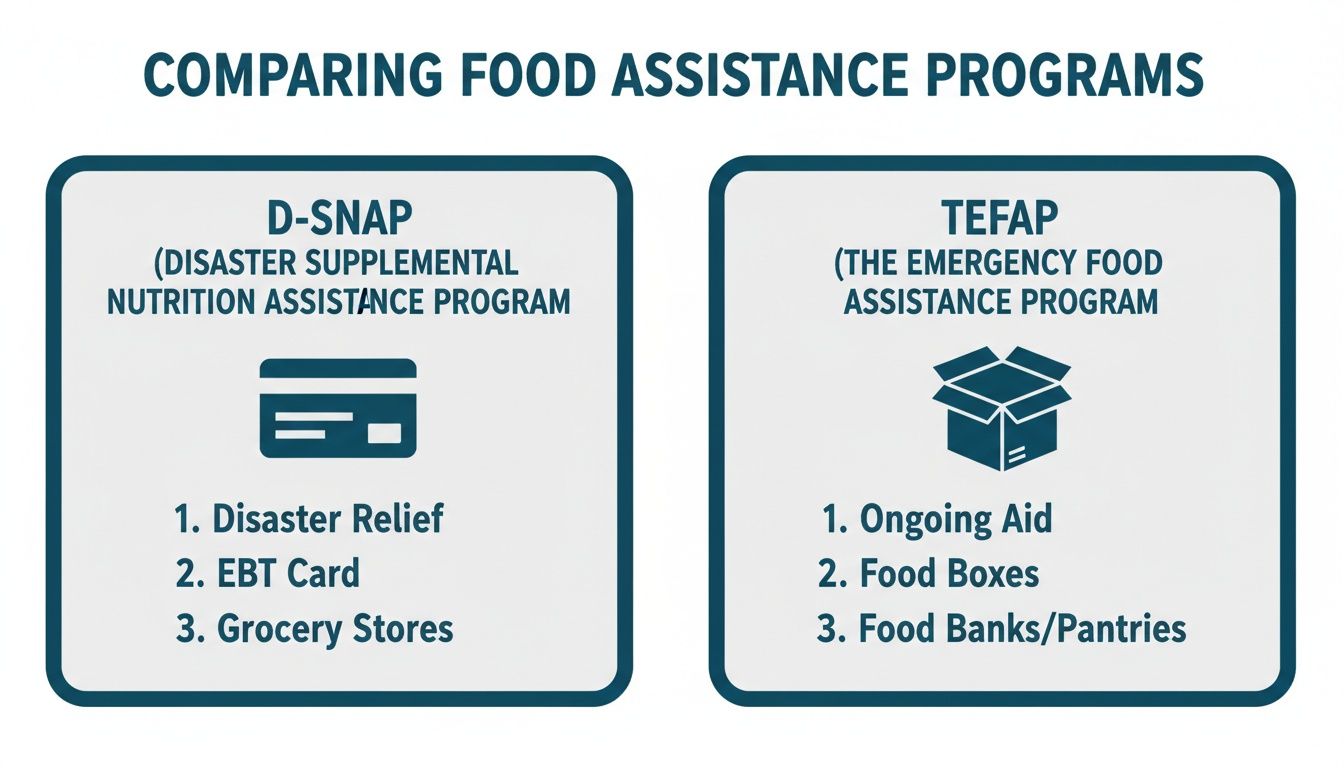
This comparison really highlights how different emergency food programs government agencies use are designed for specific scenarios. For planners, this means contingency budgets and forward-buys have to account for abrupt surges. It's what drives the need for pre-positioning shelf-stable kits and contracting with third-party logistics (3PL) providers—you have to be ready to move fast.
Understanding Procurement and the Buy American Provision
When you're running a government program, procurement is a huge part of the job, and you can't talk about procurement without talking about the Buy American provision. This federal rule is a big deal, directly shaping how food gets purchased for major initiatives like the National School Lunch Program (NSLP), Summer Food Service Program (SFSP), and the Child and Adult Care Food Program (CACFP). Frankly, it's a foundational rule every program lead has to master to stay compliant.
So, what does it mean in practice? The provision requires School Food Authorities (SFAs) and any institution using federal funds to buy domestic commodities or products whenever possible. For a food to be considered "domestic," it has to be produced and processed in the United States. On top of that, over 51% of its final processed content must come from domestic agricultural commodities.
This isn't just bureaucratic red tape. The whole point is to support American farmers and producers. By doing so, we strengthen our own domestic food supply chain—something that becomes incredibly important for national food security, especially when an emergency hits. For you, the program lead, this is a mandate that influences every single sourcing decision you make.
Requirements for Purchasing Domestic Foods
Complying with the Buy American provision means you have to be proactive about finding domestic food products. This goes way beyond just checking a box on a form; it demands clear communication and solid verification all the way through your supply chain.
Some best practices we've seen work well include:
- Explicit Contract Language: Your solicitations and contracts absolutely must include a Buy American clause. Spell it out for your vendors so there’s no confusion about the requirement to supply domestic foods.
- Supplier Verification: Don't just take their word for it. Ask your suppliers for documentation that certifies the domestic origin of their products. This could be a specific label, a formal letter from the manufacturer, or other tangible proof.
- Product Specification: Be crystal clear in your bid specifications about what "domestic" means. The less ambiguity you leave, the fewer headaches you'll have with potential suppliers down the road.
Sticking to the Buy American provision isn't just about following the rules. It's a strategic move that bolsters the national agricultural economy and builds a resilient food supply for the emergency food programs government agencies depend on.
Navigating Limited Exceptions
Now, while the requirement to buy American is strict, the USDA gets that it's not always feasible. They've built in two very specific, limited exceptions for when you can purchase a non-domestic food product.
- Product Unavailability: This applies when a specific domestic product isn't produced or manufactured in the U.S. in sufficient and reasonably available quantities of a satisfactory quality.
- Unreasonable Cost: This is for when the price tag on the U.S. product is significantly higher than its non-domestic alternative.
If you plan to use one of these exceptions, be prepared to document everything meticulously. You have to be able to prove that you made a good-faith effort to source domestically before you resorted to a foreign product. Keeping detailed records is non-negotiable here; it’s what will save you from compliance issues during an audit and protect your program's integrity.
Comparing Food Modalities and Operational Costs
Making smart logistical decisions long before a disaster hits is the cornerstone of any effective emergency response. For logistics chiefs and food bank operations leads, this means getting real about the trade-offs between different emergency food options.
The choice between Ready-to-Eat (RTE) meals and multi-day, shelf-stable family kits creates major ripples, affecting everything from your budget to your warehouse capacity.
Governments manage several types of emergency food programs, and the unit costs and logistical demands vary wildly. Historically, things like RTE meals and self-heating MREs have a higher per-unit cost, but they make last-mile distribution much simpler since they don't require any cooking or refrigeration.
On the other hand, multi-day family kits can be significantly cheaper per household, depending on their contents. A single self-heating meal might run between US$3–$8, while a comprehensive multi-day kit could cost US$10–$40 per family. It’s these numbers that drive program decisions. Emergency managers have to balance volume against cost, often mixing immediate-need RTE meals with multi-day kits for longer-term support.
Key Trade-Offs in Food Selection
When you're in the planning phase, you have to look beyond the sticker price. The analysis needs to cover the full operational cost—storage, handling, and the complexities of distribution.
- Ready-to-Eat (RTE) Meals: These are your go-to for the first 24-72 hours after a disaster, when critical infrastructure is likely down. Their biggest plus is convenience; with no prep needed, they're easy to hand out in chaotic situations. The downside? Their higher unit cost and often bulkier packaging can eat into your budget and warehouse space.
- Multi-Day Family Kits: For more sustained support, these kits are a much more cost-effective play. They provide staples for several meals, lowering the per-meal cost while supporting an entire household. The trade-off here is the need for kitting labor and more hands-on inventory management.
A phased approach is often the smartest strategy. Lead with RTE meals to meet immediate, widespread needs. As conditions begin to stabilize, transition to multi-day kits for more targeted, longer-term support to families.
Storage and Distribution Logistics
Your choice of food directly shapes your warehousing and distribution plan. Shelf-stable items are a huge logistical win because they don't need a cold chain—which is often the first thing to break in a disaster.
If your program does include perishable foods, keeping them safe is a non-negotiable part of the operation. For any emergency food programs government agencies run, following strict guidelines for maintaining safe cold storage temperatures is essential to prevent spoilage and protect public health.
Ultimately, load planning has to account for weight, volume, and how easy the items are to handle. You'll find that palletizing multi-day kits is often more space-efficient than stacking cases of individual RTE meals. Taking this kind of data-driven approach to logistics ensures you can select the right mix of products to meet diverse needs through every phase of a response.
Designing Compliant and Culturally Relevant Food Kits
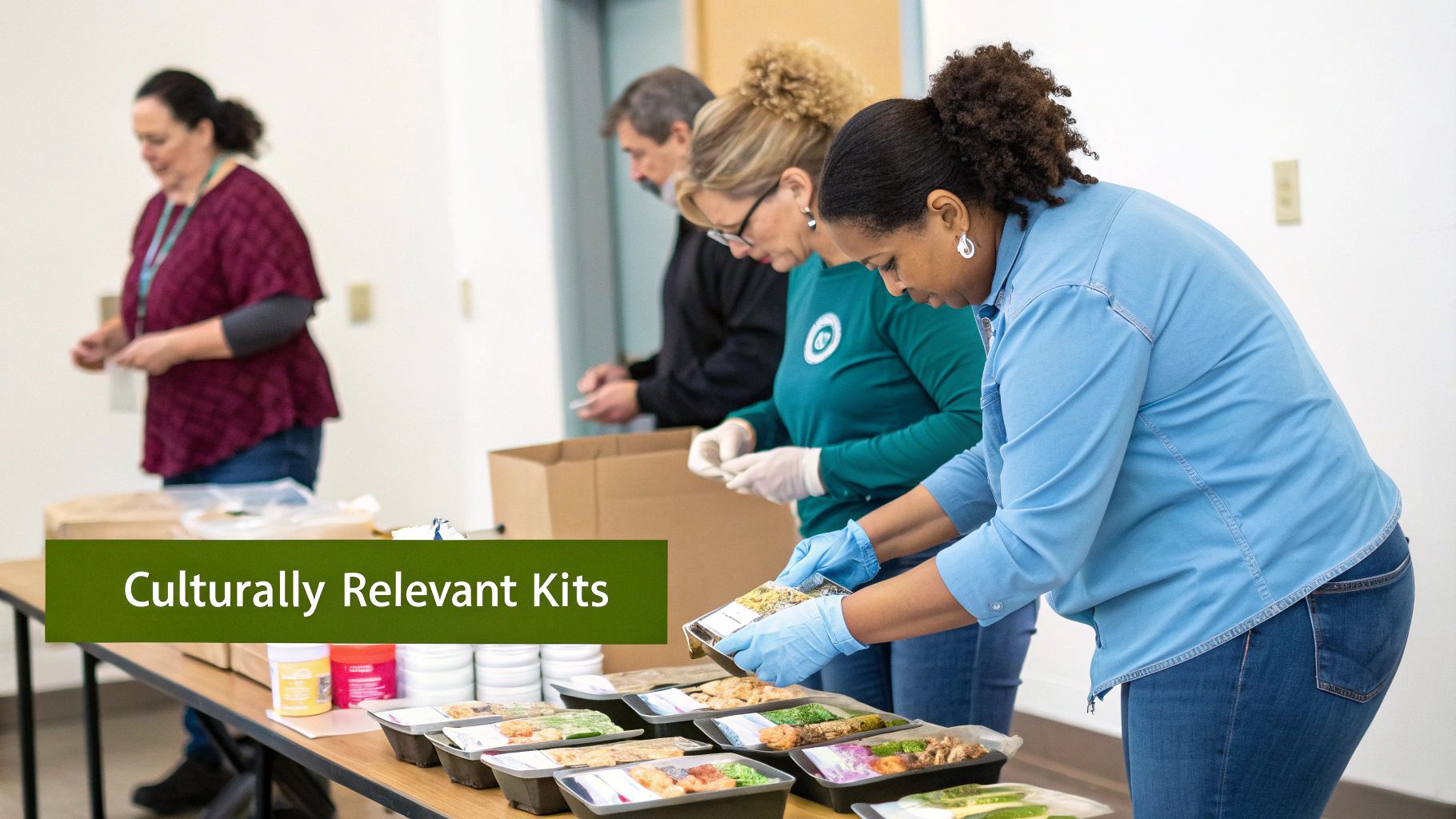
Beyond the basic logistics of getting food from point A to point B, the most impactful emergency food programs government agencies can run are the ones that offer real, dignified support. It's about more than just calories; it’s about designing emergency food kits that are not only compliant with federal regulations but also culturally relevant to the people you're serving. A thoughtfully assembled kit is one that gets used, not wasted.
Of course, the contents have to tick the right boxes. Kits for seniors under the Older Americans Act (OAA), for instance, have very different nutritional standards than meals for kids in the Summer Food Service Program (SFSP). The real challenge for program managers is hitting those targets while also acknowledging the dietary staples and preferences of the communities receiving the aid.
Crafting Kits for Specific Needs
Different emergencies and different populations demand different solutions. A one-size-fits-all approach is almost guaranteed to fall short, which is why tailoring kits to specific needs is absolutely essential for a program’s success.
- Home-Delivery Kits for Rural Non-Congregate Feeding: In rural areas where getting to a distribution site is a major hurdle, these kits are a lifeline. They're typically packed with several days' worth of shelf-stable meals and snacks, designed for simple, direct-to-doorstep delivery.
- Senior-Specific Boxes (OAA-Compliant): These kits are built around the unique nutritional needs of older adults. You'll often see items like low-sodium canned vegetables, lean proteins like canned chicken or fish, and grains that are easy to prepare. Even the packaging and portion sizes are considered, keeping individuals with limited mobility or cooking capacity in mind.
A crucial piece of this puzzle involves selecting appropriate non-perishable food items that are both shelf-stable and meet the required nutritional profiles. Getting this foundational step right ensures the kits are practical and safe when a crisis hits.
For food bank managers and program sponsors, building culturally connected kits is a powerful way to enhance the dignity and impact of food distributions. Including familiar items like masa harina, lentils, or jasmine rice shows respect for recipients and makes the assistance far more useful.
Sample Menus and Pack Lists
Once you know the who and the why, you can build a practical pack list. To give you a tangible starting point, here are a few examples of how these kits can be configured to meet specific program requirements.
| Component Category | Senior (OAA) Kit Example | Family Kit (3-Day) Example | Rural Non-Congregate Kit Example |
|---|---|---|---|
| Protein | Canned salmon (low sodium), Canned chicken breast, Peanut butter | Canned tuna in water, Black beans, Lentils, Peanut butter (large jar) | Shelf-stable milk (8 oz), Beef sticks, Canned chili, Sunflower seeds |
| Grains/Starch | Whole wheat crackers, Instant oatmeal packets, Brown rice (microwavable) | Pasta (1 lb box), Long-grain white rice (2 lb bag), Whole grain cereal | Whole grain crackers, Granola bars, Individual cereal boxes |
| Fruits | Fruit cups in juice (peaches, pears), Canned mandarin oranges, Applesauce | Canned mixed fruit, Dried raisins (multi-pack), Applesauce (large jar) | Individual fruit cups, Dried apple slices, 100% fruit juice boxes |
| Vegetables | Canned green beans (no salt added), Low-sodium vegetable soup, Canned carrots | Canned corn, Canned diced tomatoes, Canned mixed vegetables | Individual vegetable cups (corn, green beans), Tomato soup |
| Other/Snacks | Low-sugar gelatin cups, Unsalted nuts | Jelly/Jam, Cooking oil, Salt/Pepper | Shelf-stable cheese sticks, Pretzels |
These examples are just a framework, of course. The best kits are built with direct input from the communities they're intended to serve, ensuring the food is not just compliant, but welcome.
Umoja Health specializes in this exact work—creating specialized meal kits that are both compliant and culturally connected. If you're looking for solutions, feel free to explore our compliant kitting programs designed for the diverse needs of communities nationwide.
Frequently Asked Questions About Emergency Food Programs
Even for seasoned administrators, navigating the world of government emergency food programs can bring up a lot of questions. We get it. This section tackles some of the most common queries we hear about activating programs, clearing operational hurdles, and making sure the aid you provide is both effective and dignified. Think of it as a quick reference to help you get things done.
Our goal here is simple: reinforce the key takeaways from this guide and give you clear, actionable answers to solve the real-world challenges you face in the field.
How Can My Agency Prepare For A D-SNAP Activation?
The key to a smooth Disaster Supplemental Nutrition Assistance Program (D-SNAP) activation is preparing before a disaster strikes. If you’re waiting for a declaration, you’re already behind. A solid plan is the bridge between a disaster’s impact and getting aid into people’s hands quickly.
Here are a few critical steps to get your agency ready:
- Open Lines of Communication: Keep a regular dialogue going with your state's SNAP agency and emergency management office. This way, you’ll know the exact triggers for a D-SNAP activation and can sync up your efforts without a hitch.
- Get Outreach Materials Ready Now: Design and translate flyers, social media graphics, and public service announcements before you need them. Having these ready to go means you can instantly push out vital information on eligibility and how to apply.
- Scout Application Sites: If your state plan involves in-person applications, identify and lock down accessible locations ahead of time. Think about things like public transit, ADA compliance, and whether the community trusts the location—places like libraries or community centers are often a good bet.
- Plan for the Food Gap: D-SNAP benefits are loaded onto EBT cards, but that process can take time. To make sure no one falls through the cracks, set up contingency plans with pre-vetted vendors for shelf-stable food kits to support families until their benefits are active.
What Are The Biggest Logistical Challenges In Rural Food Distribution?
Getting emergency food into rural areas is a whole different ballgame, and it almost always comes down to conquering the "last mile." Unlike dense urban centers, rural distribution means dealing with huge distances, sparse transportation, and far fewer community hubs like food banks or pantries.
The main obstacles are pretty clear:
- Vast Distances: Reaching just one isolated household can burn significant time, fuel, and vehicle resources. It all adds up, driving your operational costs way up.
- Limited Transportation: Many folks in rural communities don't have a reliable car, making it nearly impossible for them to get to a central pickup point.
- Fewer Central Hubs: With fewer community centers or pantries, your delivery routes have to be much more complex and tailored to individual households.
Another major headache in rural settings is cold chain management. Keeping things refrigerated over long hauls is often just not practical. This is where shelf-stable solutions become absolutely essential for a reliable response—no special temperature controls needed.
Programs like the Summer Food Service Program (SFSP) Rural Non-Congregate option were specifically created to tackle these issues. By allowing for home delivery of multi-day meal kits, these programs eliminate the need for families to travel to a feeding site every day. To pull this off, you need a strong logistics partner who knows how to manage complicated, multi-stop delivery routes without a fuss.
How Do We Ensure Food Kits Meet Nutritional And Cultural Needs?
This is where a good program becomes a great one. A truly effective emergency food response balances nutritional compliance with cultural relevance. After all, a food kit only works if people actually eat—and enjoy—what’s inside. That requires moving beyond a simple USDA checklist.
Start by talking to the communities you're serving. Don't guess. Run surveys, hold focus groups, or just sit down with community leaders to learn about their staple foods, dietary preferences, and any religious or cultural restrictions. Doing this groundwork builds trust and shows that you genuinely want to help.
Once you have that insight, map those preferences to the specific nutritional guidelines for your program, whether it’s for seniors under the Older Americans Act (OAA) or kids in the CACFP. The final piece is partnering with a supplier who specializes in sourcing a wide variety of culturally connected foods. A kit that includes items like lentils, black beans, jasmine rice, or masa harina alongside the usual canned goods will be far better received. It’s a strategy that boosts food acceptance, shows respect, and still checks every single regulatory box.
At Umoja Health, we work with government agencies, food banks, and community organizations to build and run compliant and culturally connected food programs at scale. From disaster response kits to specialized nutrition security initiatives, our solutions are designed for the real-world needs of the communities you serve.