
Running a CACFP meal program effectively means taking a mountain of complex rules and turning them into a smooth, everyday operation. It’s about designing menus that are both compliant and kid-approved, getting your reporting streamlined, and keeping food safety top-of-mind. Get it right, and you’ll not only maximize your center’s reimbursement but also boost participation—transforming what feels like an administrative chore into a real asset for your community.
Solving the CACFP Puzzle for Your Center

Let’s be honest: navigating the Child and Adult Care Food Program (CACFP) can often feel like you’re drowning in paperwork and red tape. For child care centers and after-school operators, the goal is straightforward: serve healthy meals that kids actually want to eat, and get reimbursed for it. But making that happen while correctly filling out every single form is where things get complicated.
This guide provides real, actionable solutions for the challenges that keep so many providers from maximizing participation—from the sheer administrative load to budgets so tight that meal planning becomes a source of constant stress. Despite the program’s incredible potential, its reach isn’t what it should be. In fact, approximately 36.5% of licensed childcare centers nationwide participate in CACFP, meaning many eligible programs do not access the nutritional support available.
Our goal here is to give you a roadmap for building a program that is efficient, fully compliant, and truly sustainable for the long haul.
Maximizing Participation and Compliance
The biggest hurdle for many is the perception that CACFP is just more trouble than it’s worth. Sound familiar? The most common pain points we hear about include:
- Complex Paperwork: Juggling daily meal counts, attendance records, and procurement documents can quickly spiral out of control if you don’t have a rock-solid system in place.
- Fear of Audits: Nobody wants to be declared “seriously deficient.” The risk of getting flagged for a simple mistake in financial management or a non-compliant meal can be enough to scare off even the most dedicated providers.
- Menu Planning Stress: You need to create menus that check all the nutritional boxes, appeal to picky eaters, and somehow stay within your budget. It’s a tough balancing act.
The key is to stop being reactive. Instead of just trying to dodge errors, you need to build robust systems where compliance becomes the default, not an afterthought.
By tackling menu development, reporting, and food safety with a clear, step-by-step strategy, you can turn a source of frustration into one of your program’s greatest strengths. This ensures more children get the healthy, nourishing meals they need to learn, play, and grow. A well-run program is a key part of the broader ecosystem of child nutrition programs that supports community well-being.
Step 1: Designing a Compliant and Kid-Approved Menu
A successful CACFP program lives and dies by its menu. It has to walk a fine line, satisfying strict federal regulations on one side and, on the other, the notoriously picky palates of children. This balancing act is the true art of creating effective CACFP meal solutions. The goal isn’t just to check boxes; it’s to build a flexible, repeatable system that makes mealtime a highlight, not a compliance headache.
The foundation is always mastering the five core CACFP food components: milk, grains, protein, fruits, and vegetables. Every meal you serve—breakfast, lunch, or a snack—has specific rules about which components need to be on the plate and in what portion sizes for different age groups. This is about more than just rules; it’s about providing foundational nutrition where it counts the most.
And it really, really counts. The CACFP is a vital tool in the fight against food insecurity. In 2023, about 14 million children—approximately 18%—lived in food-insecure households, reflecting a significant but not unprecedented increase. By serving nutritious meals and snacks to about 4.4 million children daily as of fiscal year 2024, CACFP providers remain on the front lines of this critical mission. If you want to dig deeper into the program’s impact, you can review the full findings on Mathematica.org.
Building Your Flexible Menu System
Instead of getting locked into a rigid, unchanging menu, think in terms of a cycle menu. This is simply a rotating schedule of pre-approved, compliant meals that repeats over a set period. A four-week cycle is a fantastic starting point for most programs. This approach streamlines your procurement process, cuts down on food waste, and completely eliminates the daily “what are we serving?” scramble.
Here’s a practical way to structure it:
- Embrace Theme Days: Think “Taco Tuesday” or “Pasta Friday.” Themes create excitement and predictability, making it much easier to build your shopping lists and plan ahead.
- Plan for Component Swapping: Design your core meals so that individual components can be easily substituted. This allows you to adapt to seasonal availability or fluctuating costs. For instance, a side of steamed broccoli can easily be swapped for green beans without derailing the whole meal’s compliance.
- Get Creative with Kid-Friendly Concepts: Deconstructed meals are an absolute game-changer. A “build-your-own” taco bar or a yogurt parfait station gives kids a sense of control and choice, which dramatically increases the odds they’ll actually eat the meal.
One of the most common mistakes is a menu that’s technically compliant but totally unappealing to kids. Remember, a meal only provides nutrition if it’s eaten. Involve children in the process! Ask for feedback or let them vote on upcoming meal options.
Before we get into the sample menu, it’s important to see how these components come together over a full week. The following table provides a clear, 5-day template for breakfast and lunch that meets all the necessary CACFP component requirements for a typical age group. It’s a great visual guide for how to balance variety with compliance.
Sample CACFP 5-Day Menu Template
| Day | Breakfast Meal | Components Met (Breakfast) | Lunch Meal | Components Met (Lunch) |
|---|---|---|---|---|
| Monday | Whole Grain Oatmeal with Blueberries & Milk | Grain, Fruit, Milk | Chicken Bites, Brown Rice, Steamed Carrots, Apple Slices & Milk | Meat/Alt, Grain, Vegetable, Fruit, Milk |
| Tuesday | Scrambled Eggs, Whole Wheat Toast & Milk | Meat/Alt, Grain, Milk | “Taco Tuesday” – Ground Turkey, Whole Grain Tortilla, Lettuce/Tomato, Cheese & Milk | Meat/Alt, Grain, Vegetable, Meat/Alt, Milk |
| Wednesday | Yogurt Parfait (Yogurt, Granola, Strawberries) & Milk | Meat/Alt, Grain, Fruit, Milk | Whole Wheat Pasta with Meat Sauce, Green Beans, Pear Slices & Milk | Grain, Meat/Alt, Vegetable, Fruit, Milk |
| Thursday | Whole Grain Cereal with Banana Slices & Milk | Grain, Fruit, Milk | Turkey & Cheese Sandwich on Whole Wheat Bread, Cucumber Slices & Milk | Meat/Alt, Grain, Vegetable, Milk |
| Friday | Whole Grain Pancakes with Peach Slices & Milk | Grain, Fruit, Milk | “Pizza Friday” – Whole Grain English Muffin Pizza with Cheese, Side Salad & Milk | Grain, Meat/Alt, Vegetable, Milk |
As you can see, this structure ensures all component boxes are checked daily while keeping the meals interesting and kid-friendly. This kind of template takes the guesswork out and makes weekly planning a breeze.
Step 2: Streamlining Operations and Food Safety
Let’s talk about the secret sauce to a less stressful, more sustainable CACFP operation: efficiency. A well-designed system isn’t just about saving time and money—it’s about building a foundation for compliance that will actually hold up under scrutiny. This means creating clear, repeatable Standard Operating Procedures (SOPs) for every single step, from how you source your ingredients to the final pack-out of a meal kit.
When you have a solid operational blueprint, every team member, whether they’re a seasoned pro or it’s their first day, follows the exact same compliant process. Every. Single. Time. That consistency is your best defense against the common, simple errors that can suddenly put your reimbursement at risk.
This infographic lays out the core process for creating a menu that hits all three critical marks: compliant, kid-friendly, and audit-ready.
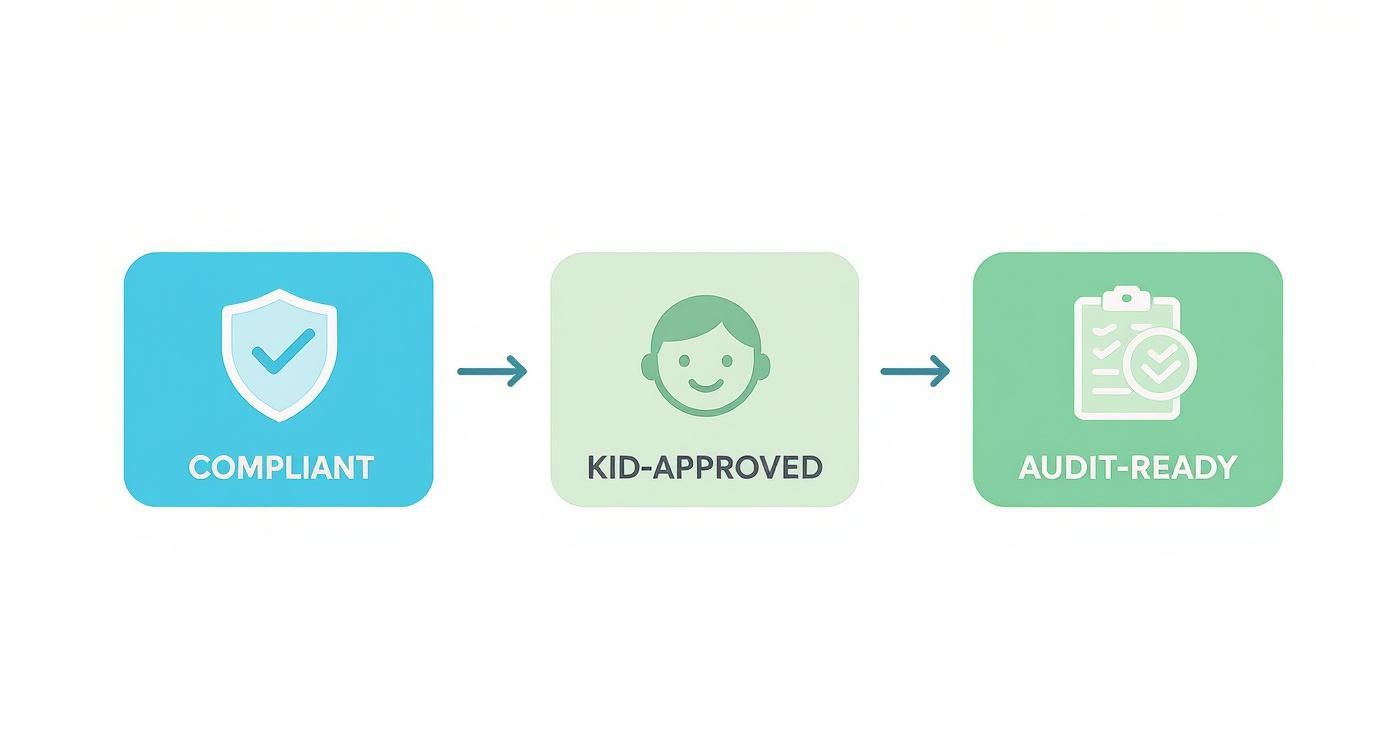
The main takeaway here is that these elements absolutely must work together. A compliant menu that kids won’t touch is just as useless as a popular menu that fails an audit.
Mastering Multi-Day Kits and Food Safety
If your program uses parent pick-up or home delivery, designing multi-day meal kits adds a whole new layer of complexity. Here, maintaining cold-chain integrity is non-negotiable. This means you have to guarantee that perishable items like milk, yogurt, and cheese stay below 41°F from the moment you pack them until they’re safely in a family’s refrigerator.
To pull this off, your kits need three key things:
- Insulated Packaging: Thermal bags or lined boxes are a must for maintaining temperature.
- Cold Packs: Always include gel packs or even frozen water bottles to keep the contents chilled during transit.
- Clear Instructions: Give parents simple, direct guidance on which items need to be refrigerated immediately. Don’t assume they’ll know.
Of course, a fundamental part of any meal program is ensuring your team has proper food handling knowledge. For a great refresher, your guide to food handler certificate training is an excellent resource to keep everyone’s skills sharp and your program safe.
Navigating the Buy American Provision
A critical, and often overlooked, piece of CACFP compliance is the “Buy American” provision. This rule requires you to purchase domestic agricultural commodities and food products to the maximum extent practicable. For audit readiness, ensure you maintain thorough documentation for any exceptions due to product unavailability or excessive cost.
Your procurement records need to show you’re making a good-faith effort to comply. A simple way to do this is by including specific language in your bids or purchase orders. Add a clause that says something like this:
“As a participant in the Child and Adult Care Food Program, we are required to adhere to the Buy American provision (7 CFR Part 250.23). All agricultural commodities and food products must be of domestic origin to the maximum extent practicable.”
If you absolutely must purchase a non-domestic product—maybe due to a huge cost difference or lack of availability—you need to document that justification thoroughly. Keeping these records organized is a simple but powerful habit that will make any audit go smoothly.
Step 3: Mastering Your CACFP Reporting
Let’s be honest, accurate records are the absolute backbone of your CACFP reimbursement. Without a rock-solid system, you’re looking at delayed payments or, even worse, being declared “seriously deficient.” This section is all about demystifying that reporting process, breaking it down into simple, real-world habits that will keep your program audit-proof and your funding secure.

The fear of a bad audit finding usually comes down to disorganized or incomplete paperwork. I’ve seen it time and again—the most common violations, like meal counts not matching attendance or serving non-compliant meals, are almost always preventable. Building a foolproof system isn’t just about dodging penalties; it’s about giving yourself operational peace of mind.
Setting Up a Foolproof Tracking System
Your daily habits are your first line of defense in any audit. Every single meal you claim has to be backed up by accurate, point-of-service documentation. That means recording the meal count as children are being served, not trying to piece it together from memory hours later.
For models like parent pick-up or home delivery, the workflow is different, but the principle is identical. You need a clear chain of custody.
- Parent Pick-Up: A simple sign-off sheet is your best friend. Parents or guardians acknowledge they received the meal kits for their child. That document is your point-of-service record.
- Home Delivery: Driver logs are essential here. They confirm delivery to the correct address. Some programs I’ve worked with even add a quick photo confirmation of the package at the doorstep for an extra layer of security.
No matter which method you use, these records have to be meticulously organized. To make this process less painful, it’s worth looking into how an AI document management system can help organize these critical files, making retrieval for an audit a breeze.
The golden rule is simple: if it isn’t written down, it didn’t happen. From an auditor’s perspective, a meal served without a corresponding record is a meal you never served at all.
Essential Templates for Daily Compliance
Consistency is born from standardized tools. Don’t let your staff invent their own tracking methods—that’s a recipe for disaster. Give them ready-to-use templates for the most critical daily tasks to ensure everything is uniform and accurate.
Your compliance toolkit should absolutely include:
- Daily Meal Count Forms: These need to be broken down by meal type (breakfast, lunch, snack) and age group. No exceptions.
- Attendance Sheets: A straightforward check-in/check-out log that you will reconcile against your meal counts daily.
- Menu Production Records: This is crucial. It shows what you planned to serve versus what was actually served, with clear notes on any substitutions.
- Inventory Logs: A basic log tracking food usage. This helps justify your procurement records and shows you’re using what you buy.
These documents are designed to work together, painting a full, compliant picture of your daily operations for anyone who comes to review them.
Conducting Internal Self-Audits
Why wait for a state agency to find problems? Proactive self-audits are one of the most powerful tools you have. I strongly recommend scheduling time each month to review your own paperwork with a critical eye, just like an official would.
When you do your self-audit, ask these key questions:
- Do meal counts match attendance records for every single day? Hunt for those tiny discrepancies. If 20 kids were present but you claimed 22 lunches, that’s an immediate red flag.
- Are all menus for the month complete and compliant? Double-check that every meal met the required component patterns for the specific age group served.
- Do you have receipts and invoices for all food purchases? Your procurement records must support your menu production records. There’s no way around it.
Catching and fixing a mistake yourself shows an auditor you’re diligent and committed to compliance. It lets you turn a minor issue into a corrected process before it becomes a systemic problem cited in an official review, protecting your program’s reputation and financial stability.
Step 4: Innovating with Technology and Cultural Menus
Once you’ve nailed down the fundamentals of compliance and efficiency, it’s time to take your program from good to genuinely exceptional. This is the moment you shift from simply meeting the rules to making your CACFP program a vibrant part of your center’s culture. Real innovation here springs from two key places: smart tech integrations that automate tasks and menu diversification that reflects the communities you serve.
These aren’t just flashy upgrades. They are strategic moves that can boost participation, get kids more engaged at mealtime, and free up your staff to do what they do best. The right tools and a thoughtful menu strategy can completely reshape your operation.
Choosing Your Tech Stack or Vendor
Manual paperwork is the biggest time sink for most CACFP providers. A smart technology stack can be a lifesaver, automating tasks like meal counts, compliance checks, and reimbursement claims. The strategy is to find a solution that fits your program’s scale and budget.
When evaluating vendors, consider these key strategies:
- Define Your Core Needs: Before you look at software, list your biggest pain points. Is it menu planning, reporting, or inventory? This list becomes your evaluation criteria.
- Prioritize Integration: Does the software integrate with your existing attendance or billing systems? A unified platform reduces duplicate data entry and errors.
- Request a Live Demo: Ask vendors to walk you through a typical day for your center. How would your staff log meals? How would you generate a claim?
- Check References: Speak with other providers of a similar size who use the software. Their real-world experience is more valuable than any sales pitch.
- Consider Scalability: Choose a solution that can grow with you. A system that works for one center should be able to scale to multiple sites without a complete overhaul.
For some operations, partnering with a Third-Party Logistics (3PL) provider is another key vendor decision. A food-grade 3PL specializes in food transport and cold-chain management, which is essential for multi-day kits. Exploring 3PL logistics solutions can help you decide if outsourcing logistics is the right move for your program.
A Lens on Innovation: Umoja’s Experience with Cultural Menus
Innovation isn’t just about software—it’s about what you put on the plate. A truly outstanding CACFP program reflects and celebrates the diverse backgrounds of the children you serve.
Umoja’s experience shows how culturally connected foods can be woven into fully compliant CACFP menus. This could be as simple as serving black beans and plantains, chicken curry with brown rice, or a hearty lentil soup. This approach goes beyond nutrition; it sends a clear message to children and families that their heritage is seen and valued. It also helps broaden palates and builds a positive, adventurous relationship with food from a young age.
The program’s scale is immense—in fiscal year 2024 alone, CACFP served approximately 4.4 million children daily, totaling around 1.7 billion meals. Eligibility for free CACFP meals is typically tied to households at or below 130% of the Federal Poverty Line, while reduced price meals are available for those up to 185%. By diversifying your menu, you honor this diversity directly.
As you introduce new cultural dishes, just make sure to keep compliance top of mind. For example, when exploring new recipes, a resource like Umoja’s U-Cloud platform can be a huge help for sourcing culturally relevant, shelf-stable ingredients that already fit within program guidelines. This thoughtful approach ensures your meals are not only delicious and compliant but also a meaningful reflection of your community.
Got Questions About Your CACFP Program? We’ve Got Answers.
Even when you’ve got a great system, running a CACFP program means you’re going to have questions. It just comes with the territory. Here, we’re tackling some of the most common challenges we hear about from providers in child care and after-school settings. Our goal is simple: give you practical, no-nonsense answers so you can get past these hurdles and back to what matters most—the kids.
Why Do Centers Fail CACFP Audits?
From what we’ve seen, the number one reason centers get dinged during CACFP audits almost always boils down to two things: incomplete paperwork and meal pattern errors. An auditor’s job is to connect the dots. If your documentation is a mess or, worse, missing, that’s an immediate red flag.
Think about the small stuff, because that’s what trips people up. A staff member forgets to log a last-minute menu swap, like using peas instead of green beans. Or maybe they grab a popular kids’ cereal that, it turns out, doesn’t meet the whole grain-rich standard. These seem like tiny slips in a busy day, but they can snowball into significant findings during a review.
Another classic pitfall is when your meal counts don’t perfectly match your attendance records. If the sign-in sheet says 15 toddlers were there for lunch, but your meal count form says you served 17, that’s a discrepancy that has to be explained and fixed on the spot.
The best defense against a bad audit is a simple system of daily double-checks. Before you lock up for the day, have a second pair of eyes quickly review all meal count forms against the attendance logs. This one habit can catch 90% of common errors before they become a real headache.
How Can I Make Meals More Appealing to Picky Eaters?
Winning over picky eaters is a long game of creativity, choice, and just plain consistency. You can’t force a child to eat something, but you can create an environment where they feel safe and curious enough to try new things. Let go of the “clean your plate” battles and focus on positive, no-pressure exposure instead.
Here are a few tactics we’ve seen work wonders in the real world:
- Pair the New with the Familiar: Never serve a plate of entirely new foods. Instead, put a small portion of something new, like roasted sweet potatoes, right next to a tried-and-true favorite like chicken nuggets.
- Let Them Build It Themselves: Deconstructed meals are a game-changer. Think “taco bar” style. Put the seasoned ground turkey, cheese, lettuce, and whole-grain tortillas in separate bowls and let the kids build their own. Giving them that sense of control is incredibly empowering.
- Make it Look Fun: Simple presentation tweaks can make all the difference. Use cookie cutters to make fun shapes out of sandwiches. Serve fruit on colorful skewers to create “fruit kebabs.” We eat with our eyes first, and this is doubly true for kids.
What’s the Best Way to Manage Food Costs?
Keeping food costs under control while staying compliant isn’t magic; it’s about smart planning and purchasing. The goal here is to stretch every dollar you have without ever sacrificing the quality and nutrition the kids need.
A great starting point is to implement a cycle menu that leans heavily on in-season produce, which is almost always cheaper and tastes better. That one change can make a huge dent in your grocery bills over time. Another powerful move is to join a group purchasing organization (GPO). These groups leverage the buying power of many centers to negotiate much better prices on staples like milk, grains, and proteins.
And, of course, minimizing food waste is non-negotiable. Use accurate meal count projections to avoid making too much food. Then, find compliant ways to repurpose leftovers. For example, extra roasted chicken from lunch can become a delicious chicken salad for snack the next day, making sure absolutely nothing goes to waste.
Is There Good Software for Smaller Providers?
Absolutely. The old idea that CACFP management software is only for huge sponsors with hundreds of sites is completely outdated. Many companies now offer flexible pricing plans designed specifically for smaller centers and even individual family day care homes. This puts powerful automation tools within reach without needing a massive budget.
When you’re looking at different options, focus on the core features that will save you the most time and prevent the most common mistakes.
- Automated Menu Compliance Checks: The software should instantly flag a meal if it’s missing a required component. No guesswork.
- Digital Meal Counts: Look for a simple, tablet-friendly interface your staff can actually use at the point of service.
- One-Click Reimbursement Claims: The best systems will automatically generate and format your claim file for your state agency, saving you hours of tedious work.
Always, always ask for a live demo to see the software in action. Even more important? Ask for references from providers who are about the same size as you. Hearing about their day-to-day experience is the single best way to know if a solution is truly the right fit for your program.
At Umoja Health, we provide culturally connected foods and the operational know-how to help you run a compliant, efficient, and impactful CACFP program. From multi-day kits to logistics support, we’re here to be your partner in nutrition. Learn more about our CACFP meal program solutions.