
Food security is more than just providing meals; it's about building resilient, healthy, and connected communities from the ground up. The most impactful community based food programs are intricate systems that weave together nutrition, logistics, compliance, and genuine human connection. But how do you move from a well-meaning idea to a scalable, compliant, and trusted operation? This article breaks down 10 proven models, moving beyond surface-level descriptions to offer a strategic blueprint for success.
We will dissect the operational nuts and bolts, providing actionable templates and workflows for a diverse range of professionals. Whether you are a state SFSP administrator developing rural non-congregate guidance, a CACFP sponsor managing multi-day meal kits, a WIC vendor manager piloting online benefits, or a managed care director evaluating Food-is-Medicine interventions, this guide provides targeted solutions.
We'll explore the tactical details, from mastering procurement with Buy American provisions and culturally-connected SKUs to managing complex cold-chain logistics and WMS/EDI integrations for kitting. Drawing on Umoja Health's experience in building local capacity, we will analyze real-world case studies to reveal how to overcome common implementation challenges. You will gain specific, replicable strategies for building the deep community trust essential for long-term program impact. These insights provide the practical framework needed to design and execute programs that truly nourish.
1. Community Supported Agriculture (CSA)
Community Supported Agriculture (CSA) represents a powerful, direct-to-consumer model among community based food programs. In a CSA, members pay an upfront subscription fee to a farm, essentially buying a "share" of the upcoming harvest. In return, they receive a regular box of seasonal produce throughout the growing season. This model forges a direct, transparent relationship between producers and consumers, providing farmers with crucial early-season capital and a guaranteed market.
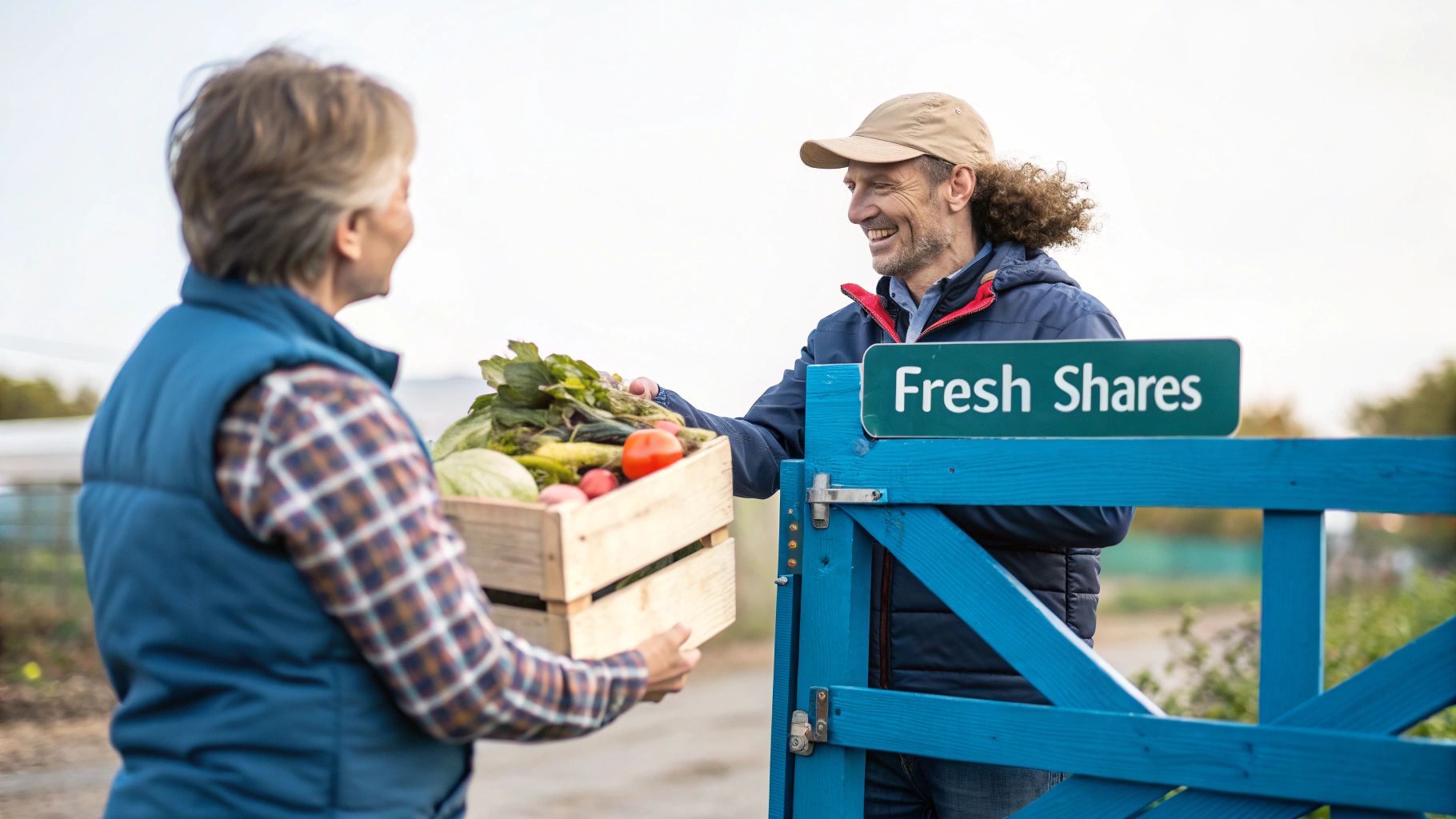
This structure stabilizes farm income, mitigating the risks of market fluctuations and unsold crops. For community members, CSAs offer consistent access to fresh, locally grown food, often at a lower cost than retail farmers' markets. The direct connection also builds trust and educates consumers about where their food comes from and the realities of seasonal agriculture.
Strategic Breakdown & Actionable Insights
Successful CSA programs often incorporate flexibility to meet diverse community needs. A key implementation challenge is ensuring equitable access, as the upfront cost can be a barrier. Successful models like Full Circle Farm CSA have scaled their delivery logistics, but true community integration requires more.
- Partnership Models: A key strategy involves partnerships with non-profits or public health agencies to accept SNAP/EBT benefits or offer cost-sharing options. This significantly broadens accessibility beyond affluent households, a common critique of early CSA models.
- Logistical Flexibility: Offering multiple pickup locations, home delivery options, and varied share sizes (e.g., individual vs. family) is crucial for retention. Case Study: Many CSAs partner with local businesses or community centers as drop-off points, reducing transportation barriers for members.
- Building Trust & Capacity: Umoja Health recommends that new programs build trust through transparent communication about crop plans, potential risks (like a failed crop), and growing practices. Hosting farm visit days or including newsletters with recipes in each box helps build an engaged community, increasing member capacity to use diverse, seasonal produce.
2. Community Gardens
Community gardens are another foundational model among community based food programs, transforming shared plots of land into vibrant centers for local food production. In these spaces, community members collaborate to grow vegetables, fruits, and herbs, either in individual allotments or communal plots. This approach directly empowers residents by giving them control over their food source, fostering self-sufficiency and enhancing neighborhood food security.
Beyond providing access to fresh, healthy produce, community gardens serve as crucial social hubs. They strengthen neighborhood bonds, facilitate intergenerational knowledge sharing, and create green spaces that beautify urban environments. This model is highly adaptable, ranging from small neighborhood lots to large-scale urban farms like the celebrated GreenThumb program in New York City.
Strategic Breakdown & Actionable Insights
Effective community gardens are built on strong governance and inclusive design. A primary implementation challenge is ensuring long-term sustainability and preventing volunteer burnout. Programs can partner with public health departments or housing authorities to integrate gardening into broader wellness and community development strategies.
- Governance and Accessibility: Establish clear rules, leadership roles, and conflict resolution processes. To maximize inclusion, create diverse bed designs, including raised beds for seniors or individuals with disabilities. Implementation challenge: Securing land tenure can be difficult; partnering with municipalities or land trusts is a key strategy for stability.
- Community Engagement: Case Study: The work of Ron Finley in South Central Los Angeles exemplifies how "guerilla gardening" can foster community pride and transformation. Success hinges on more than just planting; hosting workshops on composting or seed saving and celebrating harvests builds a strong, engaged community.
- Building Trust & Capacity: Umoja Health advises that building trust is paramount, especially in underserved communities. Start by engaging community leaders and elders to co-design the garden's layout and rules. This co-design process builds local capacity and ensures the project is owned and valued by the community it serves.
3. Food Banks and Food Pantries
Food banks and food pantries are cornerstone community based food programs, forming a critical part of the hunger-relief network. Food banks act as large, centralized warehouses that collect, store, and distribute massive quantities of donated and purchased food. They serve as the supply hub for smaller, front-line agencies, while food pantries are the direct distribution points where individuals and families receive food assistance.
This tiered model, pioneered by John van Hengel in 1967 and scaled by networks like Feeding America, allows for efficient sourcing and logistics to address immediate food needs. These programs are vital for vulnerable populations, providing a safety net for those experiencing food insecurity due to economic hardship. Their success hinges on robust volunteer networks, community donations, and corporate partnerships.
Strategic Breakdown & Actionable Insights
Modern food banks are evolving beyond simple emergency distribution. A key implementation challenge is moving from a charity model to one that promotes dignity and nutrition. Efficient storage is crucial; understanding options like warehouse steel buildings helps organizations scale operations.
- Dignity and Choice Models: Case Study: Many pantries are successfully transitioning from pre-packed boxes to a "choice pantry" model where clients select their own items. This significantly reduces food waste and increases dignity, empowering individuals and ensuring they receive food their families will actually eat.
- Integrating Nutrition: A key strategy is to partner with local farms for fresh produce donations and to implement "nudges" that promote healthier choices. Pairing food distribution with nutrition education workshops or cooking demonstrations adds significant value and builds community capacity for healthier eating.
- Building Trust & Capacity: Umoja Health recommends that growing programs build trust by creating welcoming, efficient distribution environments. Leveraging technology for client intake can improve workflow, reduce wait times, and create a more respectful experience, fostering a trusted relationship with the community.
4. Farm-to-School Programs
Farm-to-School programs represent a vital intersection of nutrition, education, and local economics within the ecosystem of community based food programs. These initiatives create direct supply chains between local farms and school cafeterias, ensuring students have access to fresh, seasonal, and minimally processed foods. The model is multifaceted, aiming not only to improve student nutrition but also to provide a stable, institutional market for local agricultural producers.
This approach transforms the school cafeteria into a hub for health and learning. By introducing children to new fruits and vegetables and connecting them to their food sources, programs like those supported by the National Farm to School Network cultivate lifelong healthy eating habits. For farmers, these partnerships offer reliable revenue streams and reduce the market volatility that often plagues small and mid-sized operations.
Strategic Breakdown & Actionable Insights
Effective Farm-to-School programs require robust partnerships. A significant implementation challenge is bridging the logistical and procurement gap between small farms and large institutional buyers. Success hinges on collaboration with food hubs or cooperatives to aggregate products and meet demand.
- Phased Implementation: A common challenge is overwhelming kitchen staff with new, unprepared produce. Successful programs often start small, introducing one or two local items like apples or carrots, and gradually expand as staff gains experience and new recipes are tested.
- Curriculum Integration: Case Study: The Berkeley Unified School District’s program is a benchmark example of integrating cafeteria offerings with classroom learning. Garden-based education, farm visits, or having farmers visit the school helps build student buy-in and reinforces nutritional concepts.
- Building Trust & Capacity: Umoja Health recommends building capacity by investing in professional development for food service staff. Training on how to prepare fresh, whole ingredients is critical for program sustainability. Building trust with farmers requires clear communication on procurement needs and payment schedules. Learn more about the frameworks that support child nutrition programs.
5. Community Kitchens and Commercial Kitchen Sharing
Community Kitchens and Commercial Kitchen Sharing programs provide access to licensed food preparation facilities for community members, small businesses, and non-profit organizations. This model acts as a crucial incubator, enabling food entrepreneurs to launch ventures without the prohibitive cost of building their own kitchens. It also empowers community groups to prepare meals at scale, teach cooking skills, and preserve local harvests.
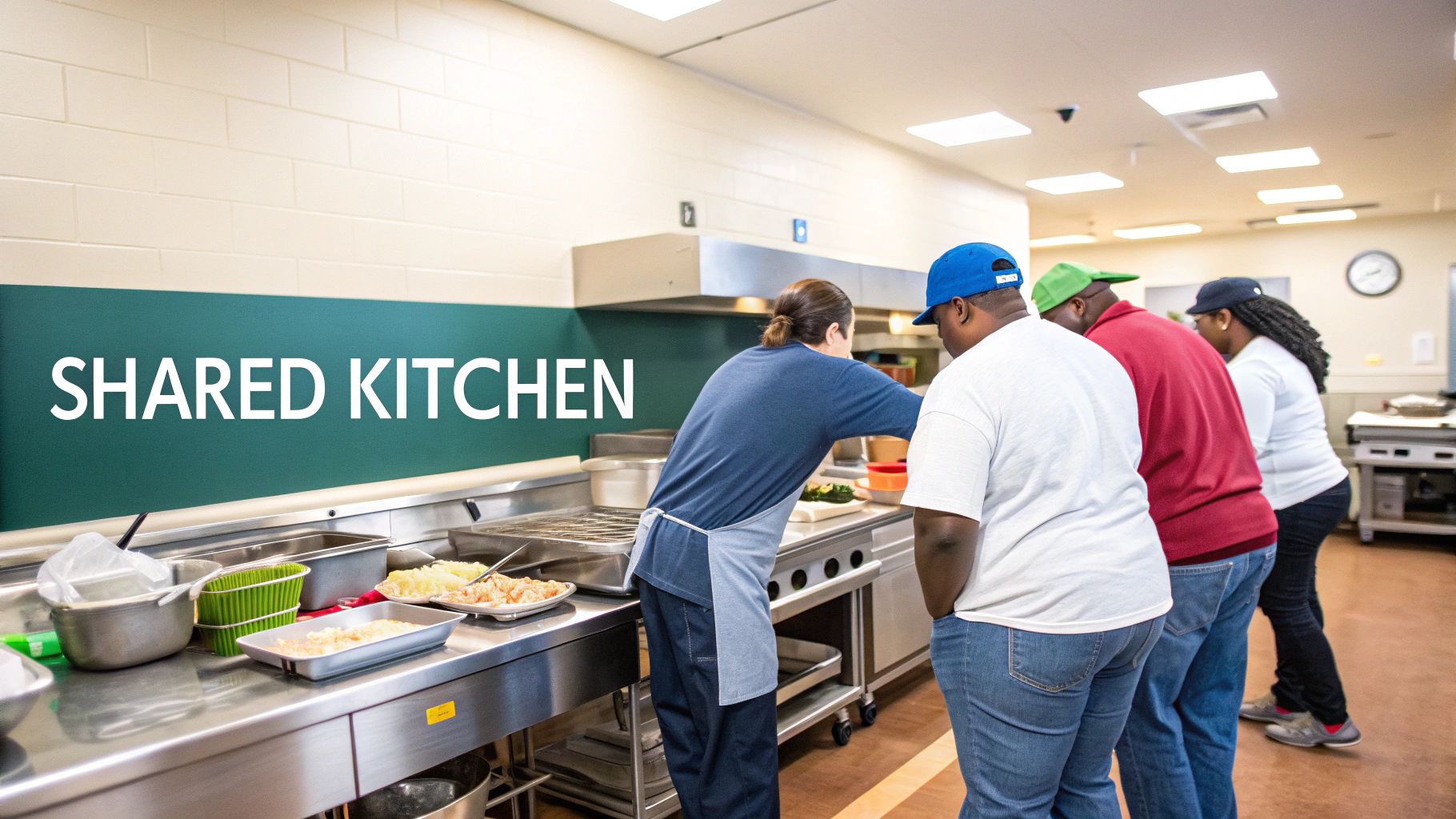
This infrastructure lowers the barrier to entry for food-based enterprises, fostering local economic development and job creation. For community based food programs, these shared spaces are vital for preparing meals for other initiatives, like food banks or home-delivery services. They become hubs for skill-building, social connection, and food system innovation, exemplified by initiatives like La Cocina in San Francisco.
Strategic Breakdown & Actionable Insights
Effective community kitchens are more than just spaces; they are ecosystems that support food safety, business development, and community resilience. The primary implementation challenge is managing the high operational costs and complex scheduling required to serve diverse user groups.
- Operational Excellence: A key to success is establishing clear, tiered rental rates and a user-friendly scheduling system. Providing mandatory food safety training ensures compliance and builds user competence. Investing in proper equipment, like commercial blast chillers, is crucial for maintaining food safety at scale.
- Entrepreneurial Support: Case Study: La Cocina focuses on providing affordable kitchen space and technical assistance to women, immigrants, and people of color. Beyond providing space, top-tier programs offer mentorship and business development workshops to build entrepreneurial capacity.
- Building Trust & Capacity: Umoja Health recommends building a strong community ethos by hosting shared cooking days and networking events. This transforms a functional space into a collaborative environment, fostering trust among entrepreneurs and creating a supportive network that enhances their capacity for success.
6. Farmers Markets
Farmers markets are quintessential community based food programs, serving as periodic, open-air marketplaces where local farmers, ranchers, and artisans sell their products directly to the public. These vibrant hubs, operating weekly or seasonally, foster a direct connection between producers and consumers, which strengthens local economies and increases access to fresh, nutritious food. This model allows small-scale agricultural producers to retain a higher percentage of their sales revenue compared to wholesaling.
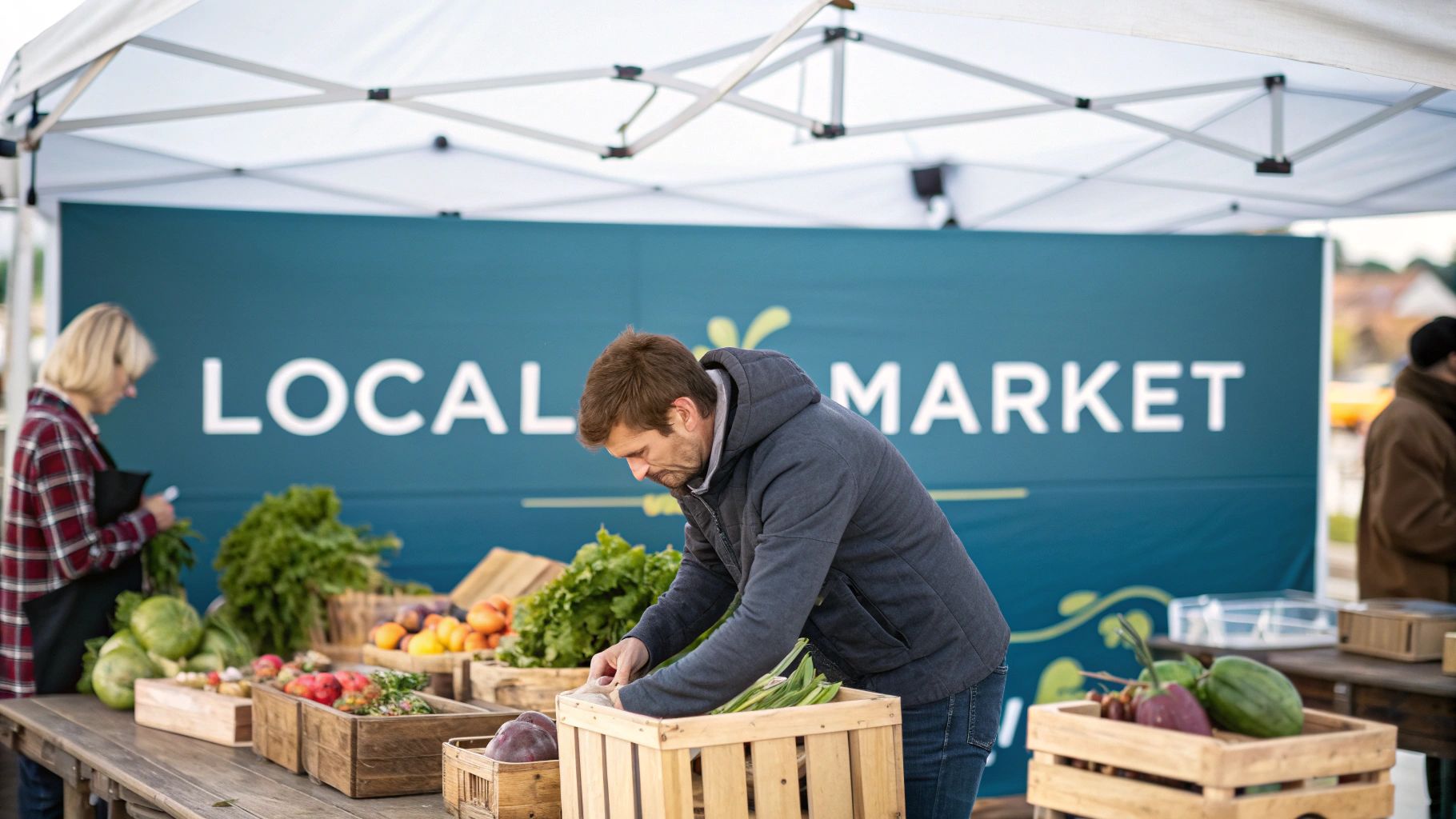
For communities, farmers markets provide a reliable source of high-quality, seasonal produce and create a festive, social atmosphere that builds neighborhood cohesion. They also serve as critical access points for federal nutrition assistance programs, empowering low-income families to purchase healthy foods. Iconic examples like the Union Square Greenmarket in NYC demonstrate how these markets can become landmark institutions, shaping a city's food culture.
Strategic Breakdown & Actionable Insights
Effective farmers markets evolve beyond simple transactions to become integral parts of a community's food security infrastructure. The primary implementation challenge is ensuring they are accessible and affordable for all community members, not just affluent shoppers.
- Integrating Nutrition Benefits: Case Study: Many markets successfully implement SNAP/EBT acceptance and participate in incentive programs like Double Up Food Bucks, which matches SNAP dollars spent on fruits and vegetables. This directly increases the purchasing power of low-income shoppers and drives sales for local farmers.
- Logistical & Community Hubs: To increase engagement, markets can host cooking demonstrations, kids' activities, and live music. Partnering with WIC clinics to host on-site benefit distribution or health screenings transforms the market into a holistic wellness hub, building capacity for healthier lifestyles.
- Building Trust & Producer Viability: Umoja Health recommends that market managers build trust by providing technical assistance to vendors on accepting different payment types. Transparent communication about farm practices builds consumer trust, while a reliable, welcoming market environment builds trust with producers, ensuring their continued participation.
7. Meal Programs and Community Kitchens (Nutrition-Focused)
Meal programs and community kitchens are foundational community based food programs that provide prepared, nutritious meals to vulnerable populations. These initiatives, ranging from large-scale operations like Meals on Wheels to smaller, local efforts run by faith-based groups, directly combat food insecurity and malnutrition, particularly for seniors, children, and low-income individuals. By offering hot or ready-to-eat meals, they remove barriers like lack of kitchen access, physical inability to cook, or limited nutritional knowledge.
Beyond nutrition, these programs serve as vital social hubs, reducing isolation and fostering community connection through shared meal experiences. They provide a dignified and consistent source of food, ensuring that the most at-risk community members receive not just sustenance but also a sense of belonging and care. This model is critical for public health, as it delivers targeted nutritional support while strengthening social safety nets.
Strategic Breakdown & Actionable Insights
Effective meal programs prioritize both nutritional quality and client dignity. A key implementation challenge is managing the logistics of sourcing, preparation, and distribution while maintaining a personal touch. Case Study: Meals on Wheels has mastered daily home delivery, creating a crucial touchpoint that serves as a wellness check for isolated seniors.
- Dignity-Focused Models: Move away from traditional "soup kitchen" lines by implementing restaurant-style service or choice-based menus. This empowers clients and creates a more respectful atmosphere, which is fundamental to building trust. Integrating social support services during meal times adds significant value.
- Volunteer Management: A robust volunteer strategy is essential. Implementation challenge: Preventing volunteer burnout is critical. Umoja Health recommends creating clear roles, providing ongoing support, and recognizing contributions to ensure consistent, compassionate service delivery that builds trust with recipients.
- Menu & Kitting Logistics: Implementing feedback systems allows for continuous menu improvement based on participant preferences and cultural needs, building capacity to serve diverse communities effectively. For take-home options, understanding the nuances of optimizing kitting programs is key.
8. Food Cooperatives (Co-ops)
Food Cooperatives (co-ops) are member-owned and democratically controlled grocery stores that serve their communities. Unlike traditional grocers, customers are also owners who invest in the store, participate in its governance, and often receive benefits like discounts or profit-sharing dividends. This model prioritizes community needs, ethical sourcing, and local economic reinvestment over maximizing shareholder profits.
This structure inherently builds community wealth and resilience. Profits are typically reinvested back into the store, used to support local producers, or returned to members. By giving community members a direct stake in their food source, co-ops create a powerful feedback loop that ensures the store's offerings reflect local preferences and values, from culturally connected SKUs to specific organic or bulk-bin products.
Strategic Breakdown & Actionable Insights
Successful food co-ops thrive on member engagement and sound business management. A major implementation challenge is securing the significant startup capital and membership commitment needed to launch and compete with traditional grocery stores.
- Governance and Participation: Case Study: The Park Slope Food Coop operates on a mandatory work-share model, which significantly lowers labor costs and deepens member investment. This highly engaged ownership base is fundamental to its long-term success and fosters a deep sense of community trust and shared responsibility.
- Operational Excellence: While community-owned, co-ops must be professionally managed. Investing in skilled general managers is non-negotiable. Building partnerships with networks like the National Co+op Grocers can provide vital operational support and group purchasing power, building the co-op's capacity to thrive.
- Building Trust: Umoja Health recommends that emerging co-ops focus on transparency from the outset. This includes open board meetings, clear financial reporting to members, and soliciting regular feedback. This transparent governance builds trust, which is the essential currency for a member-owned enterprise.
9. Food Rescue and Recovery Programs
Food Rescue and Recovery Programs are a cornerstone of community based food programs that tackle the dual problems of food waste and hunger. These organizations collect safe, edible surplus food from sources like grocery stores, restaurants, farms, and caterers that would otherwise be discarded. This recovered food is then sorted, stored, and redistributed to individuals and families facing food insecurity through a network of pantries, shelters, and other frontline agencies.
This model is incredibly efficient, redirecting nutritious food from landfills to dinner tables. Pioneers like City Harvest in New York City, founded in 1982, have demonstrated the immense scale possible, now rescuing over 75 million pounds of food annually. The model not only provides immediate relief but also promotes environmental sustainability by reducing methane emissions from decomposing organic waste.
Strategic Breakdown & Actionable Insights
Effective food rescue operations depend on robust logistics and strong partnerships. A significant implementation challenge is managing the logistics of a fast-moving, perishable supply chain while ensuring food safety.
- Donor Relationship Management: Building reliable relationships with food donors is paramount. Case Study: Organizations like Second Harvest build dedicated corporate partnership teams that establish clear pickup schedules and provide donors with impact reports, creating a trusted and predictable supply chain.
- Cold-Chain Infrastructure: Investing in refrigerated trucks and walk-in coolers is non-negotiable for handling perishable items. Maintaining a proper cold chain is a critical capacity that ensures food safety and quality, building trust with both donors and recipient agencies.
- Technology-Driven Logistics: Modern food rescue organizations use apps to match food donors with nearby agencies in real-time, create efficient routes, and track inventory. Umoja Health recommends leveraging these tools to build logistical capacity and maximize impact. Explore how a robust framework supports complex food distribution with Umoja Health's Unidad Logistics solutions.
10. Urban Agriculture and Rooftop Gardens
Urban Agriculture and Rooftop Gardens transform underutilized urban spaces like vacant lots, rooftops, and vertical walls into productive food-growing hubs. These community based food programs are vital for increasing access to fresh, nutritious produce directly within food-insecure neighborhoods. This model revitalizes urban landscapes, combining local food production with powerful community engagement and environmental benefits.
By growing food hyper-locally, these initiatives dramatically shorten the supply chain, reduce food miles, and build local resilience against disruptions. Programs like Gotham Greens in New York City demonstrate the commercial viability of rooftop farming, while grassroots efforts empower residents to reclaim their food systems, fostering food justice and creating green job opportunities.
Strategic Breakdown & Actionable Insights
Successful urban agriculture projects become centers for education and community building. The key implementation challenge is navigating municipal zoning codes and securing long-term land tenure, which can be a significant barrier to entry and stability.
- Zoning and Land Use: Proactive programs partner with city planning departments or land banks to establish formal use agreements. Case Study: In many cities, non-profits have successfully advocated for "urban agriculture incentive zones" that provide tax breaks to landowners who lease their vacant lots for cultivation.
- Integrated Program Design: Top-tier programs integrate multiple functions, such as combining a community garden with a youth employment program and a farm stand that accepts SNAP/EBT. This creates diverse revenue streams and deepens community value, building capacity for long-term financial health.
- Building Trust and Capacity: Umoja Health recommends that new programs build trust by co-designing the garden with community members to ensure it meets their needs and cultural preferences. Hosting workshops on urban growing techniques builds local capacity and ownership, which are crucial for the program's long-term success.
Community Food Programs: 10-Point Comparison
| Program | Implementation complexity | Resource requirements | Expected outcomes | Ideal use cases | Key advantages |
|---|---|---|---|---|---|
| Community Supported Agriculture (CSA) | Moderate — farm operations + subscription management | Farmland, labor, packing & distribution logistics, upfront capital | Stable farmer income; regular seasonal produce to members; stronger farmer-consumer ties | Local farms seeking direct-market sales; supporters of local food | Guaranteed revenue, fresh local produce, community engagement |
| Community Gardens | Low–Moderate — organize plots and governance | Land access, tools, volunteers, basic infrastructure | Local fresh produce, skill-building, social cohesion | Urban neighborhoods, community-building, food access projects | Low startup cost, social benefits, increased food security |
| Food Banks and Food Pantries | Moderate — inventory, storage, eligibility systems | Warehousing, cold storage, vehicles, volunteers, funding | Immediate food relief at scale; redistributes surplus food | Emergency food assistance; large populations facing food insecurity | Scalable reach, reduces waste, rapid response |
| Farm-to-School Programs | High — procurement, curriculum, kitchen upgrades | Coordination with farms, school kitchens, staff training, funding | Improved student nutrition, agricultural education, farm support | Schools aiming to improve meal quality and food education | Better child nutrition, hands-on learning, supports local farms |
| Community Kitchens & Commercial Kitchen Sharing | High — compliance, scheduling, management | Licensed kitchen space, commercial equipment, certification, staff | Enables food entrepreneurship, bulk/prepared food production | Small food businesses, social enterprises, community catering | Lowers entry barriers, builds skills, income generation |
| Farmers Markets | Low — periodic event organization | Vendor participation, public space, permits, marketing | Direct sales to consumers, local economic activity, community events | Small-scale producers seeking direct retail; neighborhood markets | Direct producer-consumer links, fresh products, community vibrancy |
| Meal Programs & Nutrition-Focused Community Kitchens | Moderate–High — meal planning, delivery, safety | Kitchen facilities, staff/volunteers, consistent funding, logistics | Reduced malnutrition, social connection, improved health outcomes | Seniors, homebound, low-income groups needing prepared meals | Nutritious meals, social support, targeted health benefits |
| Food Cooperatives (Co-ops) | High — governance, member engagement, management | Significant startup capital, retail space, committed membership | Member-driven access to local/organic foods, reinvested profits | Communities seeking democratic retail and local sourcing | Lower costs via purchasing power, member loyalty, community wealth |
| Food Rescue & Recovery Programs | Moderate — collection logistics and safety protocols | Transport, refrigeration, volunteer network, donor partnerships | Food waste reduction, redistributed nutritious food to needy | Urban areas with surplus from retailers/restaurants | Cost-effective supply, waste reduction, strong volunteer engagement |
| Urban Agriculture & Rooftop Gardens | High — site prep, permits, infrastructure needs | Rooftop/land access, growing infrastructure, startup funds, training | Local produce, job training, environmental co-benefits | Cities with vacant/roof spaces aiming for local production & jobs | Maximizes urban space, creates green jobs, environmental benefits |
From Blueprint to Reality: Building Your High-Impact Program
Throughout this guide, we've journeyed through the intricate landscape of community based food programs, deconstructing ten distinct models from community gardens to large-scale food rescue operations. We've moved beyond surface-level descriptions to dissect the strategic architecture that underpins their success: the operational logistics, the complex web of compliance, and the critical importance of program design. The core message is clear: impactful programs are not born from good intentions alone; they are meticulously built, managed, and refined.
The examples explored, from rural non-congregate SFSP delivery to medically tailored grocery programs for Managed Medicaid populations, underscore a universal truth. The most effective initiatives are those that master both the 'hard' and 'soft' infrastructure of food distribution. This means pairing robust logistics- a well-vetted 3PL, integrated WMS/EDI systems, and reliable cold-chain management- with the deep community trust essential for meaningful engagement.
Distilling Strategy into Action
The challenges highlighted are not deterrents but invitations to innovate. Navigating CACFP menu requirements with multi-day kits, ensuring OAA and Buy American compliance in procurement, or designing inventory-aware substitution logic for WIC online pilots are the crucibles where exceptional programs are forged. Success hinges on a commitment to operational excellence and a participant-centric mindset.
Your key takeaways should be rooted in this strategic duality:
- Compliance as a Foundation, Not a Ceiling: View federal and state regulations (SFSP, WIC, OAA) not as bureaucratic hurdles, but as frameworks for building equitable and accountable programs. Mastering these rules, from parent pick-up authorizations to cold-chain exceptions for milk, unlocks funding and ensures sustainability.
- Logistics as the Engine of Impact: Whether you are an emergency manager planning first-72-hours load plans or a food bank kitting culturally connected SKUs, your logistics chain dictates your reach and reliability. Strategic procurement, allergen-segregated storage, and volunteer-friendly kitting SOPs are non-negotiable components of a high-functioning system.
- Data as the Language of Trust and Growth: Effective programs measure what matters. From eligibility verification workflows to outcome surveys for Food is Medicine initiatives, robust reporting templates provide the evidence needed to build trust with funders, partners, and the communities you serve. This data becomes your story of impact.
Your Path Forward: From Concept to Community Nourishment
Translating these insights into a tangible program requires a deliberate, step-by-step approach. Begin by clearly defining the specific need within your community and selecting the program model that best aligns with your resources and goals. From there, build your operational blueprint, starting with procurement and ending with last-mile distribution.
Design flexible workflows that can adapt to different scenarios, such as no-fee home delivery versus centralized parent pick-up. Develop clear, standardized operating procedures (SOPs) for every stage, especially for complex tasks like kitting and inventory management. Most importantly, embed feedback loops into your process to continuously learn from participants and refine your approach. This iterative process, grounded in operational discipline and community connection, is the hallmark of a truly resilient and effective community based food program.
Ultimately, building these programs is about more than moving boxes. It's about constructing systems of dignity, health, and empowerment. By integrating the strategic elements we've discussed- from the granular details of pack lists to the high-level vision of community health- your organization can create a sustainable food system that nourishes, supports, and uplifts everyone it touches.
Ready to translate these complex operational blueprints into a seamless, scalable reality? Umoja Health provides the integrated platform to manage the logistics, compliance, and reporting for high-impact community based food programs, turning your strategic vision into on-the-ground success. Explore how our tools can streamline your operations and amplify your impact at Umoja Health.