
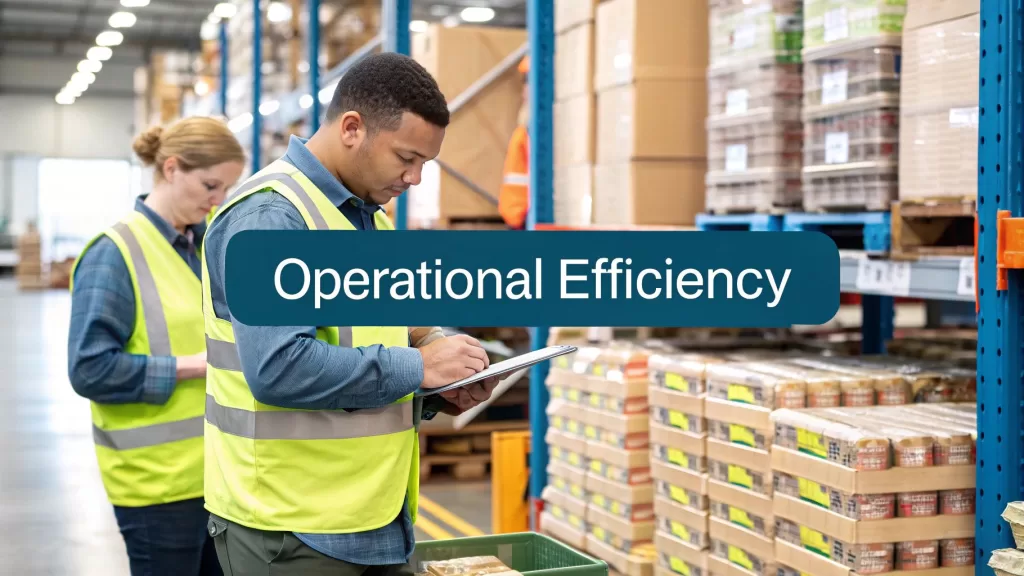
To really move the needle on operational efficiency, you first have to get brutally honest about where you are right now. That means creating a detailed map of your current workflows to shine a light on all the hidden bottlenecks and friction points slowing you down.
This isn't about documenting the "official" process from a dusty binder. It's about capturing what actually happens on the floor, day in and day out—every step, every handoff, every delay. Only by visualizing the real flow of work can you uncover the root causes of waste and establish a clear baseline for meaningful improvement.
Laying the Groundwork for Operational Excellence
You can't fix a problem you don't fully understand. That’s the entire idea behind process mapping, and it's the non-negotiable first step toward boosting your operation's efficiency. It forces you to move past assumptions and create a painfully clear picture of how work truly gets done in your food program or 3PL warehouse.
Think about tracking a multi-day meal kit destined for a childcare center. On paper, it looks simple. But in reality? There are probably unwritten rules, communication breakdowns between shifts, and spur-of-the-moment workarounds that gum up the works. These are the hidden friction points that quietly drain your resources.
Why Every Little Detail Matters
Process mapping is so much more than just drawing a flowchart; it's a full-blown investigation. Your goal is to capture the complete journey of your products and information, identifying every single touchpoint from the moment an order hits your EDI system to the final proof of delivery.
A recent study highlighted that for 74% of organizations, the biggest gains in process improvement come from automating manual tasks—but you can't automate what you haven't identified.
Your map needs to answer some tough questions:
- Who touches this? Make a list of every single person, team, or volunteer involved.
- What are the specific tasks? Get granular. Detail everything from picking an item and printing a label to loading a pallet.
- Where are the handoffs? Pinpoint the exact moments responsibility transfers from one group to another. These are prime spots for errors.
- How long does it all take? Start timing each step. This is where you'll find the unexpected delays that kill your timelines.
Once you have this level of detail, you have a powerful, visual framework for making smart changes.
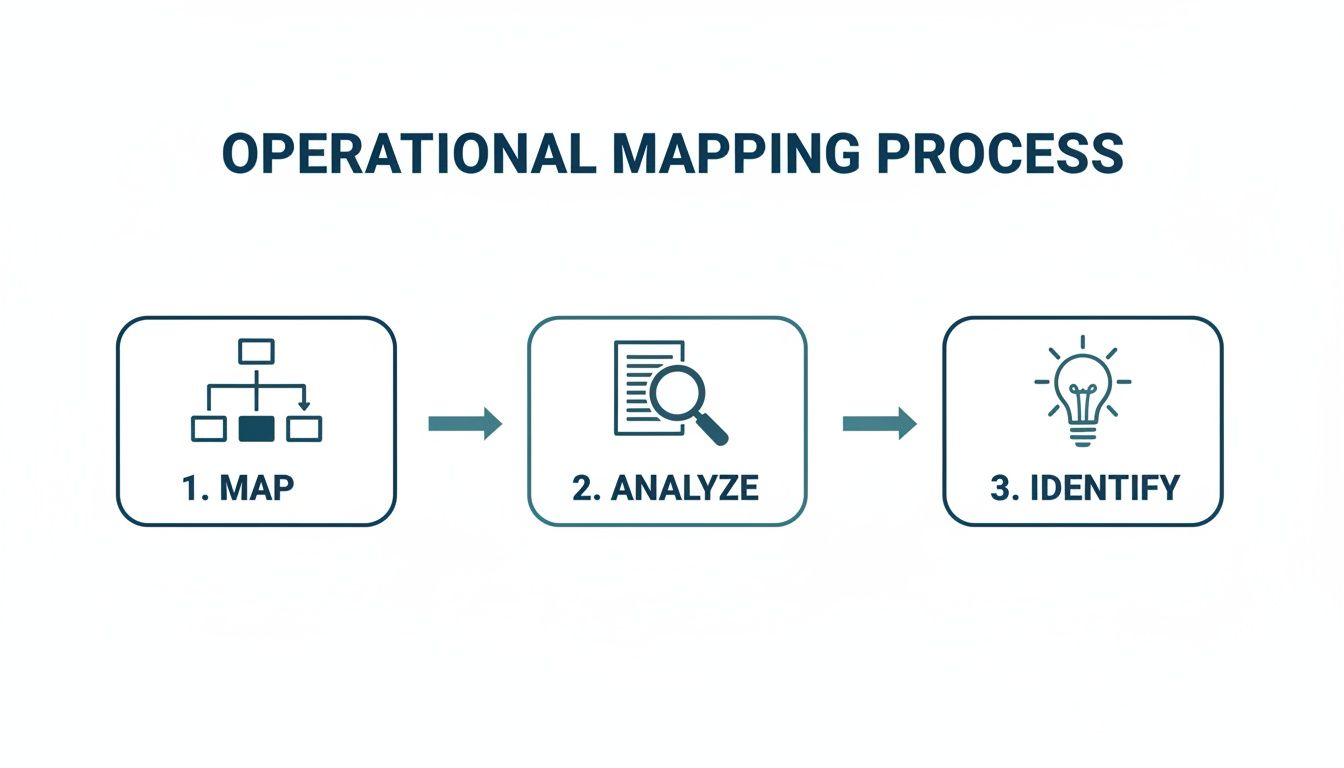
This visual shows the foundational sequence: map the current state, analyze it for weak spots, and identify high-impact opportunities. Following this path turns a messy, complex workflow into a clear roadmap for change, showing you exactly where to focus for the biggest wins.
To get started, it helps to know which workflows typically offer the most opportunity for improvement.
Key Operational Workflows to Map First
| Program / Operation Type | Critical Workflow to Map | Common Bottlenecks to Look For |
|---|---|---|
| Food Bank / Pantry | Inbound Receiving & Sortation | Manual data entry from donor forms, disorganized sorting areas, delays in getting food onto shelves. |
| 3PL Cold Chain | Outbound Order Picking & Staging | Inefficient pick paths, temperature zone transition delays, lack of pre-cooling for transport. |
| Meal Kitting Program | Assembly Line & Packing | Component stockouts, unclear packing instructions, bottlenecks at the final sealing/labeling station. |
| Disaster Relief | Volunteer Onboarding & Dispatch | Paper-based sign-ins, confusing role assignments, inefficient deployment to field sites. |
Prioritizing these areas can give you some quick wins and build momentum for broader operational overhauls.
Get Your Team to Uncover the Truth
The most accurate—and honest—process maps are always built with direct input from the people doing the work every day. Your warehouse pickers, program managers, and delivery drivers see things leaders simply can't from an office. Their firsthand knowledge is pure gold for uncovering the real-world inefficiencies.
"It’s important to get into the mud with your team and see what’s really going on. It gives managers a better insight into the technicalities of business processes—and the challenges your team face day-to-day."
When you bring the front line into the mapping process, you’re not just getting a better map; you're building buy-in for the changes that will come later. For a deeper dive into optimizing your physical workspace, check out these actionable strategies to boost kitchen workplace efficiency.
This foundational work is critical across all types of food distribution, especially in the complex world of running large-scale child nutrition programs. At the end of the day, this deep, honest look at your processes is the only way to build a solid foundation for every improvement that follows.
Selecting KPIs That Actually Drive Performance
Once you've mapped your processes, the next logical step is to figure out how to measure them. After all, you can't improve what you don't measure. But here’s the thing: not all metrics are created equal. Some look great on a report but do little to actually spark meaningful change on the warehouse floor.
Choosing the right Key Performance Indicators (KPIs) is where the rubber meets the road, turning your efficiency goals into tangible outcomes.
Vanity metrics, like the total number of boxes shipped in a month, might feel good, but they don't tell the full story. A huge shipment volume means very little if a good chunk of it arrives late, damaged, or with the wrong items inside. To really get a handle on operational efficiency, you need KPIs that give you specific, actionable insights into how you're really doing. It’s about focusing on the numbers that directly reflect the health of your core workflows.
Moving Beyond Vanity Metrics
The real goal here is to pick indicators that show you the "how" and "why" behind your results.
Let’s say you're a food bank manager running a senior nutrition box kitting line. The number of boxes you pack is one thing, but a far more powerful metric is your Kitting Accuracy Rate. This tells you the percentage of boxes packed with zero errors. A single number like that can instantly flag issues with volunteer training, how components are stocked, or the very setup of your assembly line.

In the same way, a 3PL handling urgent disaster response shipments needs to look past simple volume. For them, On-Time Shipping Rate and Dock-to-Stock Time are mission-critical. The first shows if you can meet tight deadlines, and the second reveals how fast you can get incoming aid processed and ready to go out—a crucial factor when every second counts.
Focusing on granular, process-driven KPIs shifts your perspective. You stop just looking at outcomes and start actively managing the performance that creates them. It's the difference between staring at the scoreboard and actually coaching the players on the field.
Essential KPIs for Food Operations and 3PLs
Here are a few high-impact KPIs that provide real, actionable data. Don't try to track everything at once. Just pick the two or three that line up with the bottlenecks you found during your process mapping.
-
Order Accuracy Rate: What percentage of orders are fulfilled perfectly—no wrong items, no incorrect quantities, no damage? A low number here points a giant, flashing arrow at problems in your picking and packing process.
-
On-Time Shipping: This calculates the percentage of orders that go out the door on or before the promised date. It’s a direct measure of your fulfillment speed and your ability to keep promises.
-
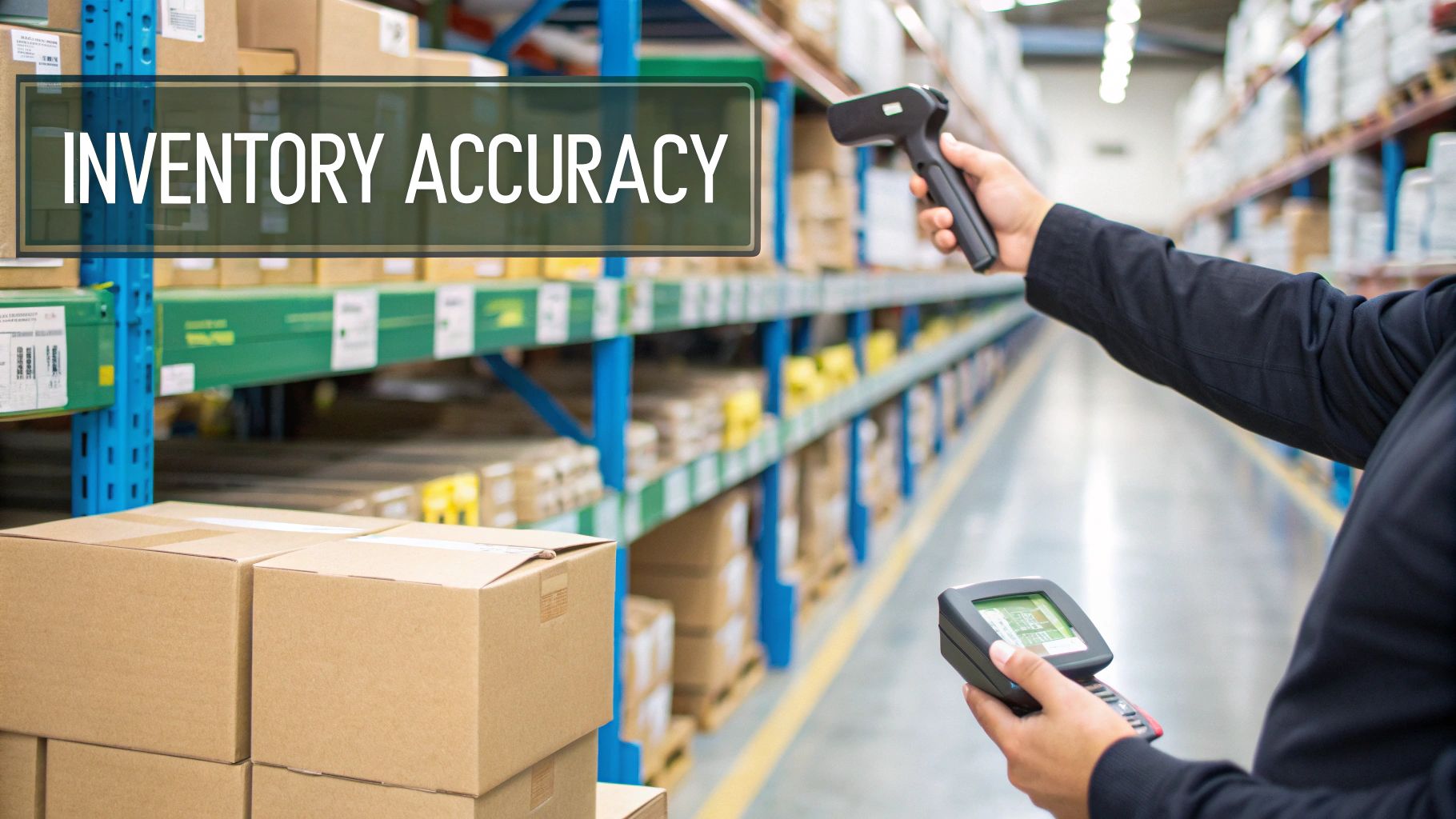
Inventory Accuracy: How well do your physical inventory counts match what your WMS or spreadsheets say? Bad data here leads to stockouts, people wasting time searching for items, and expensive rush orders.
-
Dock-to-Stock Time: This tracks the average time it takes for an inbound shipment to be received, processed, and put away. Shortening this time frees up dock space and gets inventory ready for fulfillment much faster.
The Power of Real-Time Visibility
Modern warehousing is quickly shifting toward unified platforms that give you a clear view of everything, from end to end. In fact, it’s predicted that by 2025, 72% of warehouses will make these tools a priority. The result? A projected 20% improvement in customer service metrics and the agility to handle sudden spikes in volume, like packing holiday nutrition kits.
Real-time inventory data closes the gap between manual counts and automated systems, helping to slash error rates in volunteer-driven kitting operations. You can find more details on how big data is shaping the industry in these key findings on warehouse operations.
This level of insight is a game-changer. A food bank procurement manager can confidently place orders for OAA-compliant senior boxes, knowing their inventory numbers are spot-on. CPG leaders vetting food-grade 3PLs can demand flawless EDI and WMS integration for total transparency.
The key is to turn this data into a daily decision-making tool. That’s where a good dashboard comes in. A simple, visual dashboard showing your core KPIs makes the information easy for everyone to understand, from the C-suite to the warehouse floor. It creates a shared sense of purpose and builds a culture of continuous improvement.
Optimizing Your Warehouse and Inventory Systems
Your warehouse is so much more than a storage space—it’s the beating heart of your entire food program. If you want to make a real, tangible improvement in operational efficiency, getting a firm handle on your Warehouse Management System (WMS) and inventory control is the place to start. A well-run WMS can all but eliminate costly picking errors, while smart inventory strategies prevent stockouts of your most critical items.
This isn't just about clicking buttons on a screen. It’s about building a cohesive system that transforms your physical space from a cost center into a powerful strategic asset. Whether you're tracking shelf-stable goods or managing complex kitting projects, dialing in your warehouse is the key to unlocking new levels of performance and reliability.
From Manual Chaos to WMS Control
For many growing organizations, there comes a breaking point. It’s that moment when spreadsheets and manual counts just can’t keep up with the volume and complexity of the operation. Implementing a solid WMS is what moves your team from being reactive to proactive, creating a single source of truth for every single item in your building.
A properly implemented WMS uses barcode scanning and real-time data to direct your team with absolute precision. No more wandering the aisles searching for a product. Instead, the system tells them exactly where to go and what to pick. This directed picking doesn't just speed up fulfillment; it drastically cuts down on human error—a critical factor when you're packing culturally specific nutrition kits or meal boxes with strict allergen considerations.
A modern WMS doesn't just track inventory; it orchestrates the entire flow of your warehouse. It’s the difference between navigating with a paper map and using a GPS that provides real-time traffic updates and the most efficient route.
For a 3PL, the benefits multiply, especially when it comes to integrating with partners. A good WMS is the bedrock for successful Electronic Data Interchange (EDI), which lets you automatically receive orders, send shipping notices, and invoice clients without a single manual keystroke. You can find robust solutions for food-grade 3PL storage and fulfillment that have these capabilities built right in.
Smart Inventory Strategies Beyond the Basics
Once your WMS is humming along, you can graduate to more advanced inventory strategies that cut down on waste and make sure you always have what you need on hand.
Two of the most effective methods are:
- Cycle Counting: Forget shutting down your entire operation for a massive annual inventory count. Cycle counting involves counting small, targeted sections of inventory on a rotating, daily basis. This continuous process delivers much higher inventory accuracy (up to 99.9% in some cases), flags problems faster, and completely eliminates operational downtime.
- FIFO (First-In, First-Out): For food products, this is non-negotiable. A WMS can enforce FIFO by directing pickers to the oldest lot numbers first, guaranteeing that shelf-stable goods are used well before they expire. It’s a simple discipline that has a massive impact on reducing spoilage.
When you combine these strategies with some basic demand forecasting—using past data to predict future needs—you can maintain perfect stock levels. This helps you avoid both the pain of stockouts and the financial drag of carrying too much inventory.
WMS Feature Impact on Operational Goals
Choosing the right WMS features is critical, but it can be hard to see how a specific function translates into real-world results. This table connects the dots, showing how specific WMS capabilities deliver tangible efficiency gains for food programs.
| WMS Feature | How It Boosts Efficiency | Example Program Application |
|---|---|---|
| Directed Picking & Putaway | Guides workers on the most efficient path through the warehouse, reducing travel time and errors. | A picker for a senior nutrition box program is sent directly to the correct bin for low-sodium canned vegetables. |
| Lot & Expiration Tracking | Enforces FIFO by automatically tracking lot numbers and expiration dates from receiving to shipping. | Prevents waste in a disaster response stockpile by ensuring older MREs are shipped out first. |
| Zone & Wave Picking | Groups orders by location or type, allowing multiple orders to be picked simultaneously in a single pass. | Multiple childcare center orders are grouped so a picker can grab all the shelf-stable milk for every order at once. |
| Real-Time Inventory Visibility | Provides an accurate, up-to-the-minute view of stock levels, accessible from any device. | A program manager confirms available inventory for a last-minute community food drive without having to call the warehouse. |
Ultimately, a well-chosen WMS is more than just software; it's a strategic tool that empowers your team to work smarter, faster, and with greater accuracy.
Mastering Your Kitting and Fulfillment Process
Your warehouse might be the heart of the operation, but the kitting line is where the magic really happens. For both food programs and 3PLs, this is where plans turn into tangible products. A well-designed fulfillment process isn't just nice to have; it's a massive driver of operational efficiency.
I’ve seen it firsthand: a disorganized, chaotic packing area wastes an incredible amount of time, creates errors, and hemorrhages money. This is especially true when you’re working with volunteers or pushing through high-volume projects.
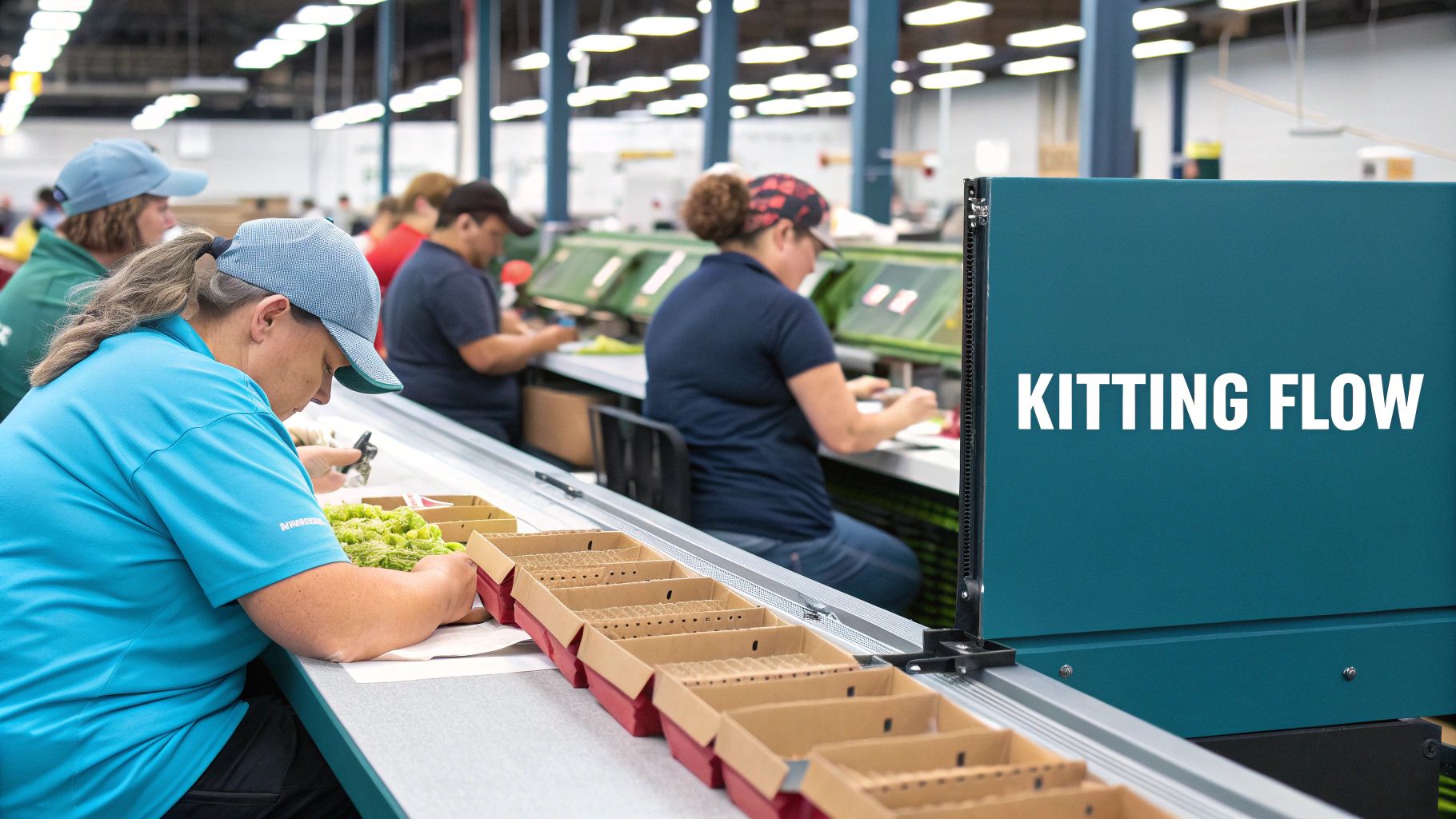
The goal is to build an assembly line so intuitive and clean that it slashes wasted movement and sends throughput soaring. This isn't just about speed. It’s about creating a predictable, high-quality output every single time, whether you're packing senior nutrition boxes for a local food bank or assembling complex multi-day meal kits for a childcare program.
Designing Your High-Throughput Assembly Line
The foundation of any great kitting process is its physical layout. Think of it like a Michelin-star kitchen—every station has a purpose, every tool is within arm's reach, and the workflow moves in one logical direction. You want to eliminate every unnecessary step, bend, and reach. These seem like small things, but they are energy and time vampires that add up dramatically over a shift.
Start by mapping out a dead-simple linear flow:
- Station 1 (Staging): This is ground zero. Empty boxes or bags are popped open and placed at the start of the line.
- Component Stations: Each station down the line is dedicated to one or two specific items. A pro tip: position the heaviest items at the beginning of the line so they naturally end up at the bottom of the kit.
- QC Checkpoint: Just before the final seal, a designated person gives each kit a quick visual scan to ensure nothing is missing. This is your safety net.
- Station 4 (Sealing & Labeling): The finish line. Kits get sealed, slapped with a label, and moved into a master case or onto a pallet.
By setting up the line this way, each person has a clear, repetitive task. This builds incredible speed and muscle memory. The design also creates a natural quality control system; a missing item sticks out like a sore thumb.
Visual SOPs and Ergonomics
The best kitting lines I’ve ever designed can be run by someone with just five minutes of training. How? With clear, visual Standard Operating Procedures (SOPs).
Forget dense text documents nobody reads. Use large photos or simple diagrams right at each station. Show exactly what item goes into the box and where it should be placed. This is an absolute game-changer when working with volunteer groups.
Ergonomics are just as crucial. Make sure your tables are at a comfortable height to reduce back strain. Angle your component bins for easy, scoop-and-drop access. Small things, like providing anti-fatigue mats, keep your team comfortable and focused, helping maintain pace through a long day. You can see the impact of these kinds of setups by exploring successful kitting programs and how they’re structured.
"Your goal should be to make the correct action the easiest action. An ergonomic station with a clear visual guide doesn't just make the work faster—it makes it harder to make a mistake."
Mastering Cold-Chain and Compliance
For many food programs, the real puzzle is managing temperature-sensitive items. Maintaining the cold chain isn't just a "best practice"—it's a critical compliance requirement that protects the health of the people you serve. One slip-up here can lead to massive product loss and put people at risk.
Your entire workflow must be built around one core principle: minimize the time that refrigerated or frozen items spend out in the open.
- Introduce Cold Items Last: Never, ever place cold items at the start of your assembly line. They should be added at the very last component station, right before the box is sealed.
- Use Pre-Chilled Coolants: Gel packs and other coolants need to be properly pre-conditioned to the correct temperature before they hit the line.
- Choose the Right Packaging: Select insulated liners or boxes rated to hold the required temperature for your entire transit time. A common and costly mistake is using packaging that isn't robust enough for the journey.
Build these steps directly into your visual SOPs. This ensures every single team member—whether they’re a seasoned pro or a first-day volunteer—understands how critical the cold chain is. This disciplined approach is fundamental to improving operational efficiency while guaranteeing food safety and compliance.
Building a Team That Drives Efficiency
Even the most sophisticated Warehouse Management System (WMS) is just a tool. It's useless without a well-trained and motivated team to actually run it. I can't stress this enough: your people are the true engine of your operation.
Investing in them—their training, their motivation, the culture you build—is a direct investment in your operational efficiency. This is where lasting improvements really take root, moving beyond just telling people what to do. You want to build a team that gets the why behind their actions, feels empowered to contribute, and actively looks for smarter ways to work.
Developing SOPs That Empower Your Team
Standard Operating Procedures (SOPs) often get a bad rap. People see them as restrictive, bureaucratic documents that just gather dust. But when done right, they're tools of empowerment. A great SOP provides clarity and ensures consistency, which are the cornerstones of an efficient operation.
The trick is to make them user-friendly and actionable. Forget those long, text-heavy binders nobody ever opens. Think visual.
- Use photos and diagrams. Show, don’t just tell. A simple picture of a correctly packed senior nutrition box is far more effective than a dense paragraph of text.
- Keep language simple. Write your instructions so a first-day volunteer can pick them up and understand them without needing to ask for help.
- Post them where the work happens. Laminate key SOPs and stick them right at the relevant workstations—the receiving dock, the kitting line, the cold-chain packing station.
This approach transforms SOPs from a chore into a reliable guidepost, drastically cutting down on errors and the time spent fixing them.
Training That Truly Sticks
An effective training program is critical, especially when you're dealing with complex compliance rules like allergen handling or Buy American provisions. The goal isn't just to check a box. It's to make sure every single team member deeply understands their role and how it impacts the larger mission.
This means going way beyond a single orientation day. You need a multi-faceted approach.
- Hands-On Mentoring: Pair new hires or volunteers with your seasoned pros who can provide real-time guidance right on the floor.
- Regular Micro-Trainings: Run short, 10-minute huddles at the start of a shift to review a specific process, like new labeling requirements for a CACFP kit.
- Cross-Training: This is a big one. Teach employees skills from other departments. A picker who understands the receiving process is much better equipped to spot and flag upstream errors before they become bigger problems.
Investing in your team's growth, especially your leaders, is paramount. You might even consider exploring resources like executive coaching and leadership training programs to build a truly high-performing, agile workforce.
Fostering a Culture of Continuous Improvement
The most efficient operations I’ve ever seen are the ones where every team member feels like an owner of the process. Your frontline staff are the first to notice the small frictions and bottlenecks that leaders might miss from their vantage point.
Creating a culture where their insights aren't just welcomed but actively sought out is a massive efficiency multiplier.
"It’s important to get into the mud with your team and see what’s really going on. It gives managers a better insight into the technicalities of business processes—and the challenges your team face day-to-day."
Encourage this by setting up a simple system for suggestions. A whiteboard in the breakroom or a dedicated chat channel can work wonders. When an idea gets implemented, celebrate that person's contribution publicly. This creates a powerful feedback loop, motivating everyone to keep their eyes open for the next small tweak that could save seconds, minutes, or even hours.
This is how you turn your workforce into your greatest operational asset.
Common Questions About Boosting Operational Efficiency
Even with a solid plan, the road to better operational efficiency always has a few bumps and questions along the way. Let's dive into some of the most common things that come up for program managers and logistics leaders when they start putting these ideas into practice.
The goal here is to give you straight answers to the real-world problems that inevitably pop up, so you can move forward with confidence.
How Do I Get Buy-In from Staff Who Are Resistant to Change?
This is probably the biggest hurdle you'll face. The secret is to stop thinking of it as a top-down mandate and start treating it as a team project. Your frontline people—the warehouse pickers, kitting leads, and drivers—are the true experts in their own workflows. They know exactly what's broken.
So, instead of just dropping a finished solution on them, bring them into the process from day one. When you’re mapping out how things currently work, make sure they are in the room. Ask them point-blank: "What's the most frustrating part of your day?" and "If you had a magic wand to fix one thing, what would it be?"
When people feel like their voice is heard and they see their own ideas in the new process, they go from being roadblocks to being champions. Suddenly, it's their solution, not just another order from management.
Another great move is to start small with a pilot program. Pick one self-contained process and a team that seems open to new ideas. Once you get a clear win, even a small one, you can broadcast that success story. It builds momentum and makes the skeptics start to wonder what they're missing out on.
What's the First Thing to Fix If My Budget Is Extremely Limited?
When cash is tight, you have to hunt for the biggest impact at the lowest cost. Almost without fail, the best place to start is by eliminating wasted motion and getting organized. This costs you more in brainpower than it does in dollars.
Take a good, hard look at the layout of your warehouse or kitting area. Are your most popular items right next to the packing stations? Or are your people walking hundreds of extra steps every single hour? A simple reorganization, maybe after drawing a "spaghetti diagram" to track how people move, can save a shocking amount of time for virtually zero cost.
Communication is another gold mine for free improvements. Misunderstandings between shifts or departments are a factory for errors and rework. You can fix a lot of this with simple, free tools:
- Daily Huddles: A quick, 10-minute stand-up meeting to kick off each shift and get everyone aligned on the day's priorities.
- Shared Digital Checklists: A basic Google Sheet can ensure critical tasks (like pre-cooling a truck) are never forgotten.
- Visual Management Boards: A simple whiteboard showing daily KPIs or order status keeps the whole team on the same page, at a glance.
These kinds of small, process-based tweaks can deliver huge gains in efficiency without ever touching your budget.
How Long Does It Take to See Real Results from These Changes?
The timeline really depends on the scale of what you're changing. You can see some wins almost instantly, while others require more patience.
For instance, reorganizing your kitting line for better flow can boost your output that very same day. Using clear, visual SOPs for a volunteer packing event will cut down on errors during that event. These are the quick victories that build confidence and keep everyone motivated.
On the other hand, putting in a new Warehouse Management System (WMS) is a major project. You might not see the full benefit to your inventory accuracy or picking speed for several months. It takes time for the team to get trained and for the system to gather enough data to be truly powerful.
The key is to set realistic expectations. Track both your leading indicators (like how quickly the team adopts a new scanning process) and your lagging indicators (like the quarterly improvement in order accuracy). And make sure you celebrate the small, early wins—they provide the fuel for the longer-term projects.
Is Investing in a WMS Worth It for a Smaller Operation?
This question comes up all the time, and the answer is increasingly "yes." It used to be that a WMS was only for giant distribution centers. Not anymore. With modern, cloud-based solutions, a WMS is now within reach for operations of all sizes, and the value is absolutely there.
Don't just think of it as software. Think of it as a system for forcing discipline and accuracy into your inventory. For a food bank, this means slashing spoilage by making First-In, First-Out (FIFO) picking the default. For a 3PL handling food products, it delivers the rock-solid lot traceability you need for compliance and recalls.
A WMS can almost completely wipe out the time your team wastes hunting for lost pallets. It gives you the real-time data you need to make smart purchasing decisions and avoid running out of crucial kit components. Yes, there's an upfront cost, but the long-term payoff from fewer errors, less waste, and more productive staff usually makes it a clear win.
At Umoja Health, we design and manage compliant, efficient food programs and logistics solutions that are built to scale. Whether you’re dealing with culturally connected senior nutrition kits, complex meal packs for childcare centers, or need FDA-registered 3PL services, we build the systems that deliver. Find out how we can help you feed more people and run a better program.