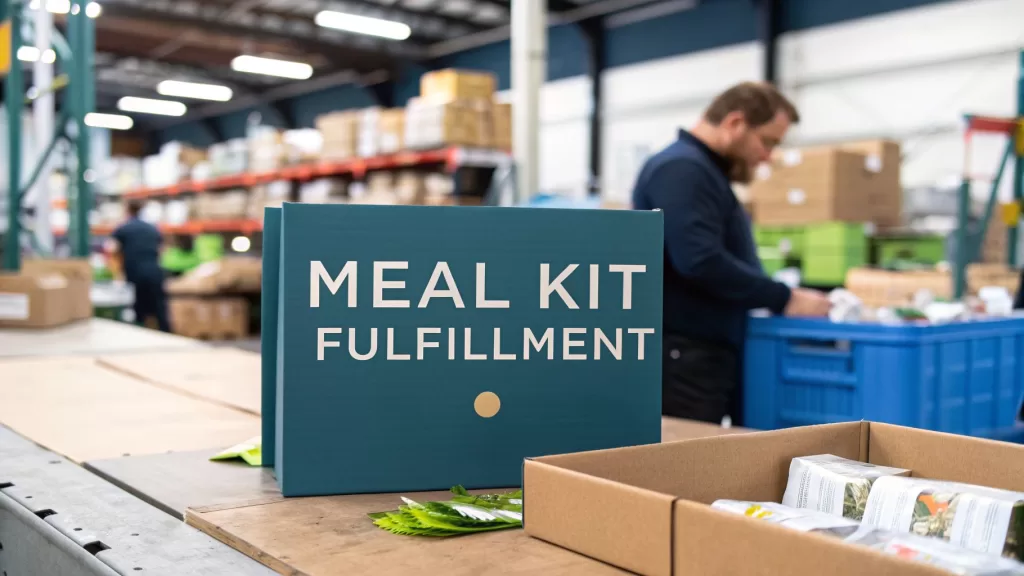
Picture a massive catering operation that also has to be an expert in nationwide logistics, navigate a maze of government regulations, and perfect last-mile delivery. When you put all that together, you've got the heart of institutional meal kit fulfillment services.
This isn't your typical direct-to-consumer meal box. This is the operational engine humming behind the scenes for government agencies, healthcare providers, and nonprofits that run large-scale food programs. For these organizations, fulfillment is more than just packing food into boxes. It’s a strategic partnership, one built to execute a specific mission—from the first conversation about the contract all the way to the final, gentle placement of a box on a participant's doorstep.
The Journey of a Meal Kit: From Contract to Doorstep
The real work starts long before a single ingredient is ordered. It's a carefully choreographed dance, making sure every single meal meets tough program rules and safety standards. This journey, from initial agreement to final delivery, is the core of how institutional meal kit fulfillment services operate.
Phase 1: Consultation and Contract
It all kicks off with a deep dive, a detailed consultation to map out the entire program. What are the participants' dietary needs? What specific compliance mandates must be met? What is the delivery frequency and geographic scope? Getting this right from the start is absolutely crucial for setting clear expectations and building a smooth workflow. Once everyone’s on the same page and the contract is signed, the fulfillment partner kicks into high gear.
A Look Inside Umoja’s Experience: A state agency once came to us with a huge challenge: launch a Summer Food Service Program (SFSP) for kids in rural, non-congregate areas in less than 60 days. That initial planning phase was a blur of activity. We were on daily calls, hammering out everything from USDA-approved menus and sourcing Buy American ingredients to charting out delivery routes across three far-flung counties. That intense upfront work was the secret sauce that made a successful, on-time launch possible.
Phase 2: Sourcing and Operations
After that critical planning phase, the process follows a series of well-oiled steps:
- Sourcing and Procurement: Your fulfillment partner taps into its supply chain to find high-quality, compliant ingredients. This often means working with very specific vendors to meet regulations like the Buy American provision.
- Receiving and Quality Control: As soon as ingredients hit the warehouse, they go through a tough inspection. This includes temperature checks for anything perishable and a close look for any damage or contamination.
- Kitting and Assembly: This is where the magic really happens. Assembly lines are set up to pack each meal kit with military precision. For institutions, this demands incredible accuracy, since different people might get custom kits based on their health needs or specific program track. Our detailed guide on successful kitting programs digs much deeper into this complex process.
Phase 3: Packaging and Last-Mile Delivery
- Packaging and Labeling: Every kit gets packed into temperature-controlled packaging. It's then labeled with all the essentials: nutritional facts, allergen warnings, and, of course, the recipient's information.
- Shipping and Last-Mile Delivery: Finally, the kits are sent out through a cold-chain logistics network. This ensures they stay at a safe temperature all the way until they land at the participant's home, completing the journey from concept to doorstep.
The Operational Pillars of Fulfillment Services
To really get how institutional meal kit fulfillment works, you have to look under the hood. It’s not just one thing; it’s a series of interconnected pillars that hold up the weight of large-scale food programs. Nailing each one isn't just a goal—it's non-negotiable for delivering on your mission.
The growth here is impossible to ignore. The global meal kit market was valued at about USD 28.43 billion in 2024 and is expected to rocket to around USD 105.03 billion by 2034. That explosion shows just how much organizations now rely on specialized partners to handle the complex, messy business of food logistics.
The infographic below really clarifies how these core pillars—logistics, assembly, and compliance—all fit together.
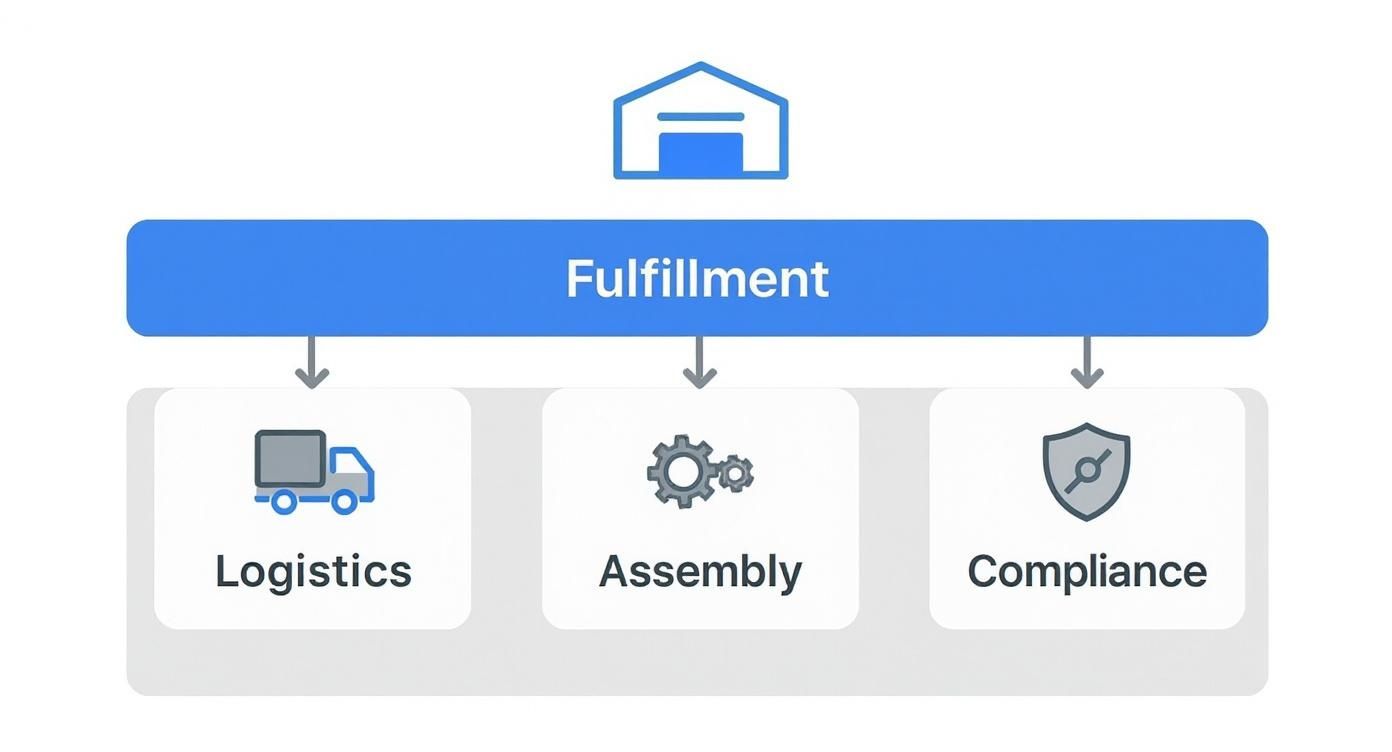
As you can see, it's a balanced system. You can’t have great logistics without precision assembly, and neither works without strict compliance. They have to operate in harmony.
Let's break down exactly what that looks like in practice. Here are the core services that make up a complete meal kit fulfillment operation.
Key Components of Institutional Meal Kit Fulfillment
| Component | Function | Why It Matters for Institutions |
|---|---|---|
| Third-Party Logistics (3PL) | Manages warehousing, inventory, and shipment coordination. | Provides the physical space and operational intelligence to handle thousands of SKUs and track expiration dates. |
| Precision Kitting | The hands-on process of assembling individual items into complete meal kits. | Ensures 100% accuracy for programs with strict nutritional requirements, like WIC or diabetes management. |
| Technology Integration (WMS/EDI) | The digital systems that track inventory and automate data exchange. | Offers real-time transparency into inventory and orders, eliminating manual errors and providing auditable records. |
| Cold-Chain Logistics | A temperature-controlled supply chain for perishable goods. | Guarantees food safety from the warehouse to the participant's doorstep, which is critical for program integrity. |
| Specialized Packaging | The use of insulated boxes, gel packs, and protective materials. | Protects food quality and safety during transit while also managing costs and environmental impact. |
Each component is a link in the chain. When they all work together seamlessly, you can deliver safe, accurate, and timely food to the people who need it most.
The Strategic Hub: Third-Party Logistics
At the heart of any solid program is a Third-Party Logistics (3PL) operation. Think of the 3PL as the air traffic control tower for your entire initiative. They’re the ones managing everything from warehousing and inventory to coordinating the final shipments.
For institutional buyers, this is so much more than just a place to store boxes. A great 3PL partner brings the operational brainpower to handle thousands of different items (SKUs), meticulously manage expiration dates, and account for every single ingredient from the moment it arrives to the moment it leaves.
The Science of Assembly: Precision Kitting
If the 3PL is the hub, then kitting is the hands-on assembly science. This is the incredibly detailed work of picking, portioning, and packing individual ingredients into a finished meal kit. In the world of institutional programs, this process demands absolute accuracy.
A WIC program, for instance, might need kits with very specific amounts of infant formula, produce, and whole grains based on a family's benefits. One small mistake can throw off the nutritional value and put the entire box out of compliance.
From Umoja's Experience: For a large-scale diabetes food-as-medicine program, our kitting teams assemble over 2,000 customized grocery boxes every week. Each box is built for a specific participant's dietary plan, with items like low-glycemic grains, fresh vegetables, and lean proteins. Our process includes multi-point verification to ensure every single box is 100% accurate before it leaves our facility.
The Digital Backbone: Technology Integration
Technology is the nervous system connecting all these moving parts. The two most critical systems are:
- Warehouse Management Systems (WMS): This software gives you a real-time, bird's-eye view of all your inventory. It tracks every item, manages where it’s stored, and tells warehouse staff exactly what to pick to keep things efficient.
- Electronic Data Interchange (EDI): EDI is what lets computer systems talk to each other automatically. It seamlessly exchanges information like purchase orders and shipping notices between you and your fulfillment partner, cutting out manual errors and saving huge amounts of time.
For program managers, these tools deliver incredible transparency. A good WMS is your single source of truth, offering live tracking that ensures accountability and gives you real peace of mind.
The Unbreakable Promise: Cold-Chain Logistics
Finally, there’s cold-chain logistics—the unbreakable promise of food safety. This is a highly specialized supply chain designed to keep perishable foods inside a specific temperature range, from the minute they hit the warehouse to the second they land on a participant’s doorstep.
This involves refrigerated storage, insulated packaging with gel packs, and temperature-controlled delivery vans. We use data loggers for continuous temperature monitoring, which creates an auditable record proving that the food has stayed safe for the entire journey. As part of this, there's also a growing focus on finding practical alternatives to single-use plastics for packaging to reduce our environmental footprint without ever compromising on safety.
Navigating Complex Regulatory and Compliance Mandates
When you're running an institutional program, compliance isn’t just another box to check. It's the very foundation of your trust, your funding, and your mission.
Unlike a direct-to-consumer service, meal kit fulfillment services for government and healthcare partners operate inside a tangled web of regulations. A misstep here doesn't just risk a bad review—it can put an entire program on the line.
This world demands more than just a logistics provider. It demands a true compliance expert, someone who lives and breathes the nuances of federal food programs and can build an entire operation around them. Every single step, from sourcing an ingredient to assembling the final meal, has to be documented, auditable, and perfectly aligned with specific rules.
Mastering Federal Program Requirements
Most institutional food programs are funded with federal dollars, and that money comes with strict, non-negotiable strings attached. Your fulfillment partner absolutely must have proven experience with these rules, because even tiny errors can snowball into major compliance headaches.
Here are a few of the big ones:
- The Buy American Provision: This is a big deal for schools and institutions in the National School Lunch and Breakfast Programs. It requires them to buy domestic agricultural commodities. A fulfillment partner has to provide crystal-clear documentation tracing every ingredient's origin to prove they are meeting this standard.
- CACFP/SFSP Meal Patterns: The Child and Adult Care Food Program (CACFP) and Summer Food Service Program (SFSP) have incredibly specific meal pattern requirements. They dictate the exact components and portion sizes needed for a meal to be "creditable" for reimbursement. No wiggle room.
- WIC-Approved Food Lists: Programs for Women, Infants, and Children (WIC) use state-specific lists of approved foods. A fulfillment partner has to build kits using only these items, manage inventory for specific brands, and know exactly how to handle substitutions when an approved item is out of stock.
These regulations are precisely why meticulous sourcing and kitting are mission-critical. Your partner must have systems that guarantee a CACFP kit for a childcare center has the exact amount of grain, protein, and milk required. You can see how this plays out in the operational details of compliant child nutrition programs that depend on this level of precision.
The Intersection of Food Safety and Program Rules
Things get even more complicated when federal program rules collide with universal food safety regulations. A partner has to follow mandates from both the USDA and the FDA at the same time, which creates a dual layer of operational oversight. It means every process has to be designed to make multiple agencies happy.
A Umoja Story of Dual Compliance: We partnered with a large childcare sponsor to deliver multi-day CACFP meal kits to hundreds of sites. The challenge was twofold: each kit had to meet strict CACFP meal patterns—including fluid milk—while also following FDA cold-chain requirements to ensure that milk arrived safely below 41°F.
Our solution involved validated cold-chain packaging, temperature data loggers in every single shipment, and a delivery network trained in food safety protocols. It’s a perfect example of how a fulfillment partner has to be fluent in both USDA program rules and FDA safety science to get the job done right.
Building a Culture of Compliance
At the end of the day, successful compliance isn't about a single checklist. It’s about building an operational culture where getting it right is second nature.
This means rigorous staff training, regular internal audits, and rock-solid documentation systems that create a clear, auditable trail for every ingredient and every single kit. It’s this deep commitment to the details that separates a simple logistics vendor from a true institutional partner.
Seeing Meal Kit Fulfillment in Action
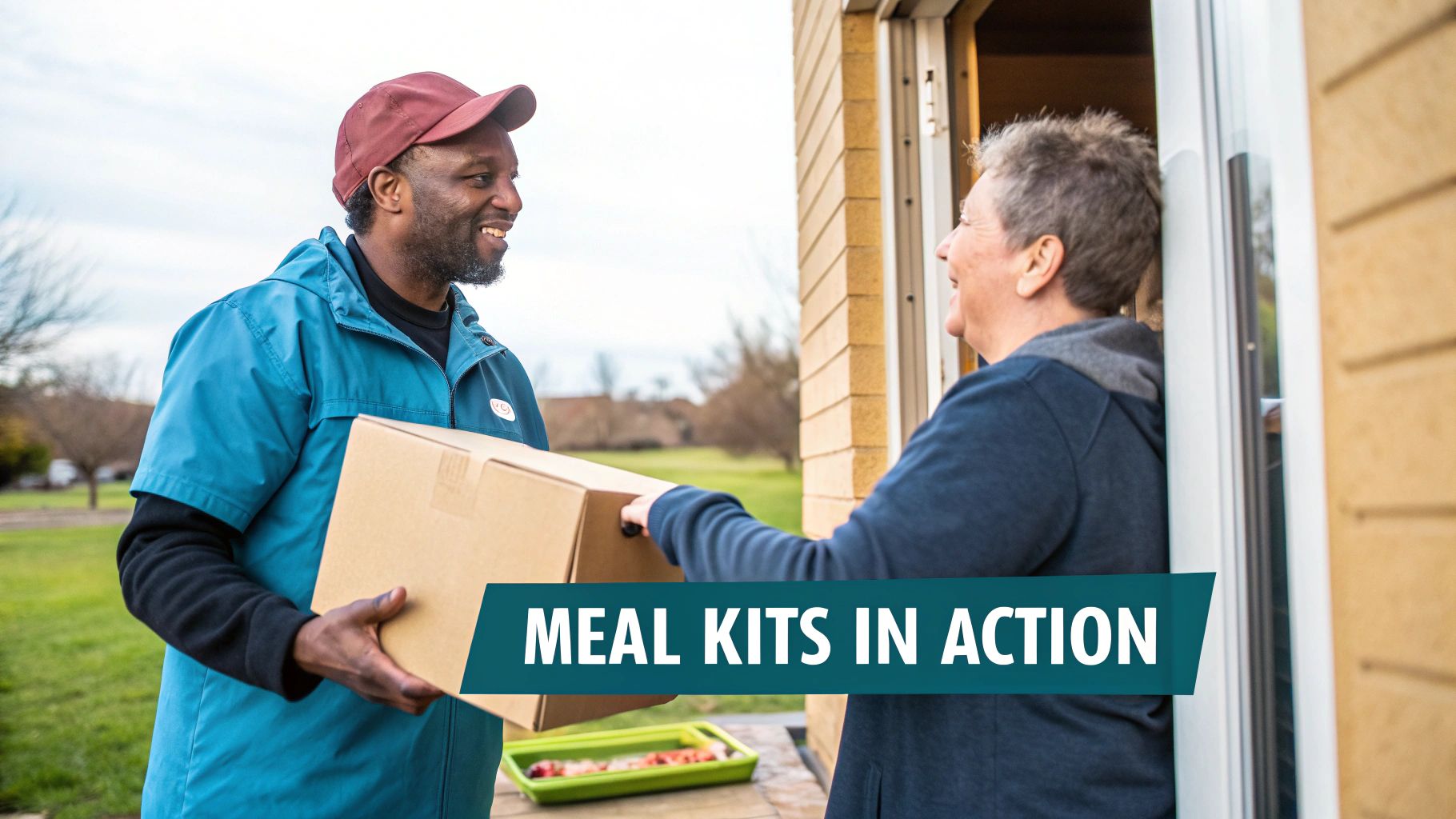
Alright, let's move from the "how" to the "who." While we can talk all day about operational pillars and compliance, the real measure of a meal kit fulfillment service is the impact it has on the communities it serves. This is where logistics and compassion meet to solve real-world hunger and health challenges.
This whole sector is growing, and it's not just a trend. The U.S. meal kit market hit around USD 8.9 billion in 2024 and is expected to climb to USD 9.1 billion by 2025. That growth isn't just coming from commercial dinner boxes; it's being driven by a serious demand for both consumer and institutional programs.
This surge highlights just how critical it is to have sophisticated fulfillment partners who know how to manage complex, mission-driven work. You can dig deeper into the numbers with this meal kit delivery market's growth report on ibisworld.com.
To show you what this looks like on the ground, we'll walk through three distinct scenarios drawn from our own work here at Umoja, showcasing how the right fulfillment approach cracks some tough logistical nuts.
Case Study 1: Delivering Summer Meals to Rural Areas
The Summer Food Service Program (SFSP) is a lifeline for kids who depend on school meals. The problem? Traditional group meal sites just don't work for families in rural areas who lack reliable transportation. The USDA's Rural Non-Congregate option is a game-changer, allowing for home delivery—but making it happen requires flawless logistics.
A state agency brought us in to serve three remote counties. The challenges were immediate and clear:
- Geographic Spread: Delivery routes stretched across hundreds of square miles of sparsely populated land.
- Compliance: Every single multi-day meal kit had to nail the strict SFSP meal patterns and follow Buy American sourcing rules.
- Recipient Communication: We had to figure out a reliable way to confirm addresses and delivery windows with families who often had limited internet access.
Our solution was a blend of tech and touch. We used specialized software to map out the most efficient delivery routes, leveraged our established supply chain to source all the compliant ingredients, and set up a bilingual call center to coordinate deliveries with every family. What started as a logistical puzzle became a steady, reliable source of nutrition for hundreds of kids all summer long.
Case Study 2: Customizing WIC Deliveries
The Women, Infants, and Children (WIC) program is another vital resource, providing supplemental foods from a very specific list of approved products that changes from state to state. A state WIC agency wanted to test a home delivery program to boost redemption rates for families struggling with transportation and time.
This job required surgical precision. The main hurdles were managing inventory for WIC-approved brands and making sure every family received a kit tailored to their exact benefits package—whether it was for an infant, a new mother, or a young child.
From Umoja's Experience: This is where our warehouse management system (WMS) became the MVP. We configured it to recognize every single state-approved WIC item. When a family placed an order, our system automatically generated a pick list that matched their specific benefits down to the last item. This tech-first approach guaranteed 100% accuracy and compliance, making the pilot a huge success and a model for future expansion.
Case Study 3: Supporting a Food-Is-Medicine Initiative
A major healthcare provider launched a "food-as-medicine" program for patients with Type 2 diabetes. The goal was simple but ambitious: provide them with 12 weeks of medically tailored groceries to help them manage their condition. This wasn't just a food delivery program; it was a clinical intervention.
The fulfillment partner’s role was to be an extension of the healthcare team. We had to:
- Assemble grocery boxes based on menus approved by dietitians.
- Manage a bulletproof cold chain for fresh produce and proteins.
- Feed data back to the provider for their outcomes reporting.
By integrating our systems directly with the provider's, we delivered weekly boxes that perfectly matched each patient's nutritional prescription. The result? Improved health outcomes for the participants and a powerful demonstration of how food fulfillment is a critical piece of the healthcare ecosystem.
How to Choose and Launch a Fulfillment Partnership
Picking the right partner for your meal kit fulfillment is the single most important call you'll make. This isn't just about logistics; it’s about finding an operational extension of your team. You need someone who gets your mission, nails your compliance needs, and executes without a hitch. This is the playbook for finding, onboarding, and launching that critical partnership.
The global meal kit market hit around USD 16.12 billion in 2022, which gives you a sense of the scale we're talking about. The market is split between "Cook & Eat" kits with raw ingredients and "Heat & Eat" kits with pre-cooked meals. This variety means fulfillment partners have to be nimble enough to handle different program models.
The Ultimate Evaluation Checklist
Before you even think about signing a contract, you need to do a deep dive. Your potential partner has to prove they can deliver across several key areas. Don’t just take their word for it. Ask for documentation, case studies, and talk to their other institutional clients.
Use this checklist as your guide:
- Food Safety and Certifications: Look for gold-standard credentials like Safe Quality Food (SQF) certification. This shows a serious, audited commitment to food safety that goes way beyond basic FDA rules.
- Technological Capabilities: Do they have a modern Warehouse Management System (WMS) and Electronic Data Interchange (EDI) in place? Real-time inventory views and automated data feeds aren't nice-to-haves; they're essential for transparency and efficiency.
- Cold-Chain Infrastructure: You need to inspect their entire cold-chain process, from warehouse to doorstep. This means refrigerated storage, validated insulated packaging, and a fleet of temperature-controlled vehicles. Ask to see their temperature logs and what they do when something goes wrong.
- Proven Institutional Experience: Have they run programs with compliance needs like yours (think CACFP, WIC, or SFSP)? Ask for specific examples of how they’ve managed challenges like Buy American sourcing or assembling medically tailored meals.
Mapping the Implementation Journey
Once you've made your choice, the path from contract to launch needs to be structured and collaborative. Rushing this part is a recipe for disaster and puts your program at risk. A well-planned rollout gets all the systems, processes, and people on the same page for a smooth start.
The process usually breaks down into three phases:
- Program Scoping and Design: This is where you and your partner get in a room and hash out the details. You'll define everything from menu cycles and ingredient specs to delivery schedules and reporting needs. This is the blueprint for the entire operation.
- Pilot Testing: Before going live, run a small, controlled pilot. This lets you test the whole workflow—from order to delivery—without the pressure of a full-scale launch. It's the perfect chance to find and fix any glitches in the system.
- Full-Scale Launch and Monitoring: Once the pilot is a success, it's go-time. This phase quickly shifts into ongoing management, where you’ll keep a close eye on performance against the key performance indicators (KPIs) you set up in the scoping phase.
Umoja’s Onboarding Experience: For one of our healthcare partners, the pilot phase was a game-changer. We delivered medically tailored grocery boxes to a small group of 50 patients for four weeks. That test run taught us something critical: a lot of people weren't home for the first delivery window. Based on that feedback, we added a pre-delivery SMS alert system, which slashed missed deliveries by over 80% before the full program even launched.
Establishing KPIs for Success
To really know if your partnership is working, you need clear, measurable metrics. Setting these Key Performance Indicators (KPIs) from day one makes sure everyone agrees on what "success" looks like. They give you an objective way to talk about performance and drive constant improvement.
When you're building a relationship with a fulfillment partner, having a clear set of KPIs is non-negotiable. These metrics should be part of your Service Level Agreement (SLA) and reviewed regularly. Here’s a template to get you started.
KPIs for Measuring Fulfillment Partner Performance
| KPI Category | Metric | Target/Benchmark |
|---|---|---|
| Delivery Performance | On-Time Delivery Rate | >99% |
| Order Quality | Order Accuracy Rate | >99.5% |
| Food Safety | Temperature Compliance Rate | 100% |
| Inventory Management | Inventory Accuracy | >98% |
| Customer Service | Participant Complaint Rate | <1% |
| Cost Management | Cost Per Kit Delivered | Within Budget |
This table isn't just a scorecard; it's a communication tool. It helps you have productive conversations with your partner, celebrate wins, and tackle challenges before they become big problems. If you want to dive deeper, our team can help you build a dashboard to track your meal kit program with our logistics solutions for even better insights.
Common Questions About Meal Kit Fulfillment
When you're running a large-scale program, the day-to-day details are what matter most. Institutional buyers often have practical questions about how meal kit fulfillment services actually work on the ground. Here are some straightforward answers to the questions we hear most often.
What Is the Typical Cost Structure?
Pricing models for institutional programs aren't one-size-fits-all, but they typically revolve around three core components:
- Per-Kit Fee: This is the baseline cost to source, assemble, and package each meal kit. It's a straightforward, fixed number for every box that goes out the door.
- Delivery Fee: This covers the actual transportation. The cost here can shift based on factors like the delivery distance, any fuel surcharges, and the specific cold-chain requirements needed to keep food safe.
- Management or Program Fee: This fee covers the human side of the operation—things like dedicated account management, detailed compliance reporting, and access to our technology platforms.
We recently worked with a state agency that needed an absolutely transparent, all-in pricing model for their grant budget. We bundled these costs into a single, predictable expense per participant, which made their financial reporting incredibly simple and stress-free.
How Much Lead Time Is Needed for a New Program?
For a full-scale institutional program, plan on a lead time of 60-90 days.
That window might seem long, but it’s crucial. It gives us the time we need for thorough planning—setting up the supply chain, finalizing menus, running pilot tests to iron out any kinks, and getting all the technology integrated smoothly. Of course, smaller or simpler programs can often get off the ground much faster.
How Is Recipient Data Privacy Handled?
Protecting recipient data is not just a priority; it's a fundamental requirement. We treat it as non-negotiable.
All participant information is managed within secure, access-controlled systems, which are often HIPAA-compliant. The data itself is encrypted both when it's stored (at rest) and when it's being sent (in transit). We have strict protocols in place to ensure that only authorized personnel can access sensitive information, and only for essential operational purposes.
Ready to build a food program that delivers on its mission with precision and care? Contact the experts at Umoja Health to learn how our fulfillment solutions can help you scale your impact. Find out more about how we can partner with you.
Appendix: Risk Management for Institutional Programs
No matter how carefully you plan a program, things go wrong. Highways get shut down by snowstorms. A key supplier runs into a shortage. For institutional meal kit programs, a solid risk management plan isn't just a "nice-to-have"—it's a critical part of making sure your program keeps running and the people you serve stay safe.
Being prepared means looking ahead at potential threats and building an operation that can take a punch. It's about having a game plan ready before you need it, not just reacting when disaster strikes. Your fulfillment partner has to prove they've thought through these scenarios and have real, workable plans ready to go.
Spotting and Handling Common Threats
Good risk management starts with an honest look at what could derail your program. While every operation is a little different, most problems fall into one of three buckets. A top-tier partner will have documented, specific strategies for each.
- Supply Chain Breakdowns: An unexpected shortage of just one ingredient can bring an entire production line to a halt. The best defense here is having multiple suppliers lined up and ready. That means vetted secondary, and even tertiary, suppliers who can step in on short notice. Keeping a smart buffer stock of non-perishable staples also provides a much-needed safety net.
- Logistics and Weather Woes: From hurricanes to blizzards, extreme weather is a huge threat to delivery timelines. The solution is building redundancy into your logistics, like having backup delivery routes mapped out and alternative carriers on standby. You also need real-time weather tracking and a clear communication plan to let participants know what's happening and when to expect a rescheduled, safe delivery.
- Quality and Safety Lapses: If the temperature inside a truck fluctuates too much during transit, a whole shipment of food could be compromised. This risk is managed with a validated cold chain, using data loggers for continuous temperature monitoring, and making sure staff are rigorously trained on food safety. You absolutely must have clear, non-negotiable procedures for pulling and dealing with any product that might be compromised.
Umoja’s Contingency Plan in Action
During a severe winter storm, a major interstate shutdown threatened a critical delivery of medically tailored meals for one of our healthcare partners. Because our plan already included pre-qualified local couriers, we were able to switch gears instantly. They used smaller, local roads that were still open, ensuring 100% of participants got their life-sustaining meals on time, right in the middle of a massive disruption. This is why having a plan matters.
The Final Risk Checklist
Before you sign on the dotted line with any partner, make sure they can give you a confident "yes" to these questions:
- Do you have documented backup suppliers for all critical ingredients?
- What are your specific contingency plans for weather-related delivery failures?
- How do you monitor and validate your cold chain in real time?
- What is your protocol for managing a food recall or a quality control issue?
A partner who can answer these questions thoroughly is a partner who takes your mission as seriously as you do. That level of foresight is the mark of a truly dependable fulfillment service.