

In the world of food security and community health, the mission is clear: feed more people, run compliant programs, and ensure every dollar is maximized for impact. But as programs like CACFP, SFSP, and WIC expand from managing a few dozen sites to hundreds, complexity grows exponentially. The simple spreadsheets and manual processes that once worked inevitably begin to break down, leading to compliance risks, wasted resources, and stalled growth. This is precisely where operational excellence ceases to be a corporate buzzword and becomes the fundamental framework for sustainable, mission-driven success.
This guide moves beyond abstract theory to provide a prioritized roundup of 10 actionable operational excellence strategies tailored for program directors, supply chain managers, and logistics chiefs. We will break down exactly how to implement each strategy, from Lean Six Sigma process improvements and robust kitting SOPs to advanced WMS/EDI integration and resilient cold-chain controls. For mission-driven organizations, effectively aligning IT with business strategy is fundamental to achieving this level of operational control and scaling impact.
Each section that follows offers specific, measurable KPIs and practical, real-world examples relevant to organizations managing everything from emergency food distribution to medically tailored meal programs. Whether you're a state vendor manager piloting online benefits or an e-commerce leader moving into a food-grade 3PL, these strategies will provide a clear roadmap to enhance efficiency, ensure compliance, and ultimately, amplify the reach and effectiveness of your programs.
1. Process Improvement & Continuous Improvement (Lean Six Sigma, Kaizen/A3)
Operational excellence begins with a systematic, data-driven commitment to refining every process. Combining Lean Six Sigma with continuous improvement methodologies like Kaizen provides a powerful framework for food distribution and program operations. Lean focuses on maximizing value by eliminating waste (e.g., waiting, excess inventory, defects), while Six Sigma aims to reduce process variation and errors. This dual approach is essential for achieving consistency and reliability, whether assembling nutrition kits, managing a cold chain, or ensuring compliance across hundreds of sites.
For organizations like food banks or CACFP sponsors, this means moving beyond simply fixing problems as they arise. Instead, it involves a cultural shift toward proactively identifying and solving root causes. Using a structured method like DMAIC (Define, Measure, Analyze, Improve, Control) or a Kaizen event, teams can systematically dissect a process, such as kit assembly, to pinpoint bottlenecks and implement sustainable countermeasures. The result is a more efficient, accurate, and scalable operation.
Key Benefits & Applications
- Reduced Errors & Waste: Minimizes mistakes in kit packing, order fulfillment, and inventory management, directly lowering food waste and rework costs.
- Improved Consistency: Standardizes processes across multiple sites and volunteer shifts, ensuring every program participant receives the same high-quality service.
- Enhanced Efficiency: Streamlines workflows, such as volunteer check-in or truck loading, reducing cycle times and increasing throughput without adding staff.
Case In Point: A regional food bank utilized the A3 problem-solving methodology to address inconsistent volunteer scheduling, which caused delays in sorting and packing. By mapping the current process and identifying root causes, they optimized scheduling communication and reduced food sorting setup time by 30%, increasing daily processing capacity.
Actionable Implementation Steps
- Start Small with a High-Impact Process: Target a high-volume, repetitive task first. For example, map the current state of your most common nutrition kit assembly line, from component staging to final palletizing.
- Conduct Gemba Walks: Managers should regularly observe the actual work being done in the warehouse or on the delivery route. Engage directly with staff and volunteers to understand hidden inefficiencies and frustrations they face.
- Train Team Leads in A3 Thinking: Equip supervisors with a standardized A3 problem-solving template. This one-page report helps teams define a problem, analyze its causes, propose solutions, and track results, fostering a culture of data-driven decision-making.
- Test Countermeasures and Measure: Before a full-scale rollout, pilot any proposed change with a small group or for a limited time. For instance, test a new kitting layout for one shift and measure its impact on assembly time and accuracy before retraining the entire volunteer base.
- Establish a Review Cadence: Schedule brief, monthly improvement reviews to discuss ongoing projects, celebrate successes, and identify the next area for focus. This keeps momentum going and embeds continuous improvement into your operational DNA.
2. Supply Chain Visibility & Real-Time Inventory Management (WMS/EDI)
True operational excellence in food and health programs is impossible without a clear, real-time view of your entire supply chain. Integrating a Warehouse Management System (WMS) with Electronic Data Interchange (EDI) platforms provides this critical visibility. This technology stack moves operations beyond manual spreadsheets, offering live data on stock levels, lot tracking, expiration dates, and order status, which is non-negotiable for food-grade compliance and program integrity.
For organizations managing complex inventories for programs like WIC, CACFP, or Medicaid, this digital foundation is transformative. It enables precise allergen and dietary flag management, ensures First-Expired, First-Out (FEFO) inventory rotation, and provides the rapid substitution intelligence needed to adapt to supply disruptions without compromising program rules. This level of control prevents waste, ensures participant safety, and maintains audit-readiness at all times, forming one of the core operational excellence strategies for modern social and health logistics.
Key Benefits & Applications
- Enhanced Compliance & Safety: Automates lot tracking and expiration date management, ensuring adherence to FDA regulations and program-specific requirements like Buy American provisions.
- Reduced Waste & Costs: Minimizes spoilage by enforcing FEFO rules and provides data to right-size SKU counts, reducing carrying costs and eliminating obsolete inventory.
- Improved Order Accuracy: Barcode scanning at receiving, picking, and packing stages drastically reduces human error, ensuring the right components go into every nutrition kit and order.
Case In Point: A large CACFP sponsor integrated their WMS with EDI feeds from state agencies and suppliers. This automation cut their order processing and cycle time by 40% and provided real-time visibility into inventory, allowing them to create inventory-aware substitution rules that met strict WIC benefit categories, virtually eliminating non-compliant shipments.
Actionable Implementation Steps
- Conduct a Full SKU Audit: Begin by cataloging and analyzing all active SKUs. Identify slow-moving items and opportunities to consolidate or "right-size" your inventory to reduce picking complexity and storage costs.
- Implement Barcode Scanning at All Key Stages: Mandate barcode scanning at receiving, put-away, kitting, and final pick-confirmation. This is the foundational step for achieving 99%+ inventory accuracy.
- Configure System Alerts and Rules: Set automated alerts in your WMS for critical events. For example, create an alert for inventory approaching its expiration date 30 days out and define cold-chain exception flags for any temperature variance greater than ±3°F.
- Establish EDI Testing Protocols: Before going live with a state agency or major supplier, schedule a 60-day EDI testing and validation period. This ensures all transaction sets (like orders, acknowledgments, and invoices) function correctly, preventing data errors post-launch. For more details on system integration, you can learn more about how our solutions can help.
- Develop Inventory-Aware Substitution Logic: Work with program managers to define and build compliant substitution rules directly into your WMS. Link these rules to specific benefit categories (e.g., WIC-approved cereals) so the system can suggest appropriate alternatives when a primary item is out of stock.
3. Cold-Chain & Food Safety Compliance Management
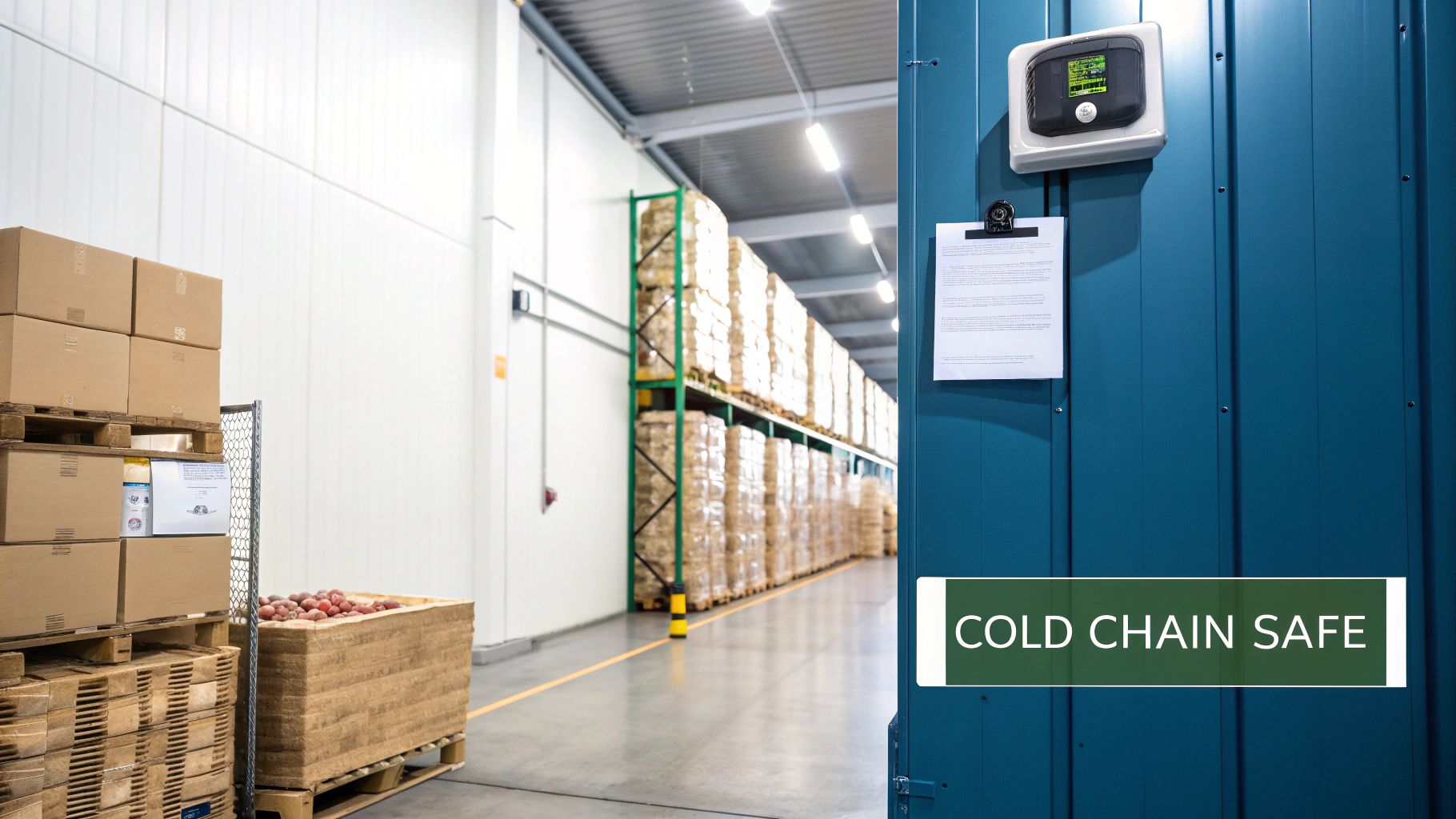
One of the most critical operational excellence strategies for any organization handling perishable goods is mastering cold-chain and food safety compliance. This involves a systematic, documented process for monitoring and maintaining specific temperature ranges from warehouse storage to last-mile delivery. For programs involving refrigerated items like milk in CACFP meals or fresh produce in diabetes-focused grocery boxes, unbroken temperature control is non-negotiable for ensuring participant safety and meeting strict regulatory standards.
This strategy goes beyond simply owning refrigerated trucks. It requires an end-to-end system of temperature sensors, clear handling protocols, and predefined corrective actions for any deviation. The goal is to proactively prevent temperature abuse, ensuring the integrity and safety of every item distributed. Adherence to frameworks like HACCP and the Food Safety Modernization Act (FSMA) is not just about compliance; it is a fundamental pillar of operational integrity and public trust.
Key Benefits & Applications
- Guaranteed Product Safety: Prevents the growth of harmful bacteria, protecting program participants and eliminating the risk of foodborne illness.
- Regulatory Compliance: Ensures adherence to FDA, USDA, and state health department regulations, avoiding fines, penalties, and program shutdowns.
- Reduced Product Loss: Minimizes spoilage and waste from temperature excursions, protecting inventory investment and ensuring program resources are maximized.
Case In Point: A WIC home delivery pilot program implemented real-time temperature monitoring in all delivery vehicles. By setting an automated alert for temperatures nearing 41°F, they identified a faulty cooling unit mid-route, allowing the driver to take immediate corrective action. This prevented the spoilage of 200 gallons of milk and ensured zero compliance deviations during their state audit.
Actionable Implementation Steps
- Map Your Cold Chain & Install Sensors: Identify every touchpoint where temperature-sensitive products are handled, from receiving docks to participant doorsteps. Install calibrated temperature sensors in all cold storage areas and delivery vehicles.
- Establish Clear Temperature Thresholds: Define and document acceptable temperature ranges (e.g., 33°F-40°F for refrigerated goods) and time-based deviation limits (e.g., any product held above 41°F for more than two hours must be flagged for review).
- Develop & Train on Corrective Action SOPs: Create simple, clear Standard Operating Procedures (SOPs) for what to do when a temperature deviation occurs. Train all warehouse staff, drivers, and program managers on these protocols, including the "4-hour rule" for time-temperature control.
- Utilize Appropriate Packaging for Last-Mile Delivery: For non-congregate or rural home deliveries, use validated insulated packaging with correctly sized gel packs to maintain temperature for the entire delivery window. Learn more about how these controls support compliant home-delivery kitting programs.
- Document Everything for Audits: Maintain meticulous logs of all temperature checks, deviations, and corrective actions taken. This documentation is your proof of compliance for state and federal reviewers and is an essential component of an effective food safety plan.
4. Demand Forecasting & Seasonal Planning
Operational excellence in program delivery is impossible without accurately anticipating future needs. Demand forecasting and seasonal planning use historical data, program calendars, and trend analysis to predict requirements for kit volumes, specific SKUs, and volunteer hours. This predictive approach moves an organization from a reactive stance, where stockouts and overstocking are common, to a proactive one that optimizes procurement, cash flow, and warehouse utilization. This is especially critical for managing predictable surges like the Summer Food Service Program (SFSP), holiday drives, or disaster response pre-positioning.
By analyzing past participation data and incorporating external factors like state enrollment projections, organizations can build a reliable model of future demand. This isn't just about ordering the right amount of food; it's about ensuring the entire supply chain is prepared. Accurate forecasts inform volunteer scheduling, truck routing, and cash flow management, preventing last-minute crises and enabling smoother, more cost-effective operations that are fundamental to achieving operational excellence strategies.
Key Benefits & Applications
- Optimized Inventory Levels: Prevents both costly overstocking of perishable goods and mission-critical stockouts during peak demand periods.
- Improved Financial Planning: Allows for better cash flow management by aligning procurement schedules and large purchases with predictable funding and demand cycles.
- Enhanced Resource Allocation: Ensures staffing, volunteer, and transportation resources are scaled appropriately ahead of seasonal peaks like SFSP or holiday programs.
Case In Point: A large CACFP sponsor that historically faced shortages in September used demand forecasting to analyze the previous three years of back-to-school enrollment data. By creating low, mid, and high demand scenarios, they adjusted their August procurement and pre-built 15% more inventory, completely eliminating stockouts and ensuring all 300+ childcare sites were fully supplied during the critical first weeks of school.
Actionable Implementation Steps
- Establish a Baseline Forecast: Gather and clean at least 24 to 36 months of historical program data (e.g., meals served, kits distributed by type). Use this to create a simple moving average or seasonal baseline forecast for the upcoming 12 months.
- Incorporate External Data Triggers: Enhance your baseline by layering in key external variables. For SFSP, integrate state administrator enrollment projections (typically released in Q1) to refine summer demand models.
- Develop Demand Scenarios: Do not rely on a single number. Create three-point estimates for key periods: a conservative case (85% of forecast), an expected case (100%), and a high-growth case (115%). Use these scenarios to define risk buffers.
- Build In Safety Stock Strategically: For programs with high variability, like rural non-congregate meal delivery, establish a defined safety stock level. A 10-15% buffer on critical, long-shelf-life components can prevent service disruptions.
- Implement a Monthly Review Cadence: Schedule a recurring monthly meeting to review forecast accuracy against actuals. Document all assumptions made during the forecasting process and adjust future models based on what you learn.
5. Standardized Work & Standard Operating Procedures (SOPs)
Standardized work is the foundation for consistency and scalability in any operation. It involves creating a documented, repeatable best practice for every critical task, from kit assembly and cold-chain handling to volunteer coordination. This strategy moves beyond tribal knowledge and ensures that every team member, regardless of experience, performs a task the same way every time, minimizing variation and errors. This is one of the most fundamental operational excellence strategies for achieving predictable outcomes.
For organizations managing multi-site programs or relying on a rotating volunteer workforce, standardization is non-negotiable. It transforms complex processes into a series of clear, manageable steps, often supported by visual aids, checklists, and quality gates. To foster consistency and boost efficiency, it's essential to develop clear and effective Standard Operating Procedures (SOPs). This not only accelerates training but also creates a reliable baseline for future process improvement efforts.

Key Benefits & Applications
- Drastically Reduced Training Time: Visual, step-by-step SOPs allow new staff and volunteers to become productive almost immediately, reducing the burden on experienced supervisors.
- Improved Quality & Safety: Ensures critical steps, such as allergen segregation or temperature checks, are never missed, enhancing compliance and participant safety.
- Establishes a Baseline for Improvement: You cannot improve what you haven't standardized. SOPs provide a stable process baseline to measure the impact of changes accurately.
Case In Point: A CACFP sponsor managing 200 childcare sites created simple, laminated, one-page visual SOPs for meal packing and temperature logging. This move reduced packing errors by over 60% and ensured consistent compliance with health regulations across all locations, even those with high staff turnover.
Actionable Implementation Steps
- Engage Frontline Staff in SOP Creation: Involve the warehouse staff, drivers, and volunteers who perform the work daily. Their input is crucial for creating procedures that are practical, realistic, and effective.
- Use Visuals and Simple Language: Prioritize photos, simple diagrams, and checklists over dense text. For a kit assembly line, use pictures of actual components and show the correct placement in each step.
- Post SOPs at the Point of Use: Don't file procedures away in a binder. Print and post laminated, large-format visual SOPs directly at the relevant workstations, such as packing tables, receiving docks, or volunteer check-in stations.
- Incorporate Quality Gates: Build verification steps directly into the SOP. For example, include a checklist item like "Supervisor verifies pallet wrap integrity and temperature log before loading."
- Implement Version Control and Regular Reviews: Use a digital system (like Google Docs or a dedicated platform) to manage SOPs. Schedule a quarterly review of high-impact procedures to ensure they remain current and incorporate any lessons learned.
6. Workforce Capability & Cross-Training Programs
Operational excellence is built on the skills and adaptability of your people. A proactive approach to workforce development involves structured training, role rotation, and certification programs that build deep competencies in critical areas like food safety, equipment operation, and SOP adherence. This strategy transforms the workforce from a variable cost into a strategic asset, increasing operational resilience and ensuring consistent quality, especially during periods of surge demand or staff turnover.
For organizations managing complex supply chains or large-scale food programs, this means creating a culture of continuous learning. Instead of relying on informal on-the-job training, a formalized system ensures every staff member and key volunteer understands the 'why' behind the 'what'. By cross-training teams in multiple roles, such as warehouse packing and delivery coordination, an organization builds flexibility into its structure, allowing it to adapt swiftly to unexpected challenges without disrupting service.
Key Benefits & Applications
- Increased Resilience & Flexibility: Cross-trained staff can cover for absent colleagues or be redeployed to high-priority areas, ensuring operations continue smoothly.
- Improved Quality & Compliance: Formal training in food safety and SOPs reduces errors, minimizes compliance risks, and ensures consistent service delivery across all sites.
- Enhanced Employee Retention: Investing in employee development boosts morale and loyalty, creating a more stable and experienced team. Costco's culture of training is a key driver of its 90%+ retention rate.
Case In Point: A large food bank network implemented a 'Master Volunteer' program to address inconsistent sorting quality. By providing advanced training and certification on specific tasks, they created a reliable corps of volunteer leaders who could train and supervise new recruits, resulting in a 25% reduction in sorting errors and improved volunteer retention.
Actionable Implementation Steps
- Develop a Tiered Training Curriculum: Map out learning objectives for new hires at key milestones: 30 days (core orientation, safety basics), 90 days (role proficiency, SOP mastery), and 6 months (expert skills, cross-training).
- Implement a 'Buddy System': Pair every new hire or key volunteer with an experienced mentor for their first two weeks. This accelerates learning, reinforces correct procedures, and builds institutional knowledge.
- Create a 'Train-the-Trainer' Program: Identify high-performing staff members and provide them with the skills and certification to become internal instructors. This scales your training capacity and ensures consistent delivery of content.
- Use Blended Learning Tools: Combine hands-on training with accessible video modules for asynchronous learning. This is ideal for reinforcing food safety protocols or demonstrating equipment use, allowing staff to learn at their own pace.
- Document and Track All Training: Maintain meticulous records of all completed training, especially for food safety and regulatory compliance. This is critical for audits and demonstrates a commitment to operational excellence.
7. Supplier Quality Management & Vendor Partnerships
Operational excellence extends beyond your own four walls; it requires treating suppliers and logistics providers as true partners in your value chain. This strategy moves away from purely transactional, cost-driven procurement toward collaborative relationships focused on mutual growth, quality assurance, and shared accountability. By deeply integrating with key vendors, organizations can ensure product quality, verify compliance with standards like Buy American, and co-develop solutions that optimize the entire supply chain.
This approach transforms the traditional adversarial procurement model into a long-term partnership. Instead of simply penalizing suppliers for failures, you work with them to identify and resolve root causes of issues, from inconsistent product quality to late deliveries. Inspired by Lean Supply Chain philosophies, this partnership model ensures reliability and drives innovation, whether that means securing culturally relevant food SKUs for diverse communities or improving packaging to reduce damage in transit.
Key Benefits & Applications
- Improved Product Quality & Safety: Ensures consistent adherence to food safety standards (HACCP), allergen controls, and product specifications, reducing risks for program participants.
- Enhanced Reliability & Compliance: Increases on-time delivery rates and guarantees adherence to complex requirements like Buy American provisions through shared documentation and audits.
- Greater Cost-Effectiveness: Collaborative problem-solving can identify shared efficiencies in logistics, packaging, and inventory, reducing total costs beyond the initial purchase price.
Case In Point: A large CACFP sponsor struggling with inconsistent produce quality from its primary vendor established quarterly business reviews (QBRs) and shared quality scorecards. By partnering to refine product specifications and handling protocols, they reduced spoilage-related credits by 40% and improved participant satisfaction with fresh meal components.
Actionable Implementation Steps
- Develop Supplier Scorecards: Create a simple, data-driven scorecard for your top 5-10 suppliers. Track key metrics like on-time in-full (OTIF) delivery (target >98%), order accuracy, and defect rate (target <0.5%).
- Establish a QBR Cadence: Schedule quarterly business reviews with strategic partners. Use the scorecard data to guide discussions on performance, upcoming demand forecasts, and joint improvement opportunities.
- Define Clear Product Specifications: Document detailed specifications for all critical items, including quality attributes, packaging requirements, and any compliance documentation needed (e.g., proof of origin for Buy American).
- Conduct Collaborative Site Audits: Instead of a "gotcha" inspection, schedule partnership-focused site visits to understand your suppliers’ processes. Observe their quality controls firsthand and identify areas for mutual improvement.
- Create Joint Improvement Teams: For recurring issues like damaged goods or incorrect labeling, form a small, cross-functional team with representatives from your organization and the supplier to investigate root causes and implement lasting countermeasures.
8. Financial Performance Management & Cost Accounting
True operational excellence strategies extend beyond the warehouse floor into financial rigor. Robust cost accounting provides the crucial link between operational activities and financial outcomes, allowing organizations to understand the true cost-to-serve for each program, partner, or delivery route. By implementing methods like activity-based costing, leaders can move from high-level budget reviews to granular, program-level Profit & Loss (P&L) analysis. This data-driven approach is essential for demonstrating ROI to funders, making informed pricing decisions, and ensuring long-term sustainability.
For organizations managing government contracts or healthcare partnerships, this level of financial detail is non-negotiable. It allows you to prove fiscal responsibility and justify investments in new initiatives. Whether analyzing the cost per meal for a CACFP program or the total expense of a medically tailored grocery delivery, precise cost accounting transforms operational data into a powerful tool for strategic decision-making, ensuring resources are allocated to the most impactful and efficient activities.
Key Benefits & Applications
- Informed Decision-Making: Provides clear data to justify program expansion, adjust service fees, or discontinue unprofitable activities.
- Enhanced Grant Reporting: Enables detailed financial reports that demonstrate ROI and responsible stewardship of funds to government agencies and healthcare plans.
- Improved Procurement Strategy: Pinpoints the true cost of goods, including freight and labor, leading to more strategic sourcing and vendor negotiations.
Case In Point: A large food bank network implemented program-level P&L tracking to analyze its senior box program. By accurately allocating warehouse labor, transportation, and administrative overhead, they discovered the program's cost-per-box was 15% higher than budgeted. This insight drove a successful initiative to renegotiate food sourcing and optimize delivery routes, bringing the program back to financial health.
Actionable Implementation Steps
- Establish a Baseline Cost Per Unit: Define your primary service unit (e.g., meal, kit, delivery) and calculate its baseline cost. Meticulously track all direct costs (food, packaging) and allocate a reasonable portion of indirect costs (rent, utilities, salaries).
- Separate Direct vs. Indirect Costs: Create distinct general ledger accounts to track costs directly tied to service delivery versus shared operational overhead. This separation is fundamental for accurate program-level profitability analysis.
- Implement Standard Costing for Labor: Determine a standard time and labor cost for repetitive tasks like kit assembly. Track actual labor costs against this standard and analyze variances monthly to identify training needs or process inefficiencies.
- Analyze Contribution Margin by Program: Regularly calculate which programs contribute positively to covering overhead and which do not. Use this data to guide strategic discussions about program design, pricing, or potential subsidies.
- Benchmark Costs and Model New Programs: Before launching a new service, build a detailed cost model based on your established metrics. Compare your key costs, like cost-per-meal, against industry benchmarks to ensure your operational plan is competitive and financially sound.
9. Risk Management & Supply-Chain Resilience Planning
Operational excellence is not just about efficiency in stable conditions; it’s about maintaining service continuity when disruption strikes. Supply-chain resilience planning involves proactively identifying, assessing, and mitigating risks that could threaten your mission. This includes everything from supplier disruptions and cold-chain failures to natural disasters and sudden demand volatility. A resilient operation anticipates potential failures and builds in the redundancy and flexibility needed to persevere.
For organizations delivering critical food and nutrition programs, this means creating a robust business continuity plan that goes beyond a single backup. It's about developing a multi-layered defense. This strategic foresight ensures that even when a primary supplier fails or a transportation route is cut off, the flow of essential goods continues with minimal interruption. This proactive stance is fundamental to an organization's ability to serve its community reliably, especially during a crisis.
Key Benefits & Applications
- Ensured Program Continuity: Guarantees that essential services, like meal delivery for seniors or disaster relief, can continue even during major supply-chain disruptions.
- Reduced Financial Impact: Mitigates the high costs associated with emergency procurement, spoilage from cold-chain breaks, and last-minute logistical changes.
- Enhanced Stakeholder Trust: Builds confidence among funders, partners, and program participants by demonstrating a reliable and prepared operational structure.
Case In Point: Following the 2011 earthquake and tsunami, Toyota’s long-standing investment in supplier diversification and deep supply-chain visibility allowed it to recover far more quickly than competitors. By understanding its multi-tier supply network, it could rapidly identify bottlenecks and activate alternative sources, a key lesson in resilience.
Actionable Implementation Steps
- Conduct a Supply-Chain Risk Assessment: Map your critical supply chains from end to end. Identify single-source suppliers, components with long lead times, and geographic concentrations of vendors that create points of failure.
- Establish Strategic Safety Stock Levels: Define and maintain safety stock for mission-critical items. For instance, hold a 30-day forward inventory of core components for disaster response kits to buffer against immediate shortages.
- Develop Alternate Supplier and Logistics Networks: Prequalify and build relationships with backup suppliers and transportation carriers in different geographic regions. Conduct small annual trial runs to ensure they can integrate smoothly when needed.
- Create and Test Contingency Plans: Document clear action plans for specific scenarios like a key warehouse shutdown or a major food recall. Test these business continuity plans annually through tabletop exercises or live drills. Learn more about developing a robust logistics plan for disaster response operations.
- Build in Cold-Chain Redundancy: For temperature-sensitive goods, secure backup cold storage facilities and transportation partners. Use data loggers to monitor temperatures and establish clear protocols for handling deviations to prevent spoilage.
10. Technology Integration & Automation (Warehouse Automation & Software)
Achieving operational excellence in today's complex supply chains requires strategically deploying technology to reduce manual labor, enhance data accuracy, and enable scalability. Integrating systems like a Warehouse Management System (WMS), Enterprise Resource Planning (ERP), and Electronic Data Interchange (EDI) creates a single source of truth for inventory, orders, and compliance data. This connectivity eliminates data silos and automates communication between partners, from state agencies to third-party logistics providers.

This strategy extends to physical automation, from simple barcode scanners and pick-to-light systems to advanced robotics that handle repetitive tasks like kitting and palletizing. The goal isn't just to replace manual work but to augment human capabilities, allowing teams to focus on higher-value activities like quality assurance and exception management. By automating data flow and physical tasks, organizations can significantly increase throughput, reduce errors, and maintain real-time visibility across their entire operation.
Key Benefits & Applications
- Improved Accuracy & Traceability: Automates data capture, dramatically reducing human error in receiving, picking, and shipping. Essential for compliance and rapid recall management.
- Increased Throughput: Speeds up order fulfillment and kitting processes, allowing operations to handle higher volumes without a proportional increase in labor costs.
- Enhanced Visibility: Provides real-time inventory levels, order status, and performance metrics, enabling proactive decision-making for procurement and logistics.
Case In Point: A large-scale food-grade 3PL integrated its WMS with its clients' ERP systems via EDI. This automation eliminated manual order entry and provided real-time inventory feeds, reducing order processing errors by 98% and shortening the order-to-ship cycle time by a full day.
Actionable Implementation Steps
- Prioritize High-ROI Automation First: Begin with foundational technologies like barcode scanning for all inventory movements. Implement mobile WMS apps to empower warehouse staff with real-time receiving, putaway, picking, and cycle-counting capabilities directly on the floor.
- Focus on Critical Integrations: Establish EDI connections with your most significant partners, such as key suppliers or state agencies, to automate purchase orders, advance ship notices (ASNs), and invoicing. This cuts administrative overhead and strengthens partner relationships.
- Deploy Actionable Analytics Dashboards: Create and display simple, real-time dashboards tracking key performance indicators (KPIs) like orders picked per hour, inventory accuracy, and on-time shipping. This visibility drives daily accountability and continuous improvement.
- Evaluate SaaS and Cloud-Based Options: For organizations with limited IT resources, explore Software-as-a-Service (SaaS) WMS and ERP solutions. These platforms reduce the upfront investment and ongoing maintenance burden while providing access to enterprise-grade functionality.
- Plan a Phased Rollout and Train Extensively: Implement new technology in stages, starting with a single process or warehouse area. Comprehensive training and clear communication are critical to ensure user adoption and minimize disruption to ongoing operations.
Operational Excellence: 10-Point Strategy Comparison
| Item | Implementation complexity | Resource requirements | Expected outcomes | Ideal use cases | Key advantages |
|---|---|---|---|---|---|
| Process Improvement & Continuous Improvement (Lean Six Sigma, Kaizen/A3) | Medium–High — structured methods, statistical tools, cross-functional teams | Moderate — training/certification, staff time, possible consultants/software | Measurable error reduction and cost savings; sustained process improvements | Kit assembly accuracy, multi-site consistency, recurring defect resolution | Data-driven root-cause elimination; frontline engagement; documented improvements for audits |
| Supply Chain Visibility & Real-Time Inventory Management (WMS/EDI) | High — complex integrations and EDI onboarding | High — WMS/EDI software, scanners/RFID, IT integration, staff retraining | Real-time stock accuracy, fewer substitutions and regulatory-ready reports | WIC substitution workflows, lot/expiry control, multi-warehouse operations | Live visibility, automated alerts/reorders, compliance and traceability |
| Cold-Chain & Food Safety Compliance Management | Medium — IoT sensors, SOPs, escalation workflows | Moderate ongoing — sensors/hardware, monitoring services, staff training | Reduced spoilage and food-safety incidents; audit preparedness | Refrigerated kit programs, perishable last-mile delivery, regulatory compliance | Continuous temp monitoring, automated deviation alerts, recall readiness |
| Demand Forecasting & Seasonal Planning | Medium — analytics models, collaborative inputs | Moderate — historical data, forecasting software, analyst time | Lower carrying costs, fewer stockouts, optimized procurement timing | SFSP summer surge, holiday programs, disaster-response pre-positioning | Predictive demand visibility, improved cash flow, better supplier negotiations |
| Standardized Work & Standard Operating Procedures (SOPs) | Low–Medium — documentation and version control | Low — time to document, visual aids, small training effort | Consistent output, reduced errors, faster onboarding | Volunteer kitting, multi-site scaling, audit-required processes | Repeatability, faster training, clear quality gates and audit trails |
| Workforce Capability & Cross-Training Programs | Medium — curriculum design, certification tiers | Moderate — training materials, instructor time, ongoing refreshers | Greater flexibility, improved retention and consistent quality | Surge staffing, high-volunteer environments, multi-role coverage | Resilience through cross-trained staff, career pathways, regulatory training compliance |
| Supplier Quality Management & Vendor Partnerships | Medium — contracts, scorecards, audits | Moderate — supplier audits, relationship management resources | Fewer quality issues, improved delivery reliability and compliance | Buy American sourcing, culturally relevant SKU sourcing, long-term supply | Stronger supplier performance, lower recall risk, cost stability via partnerships |
| Financial Performance Management & Cost Accounting | Medium–High — activity-based costing and program P&L setup | Moderate — accounting systems, detailed data collection, finance expertise | Clear program profitability, informed pricing and resource decisions | Program ROI evaluation, pricing negotiation, budget allocation | Visibility into true costs, decision support, benchmarking and profitability control |
| Risk Management & Supply-Chain Resilience Planning | Medium — risk mapping, scenario and continuity planning | Moderate — safety stock, alternate suppliers, contingency testing | Reduced disruption impact and faster recovery; continuity of critical programs | Disaster response readiness, single-source risk mitigation, cold-chain failures | Business continuity, reduced emergency sourcing costs, stakeholder confidence |
| Technology Integration & Automation (Warehouse Automation & Software) | High — robotics, WMS/ERP integrations, lengthy rollouts | Very high — capital for automation, IT integrations, maintenance and cybersecurity | Lower labor costs, higher accuracy, faster throughput and scalable operations | High-volume 3PLs, multi-site scaling, accuracy- and speed-critical fulfillment | Labor reduction, >99% accuracy potential, scalable throughput and real-time analytics |
From Strategy to Action: Your Next Move Towards Operational Excellence
Embarking on the path to operational excellence is not about a single, revolutionary change. It is a sustained commitment to incremental improvement, a cultural shift that embeds efficiency, quality, and resilience into the very DNA of your organization. The ten operational excellence strategies detailed in this article, from implementing Lean Six Sigma to integrating advanced warehouse automation, are not isolated tactics but interconnected pillars supporting a stronger, more agile operation.
We’ve explored how standardizing work through robust SOPs can eliminate costly errors in kitting and assembly, a critical factor for food bank managers and CPG leaders alike. We’ve seen how real-time inventory visibility, powered by WMS and EDI integration, transforms supply chains from reactive to predictive, enabling state WIC administrators and e-commerce directors to manage inventory-aware substitutions and meet demand with precision. Each strategy offers a distinct lever for transformation.
Turning Insights into Impactful Action
The true value of these frameworks lies not in understanding them, but in applying them. The journey from your current state to a future of optimized performance can feel daunting, but it begins with a single, well-chosen step. The key is to avoid analysis paralysis and build momentum through focused execution.
Consider these actionable starting points based on the strategies we've covered:
- For High-Variability Operations: If you manage complex programs like CACFP multi-day menus or emergency meal distribution, begin with Standardized Work (SOPs). Document and pilot one critical process, such as your cold-chain handling protocol for home delivery or your volunteer-friendly kitting workflow. A single, well-defined SOP can immediately reduce errors and improve compliance.
- For Supply Chain Complexity: If your biggest challenges involve inventory, procurement, or vendor management, focus on Supply Chain Visibility & Real-Time Inventory Management. Start by conducting a gap analysis of your current WMS capabilities or initiating a pilot project with a key supplier to improve data exchange. This initial step can provide the business case needed for broader technology investments.
- For Quality and Compliance Demands: For organizations navigating strict regulatory landscapes, like Medicaid population-health programs or SFSP administration, prioritizing QA and Compliance Management is non-negotiable. Your first move could be to formalize a supplier quality audit checklist or implement a more robust KPI dashboard to track compliance metrics, such as cold-chain temperature logs or Buy American procurement adherence.
The Lasting Value of Operational Excellence
Mastering these operational excellence strategies does more than just lower costs or speed up delivery times. It builds organizational resilience, enabling you to better navigate supply chain disruptions, adapt to new regulatory requirements, and scale your impact without sacrificing quality. For a food bank, this means feeding more families. For a public health program, it means delivering life-sustaining nutrition more reliably. For a CPG brand, it means building unwavering customer trust.
Ultimately, operational excellence is the engine that powers your mission. It transforms your strategic goals into tangible, repeatable, and measurable results. By committing to this journey, you are not just improving processes; you are building a more capable, more resilient, and more impactful organization ready to meet the challenges of today and tomorrow.
Ready to translate these strategies into seamless execution for your food and health programs? Umoja Health provides the operational backbone, from compliant kitting and cold-chain logistics to nationwide distribution, so you can focus on your core mission. Visit Umoja Health to learn how our expertise in operational excellence can help you scale your impact.