
Summer food service program providers are the unsung heroes in our communities, the partners who step up to bridge the nutrition gap when school lets out for the summer. These organizations, from school districts to local nonprofits, run USDA-funded sites to serve free, healthy meals, making sure kids have the fuel they need to keep growing and thriving all summer long.
Your Blueprint for Starting a Summer Food Service Program
Becoming a Summer Food Service Program (SFSP) provider is one of the most direct ways you can fight childhood hunger and strengthen your community. But a successful program doesn’t just happen. It’s built on a solid foundation of careful planning, a clear understanding of the rules, and a real connection to the families you’re hoping to serve. This blueprint will guide you through the process, with an emphasis on compliance and maximizing participation.
Your journey starts with getting to know the core rules from the USDA and your specific state agency. Think of them as your primary partners—they provide the framework and the funding. The very first step is to dig into their guidelines and build a compliant, sustainable program from the ground up.
First, Understand Your Community’s Needs
Before you even think about applying, you need to pinpoint exactly where your services are needed most. A community needs assessment isn’t just a box to check off a list; it’s your strategic compass. Start by identifying neighborhoods with high concentrations of low-income families. School data on free and reduced-price meals is often the best place to find this information.
Look for “food deserts”—areas where families have limited access to fresh, healthy food. What about transportation? Are there barriers that might keep kids from getting to a meal site? Doing this research ensures your program lands where it will make the biggest difference.
Choosing the Right SFSP Site Model
The SFSP is flexible, offering several different ways to operate. This allows you to pick the model that best fits your community’s unique rhythm and needs. Each one comes with its own set of rules and requirements.
- Open Sites: These are typically located in low-income areas where at least 50% of the kids are eligible for free or reduced-price school meals. They are open to any child who shows up, no questions asked.
- Closed Enrolled Sites: These sites are for a specific group of children who are already enrolled in an activity, like a summer camp or enrichment program where you have consistent attendance.
- Camp Sites: This model is for residential and non-residential camps that offer food service as a regular part of their program.
At Umoja, we’ve seen firsthand how powerful the right model can be. An open site at a public library might reach children who are harder to connect with, while a closed enrolled site at a community center guarantees consistent nutrition for kids in a summer learning program. The key is to match your model to how your community actually lives and moves.
Navigating the Application and Approval Process
Once you’ve done your homework on the community’s needs and picked a site model, it’s time for the formal application. It can feel like a lot of paperwork, but breaking it down into smaller pieces makes it manageable. You’ll need to show that your organization has the administrative and financial chops to run the program well. To keep things organized, it helps to create a clear process map for your workflow that visualizes everything from application to meal service.
Think of this documentation as your roadmap to getting the green light. You’re proving you can be a responsible steward of federal funds. Building a strong case here isn’t just about launching; it’s about setting yourself up for long-term success. For more ideas on how to scale your impact, check out our guide on how Umoja supports various child nutrition programs. This foundational work lets you focus on what truly matters: feeding hungry kids.
Your Pre-Summer Planning Timeline and Checklist
Let’s be honest: a successful Summer Food Service Program isn’t something you throw together in May. It’s the direct result of thoughtful, phased planning that kicks off months before the first meal is ever served. To avoid that last-minute chaos, the most effective SFSP providers follow a structured timeline. This approach breaks a massive undertaking into manageable chunks, helping you stay compliant and get everything lined up for a smooth summer.
And the scale of this effort is truly massive. In fiscal year 2024, the Summer Food Service Program served an estimated 159 million meals nationally, per USDA Economic Research Service data; state and local totals may differ—check your agency’s published reports for current updates. At its peak, 2.8 million children a day were getting free meals across more than 36,000 sites. These numbers from the USDA’s Economic Research Service underscore why getting a head start isn’t just a good idea—it’s essential to meeting the deep need in your community.
The journey to launching a new SFSP always starts with the same foundational steps.
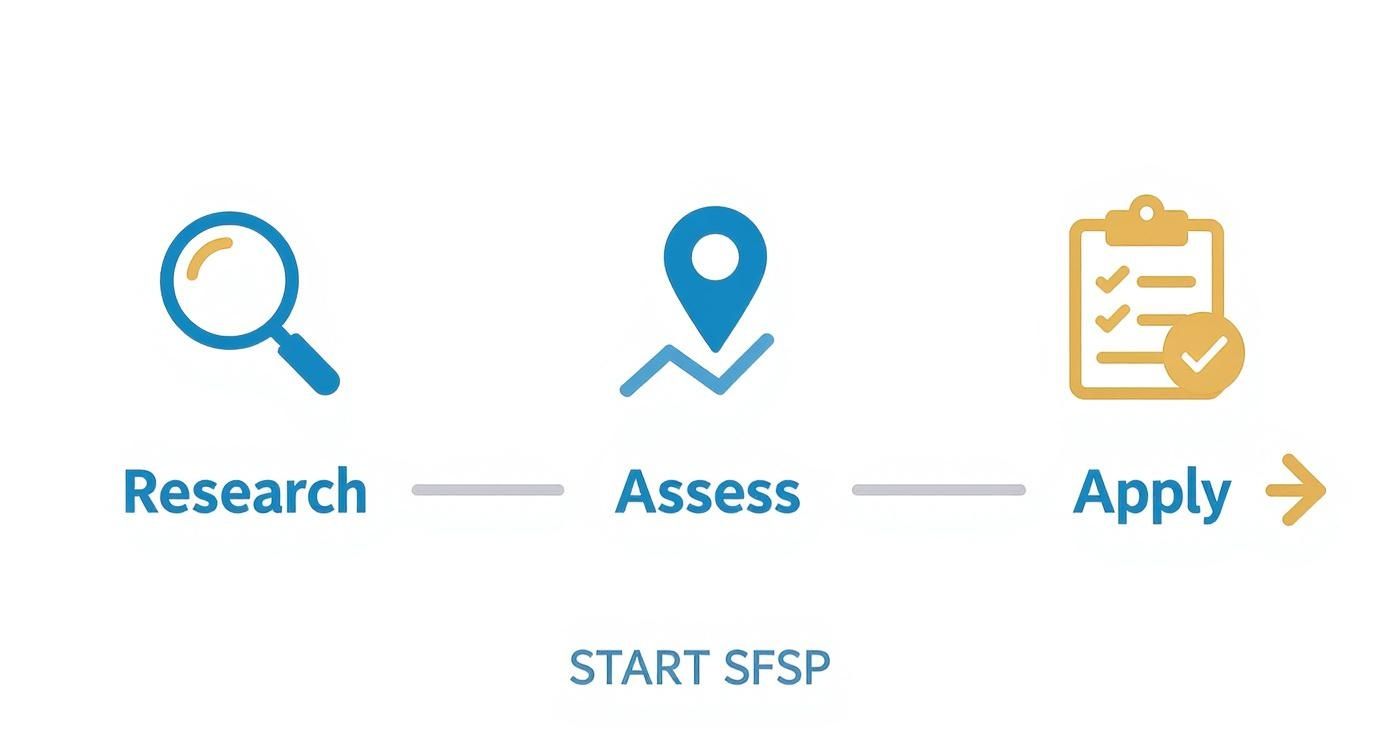
As you can see, the real work begins long before you even think about the application, starting with solid research and a clear-eyed assessment of what your community truly needs.
To help you map out your own program launch, we’ve put together a practical timeline and checklist that walks you through the key phases of preparation.
SFSP Pre-Summer Preparation Checklist
| Phase (Timeframe) | Key Tasks | Compliance Focus |
|---|---|---|
| Early Year Groundwork (January – March) |
– Identify and secure site agreements – Begin dialogue with food vendors – Develop initial program budget – Map out community outreach strategy |
– Verifying site eligibility (area eligibility) – Understanding procurement regulations – Preliminary budget alignment with SFSP rules |
| Critical Spring Planning (April – May) |
– Finalize kid-friendly, compliant menus – Hire and train program staff/volunteers – Submit SFSP application to State Agency – Plan meal delivery/kitting logistics |
– Menu compliance with USDA meal patterns – Mandatory Civil Rights training – Rural Non-Congregate and Buy American provisions |
| Final Launch Prep (June) |
– Conduct final site inspections – Confirm delivery schedules and routes – Launch public outreach campaign – Set up meal count and record-keeping systems |
– Pre-operational site reviews – Finalizing record-keeping SOPs – Ensuring all public info is accurate and compliant |
This timeline isn’t just about checking boxes; it’s about building a strong, compliant, and impactful program from the ground up.
Early Year Preparation (January-March)
The first quarter is all about laying the foundation. This is your time to lock in the core commitments and partnerships that your entire program will lean on. Putting these tasks off can create serious headaches down the road.
- Secure Site Agreements: Start talking to potential sites—think libraries, community centers, and local housing authorities. Get written agreements that spell out everyone’s responsibilities, operating hours, and how the facility will be used.
- Initiate Vendor Dialogues: If you plan to outsource meals, now is the time to research and connect with potential food service management companies. Don’t be shy about asking for sample menus and references from other SFSP sponsors.
- Develop an Initial Budget: Sketch out your expected costs for food, labor, supplies, and any administrative overhead. A solid, realistic budget is non-negotiable for your application and for keeping the program financially healthy all summer.
Critical Spring Planning (April-May)
With spring’s arrival, your attention needs to shift from big-picture strategy to the nitty-gritty operational details. This is when you finalize the how—from the exact meals you’ll serve to the people who will serve them. It’s also prime time for getting all your compliance training in order.
A huge piece of this is finalizing menus that are both kid-friendly and compliant. This is more than just picking tasty meals; you have to ensure they meet USDA nutrition guidelines. For multi-day kits, especially if you’re running a Rural Non-Congregate model, this means careful planning for items that hold up well and meet cold-chain requirements for sensitive items like milk.
Umoja’s Perspective: High-impact partnerships are built on mutual trust and shared goals. We’ve found that early engagement with community leaders—long before you ask them to host a site—is key. Show up at community meetings, listen to their concerns, and position your program as a solution. When families see you as a consistent, trustworthy presence, participation naturally follows.
You’ll also need to conduct mandatory civil rights training for every single staff member and volunteer. This isn’t optional; it’s a federal requirement that ensures everyone involved understands their duty to serve all eligible children without discrimination. Make sure you document this training—it’s a critical compliance step.
Final Launch Preparations (June)
The final weeks before launch are all about double-checking and confirming. If you did the detailed work in the spring, this phase should be about smooth execution, not frantic crisis management.
- Conduct Final Site Inspections: Get out and visit every single site. Make sure it’s clean, safe, and ready for service. Check that all the necessary equipment, like refrigerators and tables, is in place and working properly.
- Confirm Delivery Logistics: Lock in the delivery schedules and routes with your food vendor or your own kitchen staff. Every site supervisor needs crystal-clear instructions on how to receive and document meal deliveries.
- Launch Your Outreach Campaign: Now that your sites and schedules are set in stone, it’s time to shout it from the rooftops. Distribute flyers, get active on social media, and lean on your community partners to make sure every family knows exactly where and when they can find a free, healthy summer meal.
Mastering Food Procurement and Menu Planning
Let’s be honest: the heart of any Summer Food Service Program is the food. Your success really boils down to sourcing meals that not only check all the USDA compliance boxes but are also food that kids actually want to eat. It’s a tricky balancing act of smart procurement, creative menu planning, and logistics that have to be absolutely airtight, especially as service models keep evolving.
It all starts with your procurement strategy and getting the “Buy American” provision right. This isn’t just a suggestion; it’s a federal rule that requires SFSP providers to buy domestically grown and processed foods whenever possible. The best way to stay compliant is to use domestic vendors whenever possible and—if you must use non-domestic products—retain written justification and cost or availability documentation for each exception, as required by federal audit standards. They become your first line of defense against compliance headaches.
This goes way beyond just placing orders. You’re creating a resilient supply chain. Make sure you vet potential vendors thoroughly—ask for references from other SFSP sponsors and dig into their capacity. Can they really handle the volume you need? Do they have experience providing the right components for multi-day meal kits?
Planning Menus for Different Service Models
Today’s SFSP providers have to be flexible, planning menus that can adapt to completely different delivery methods. A hot meal served at a park has totally different needs than a seven-day meal kit designed for a Rural Non-Congregate program.
When you’re building those take-home kits, the name of the game is nutrition and durability.
- Shelf-Stable Staples: Think single-serve cereals, shelf-stable milk, crackers, and fruit cups. These are the workhorses of a great meal kit.
- Cold-Chain Management: Milk is usually the biggest logistical puzzle. You absolutely must have a documented plan for keeping that cold chain intact, from your warehouse all the way to a family’s front door, complete with regular temperature checks.
- Kid-Friendly Appeal: Never forget who you’re serving. Simple additions like sun butter cups, cheese sticks, and whole-grain granola bars can be the difference between a meal that gets eaten and one that gets tossed.
The sheer scale of these programs can be staggering, which means planning has to be meticulous. Just look at New York State’s SFSP—in 2025, they’re on track to serve over 20 million meals across nearly 2,500 sites. That kind of volume shows just how critical a robust, scalable menu planning process is to making sure every child gets a quality meal.
Developing Clear Standard Operating Procedures
Think of your Standard Operating Procedures (SOPs) as the program’s playbook. They’re what guarantee consistency, safety, and compliance no matter who is working or at which site. Vague instructions are a recipe for disaster; your SOPs need to be detailed and crystal clear.
Get specific and document the workflows for every critical step:
- Meal Assembly and Kitting: Lay out the exact components and portion sizes for every meal. I highly recommend using visual aids or pack lists to guide your team—it dramatically cuts down on errors when you’re in the middle of a high-volume kitting session.
- Receiving and Storage: Create a detailed process for checking deliveries against invoices, taking temps on perishable items, and organizing your stock using the First-In, First-Out (FIFO) method.
- Inventory-Aware Substitutions: Food waste is a budget killer. The solution is to develop a pre-approved list of USDA-compliant substitutions that your staff can grab when a planned item doesn’t show up. This prevents that last-minute panic and ensures you always meet meal pattern requirements.
From our experience at Umoja, the most effective summer food service program providers are those who empower their teams with clear, easy-to-follow instructions. A well-written SOP for inventory substitutions, for instance, doesn’t just reduce waste—it gives site supervisors the confidence to make smart decisions on the fly while staying compliant.
Ultimately, mastering your food operations is about more than just moving boxes. It’s about building a system that runs efficiently while staying laser-focused on the kids you serve. For organizations looking to streamline these complex moving parts, Umoja offers logistical and kitting solutions that help ensure compliant and efficient program execution. A well-managed food procurement and menu system is the engine that drives a high-impact summer meals program.
Boosting Participation with Community Outreach
You can have the most incredible Summer Food Service Program, but it means nothing if families don’t know it exists or don’t feel comfortable showing up. The difference between a good program and a truly great one often boils down to one thing: effective community outreach. It’s about building genuine trust and meeting families where they are, transforming your meal sites from simple distribution points into real community hubs.
This process starts by moving beyond just hanging a flyer. Real engagement requires forging authentic partnerships with the institutions that families already know and trust. Your outreach strategy is the bridge connecting your carefully planned meals to the children who need them most.
Forging High-Impact Partnerships
The most successful summer food service program providers I’ve seen are deeply embedded in their communities. They don’t operate in a vacuum. Instead, they build a network of allies who share a common goal of supporting children and families.
Think about the pillars of your community:
- Public Libraries: Libraries are natural partners. They’re safe, accessible spaces that families already frequent for summer reading programs and other activities.
- Housing Authorities: Partnering with local housing authorities allows you to bring meals directly to high-need apartment complexes, which removes huge transportation barriers for parents.
- Local Nonprofits and Faith-Based Groups: Organizations like the Boys & Girls Clubs, YMCAs, and local churches often have deep, long-standing relationships with families. They can become powerful advocates for your program.
Umoja’s Perspective: Building trust isn’t a one-time action; it’s a continuous process. We’ve seen that showing up at community meetings, listening to residents’ needs, and co-designing outreach materials with local leaders makes all the difference. When community members see you as a consistent, reliable partner, they become your most effective champions, spreading the word far better than any flyer could.
Grassroots Outreach That Truly Connects
Once you have your partners on board, it’s time to get the word out with materials that speak directly to your community. This means being thoughtful about language, accessibility, and placement. A one-size-fits-all approach just doesn’t work here.
Practical Outreach Tactics:
- Create Multilingual Materials: Make sure your flyers, social media posts, and robocalls are available in all major community languages and also provide them in accessible formats (e.g., large print, audio, alternate text) for families with disabilities. Use simple, clear language that focuses on the key details: free, healthy meals for kids, with times and locations.
- Use Social Media Strategically: Find the local parent groups on platforms like Facebook and share your program information there. Post clear, friendly graphics with site details and tag your community partners to amplify your message.
- Go Where Families Are: Don’t wait for families to find you. Set up information tables at local grocery stores, community health fairs, and even laundromats. This grassroots effort shows you are an active and accessible part of the neighborhood.
Transforming Meal Sites into Community Hubs
The final piece of the puzzle is making your sites places where kids are genuinely excited to go. Best practices have shown us time and again that pairing meal service with engaging activities is a powerful way to boost participation. Programs that integrate educational or physical activities aren’t just feeding bodies; they’re nourishing minds and helping to reduce summer learning loss.
This approach dramatically improves attendance and strengthens community bonds. You can learn more about how activities can drive program success and sustainability.
Consider pairing your meal service with simple, low-cost activities:
- Summer Reading: Team up with the local library to have a librarian read stories or bring a bookmobile to your site once a week.
- Sports and Games: Organize simple things like jump rope, soccer, or sidewalk chalk art to get kids moving.
- Arts and Crafts: Offer basic craft supplies for kids to get creative while they enjoy their meals.
By combining nutritious food with fun, you create a positive, welcoming environment. This is how you transform your meal site from a simple service into a beloved summer destination, ensuring kids come back day after day.
Navigating Compliance and Program Reporting
For any Summer Food Service Program provider, airtight compliance isn’t just a nice-to-have—it’s the very foundation of a sustainable operation. While the administrative side can feel daunting, it’s entirely manageable once you build clear systems and lock in consistent daily habits. Think of it this way: a solid documentation process is your ticket to timely reimbursements, fewer errors, and proving you’re a responsible steward of federal funds.
The trick is to weave compliance into your daily workflow so it isn’t an afterthought. Simple, repeatable tasks are your best defense against the common slip-ups that can jeopardize your funding. This is about creating a culture where everyone, from the delivery driver to the site supervisor, understands their role in keeping accurate records.
Mastering Daily Record-Keeping
Your program’s success often lives in the details of your daily paperwork. In my experience, inaccurate meal counts are one of the most frequent findings during state agency reviews. This makes getting it right the single most critical daily task for your team.
The best way to guarantee accuracy is to use easy, real-time point-of-service meal count forms or, where possible, electronic meal counting systems, which are now encouraged (and sometimes required) for accuracy and auditability by many states. This completely removes the guesswork later. For example, a basic hand-clicker or a check-off sheet used as each child gets their meal creates a reliable, auditable trail.
Of course, it’s not just about meal counts. Other daily logs are just as crucial:
- Temperature Logs: This is non-negotiable for food safety. You must document the temperature of all perishable items when they arrive and while they’re in storage.
- Delivery Records: Every single delivery needs to be checked against the invoice. Any discrepancies should be noted on the spot and reported back to your food vendor or central kitchen immediately.
- Milk Inventories: If you’re doing multi-day kits, tracking milk requires extra diligence to stay compliant and ensure it’s being handled properly.
To really elevate your food safety and compliance game, it’s worth diving into the essential HACCP certification principles. These guidelines offer a structured approach to identifying and controlling potential hazards throughout your entire process.
Effective Site Monitoring and Team Training
You can’t manage what you don’t monitor. Regular site monitoring is a USDA requirement, but it’s also your best tool for getting ahead of problems. These visits aren’t about playing “gotcha”; they’re about offering support, answering questions, and reinforcing the right way to do things.
Create a standardized site monitoring form that hits all the key compliance points, from civil rights signage to meal counting procedures. This ensures your monitors are consistent at every site and can provide feedback that’s truly helpful. These visits let you catch and fix small issues before they blow up into major problems during an official review.
At Umoja, we see consistent training as the bedrock of a compliant program. An empowered team is a compliant team. We’ve found that when staff and volunteers get the “why” behind the rules—like protecting kids’ health and the program’s integrity—they become far more invested in nailing the details.
This training can’t be a one-and-done event before summer kicks off. Brief weekly check-ins or quick reminders about program rules are great ways to keep compliance top-of-mind for everyone.
Preparing for State Agency Reviews with Confidence
An administrative review from your state agency shouldn’t be a cause for panic. If you’ve built strong daily processes and are doing your own regular monitoring, you’re already most of the way there. The final piece is having all your documentation organized and ready to go.
Checklist for Review Readiness:
- Centralize Your Records: Keep all your meal count forms, temperature logs, training sign-in sheets, and monitoring reports in one organized system, whether it’s a binder or a digital folder.
- Conduct a Mock Review: Before the real deal, have someone on your team (or even a partner organization) run through a mock audit using the state agency’s own forms. It’s the best way to pressure-test your systems.
- Review Civil Rights Compliance: Ensure the ‘And Justice for All’ USDA civil rights poster is posted in a prominent, visible location at every site and keep the dated sign-in sheets for all staff and volunteer civil rights trainings as required federal documentation.
Building these kinds of robust systems shows a real commitment to operational excellence. Many successful providers find value in seeing how other government partners manage large-scale programs to refine their own processes and meet the highest standards. In the end, strong compliance is what frees you up to focus on the mission that really matters: feeding children.
Common Questions We Hear from SFSP Providers
Whether you’re launching your first site or scaling up an established operation, you’re bound to have questions. Getting clear, straightforward answers is key to running a summer program that’s both compliant and impactful.
Let’s walk through some of the most frequent queries we get from partners on the ground, from evolving program rules to the nitty-gritty of daily operations.
Congregate vs. Non-Congregate Models
One of the first things to get straight is the difference between congregate and non-congregate feeding. Think of it this way:
Congregate feeding is the classic SFSP model. It’s where kids gather at a central spot—a park, a library, a community center—and eat their meals together. This approach is fantastic for building community but can sometimes be a hurdle for families who struggle with transportation or daily attendance.
The Rural Non-Congregate model was initially created for eligible rural areas but has recently expanded—under USDA waivers and guidance—to include certain non-rural or pilot regions, depending on state policy and current federal flexibilities. Always check your state agency’s most up-to-date eligibility criteria. It gives you the flexibility to provide multi-day meal kits for parents to pick up. To do this right, you have to first confirm your sites are in an officially designated rural area. You’ll also need to follow stricter rules for things like packaging, shelf-stability, and maintaining the cold chain for items like milk.
Controlling Food Costs and Reducing Waste
Every provider I’ve ever worked with grapples with controlling food costs and minimizing waste. It’s a constant balancing act. The best way to tackle this starts long before you pack the first meal. It begins with solid participation forecasts, ideally based on historical data from your own sites or similar programs nearby. This helps you order much more accurately from the get-go.
From there, it’s all about building flexibility into your menu planning.
- Create Pre-Approved Substitutions: Work with your team to develop a list of USDA-compliant swaps for common menu items. This gives your site staff the power to make smart, compliant decisions when a delivery is short or an item is suddenly unavailable.
- Implement First-In, First-Out (FIFO): This is non-negotiable. Train every single person handling food to use the older inventory first. It’s a simple practice that can drastically cut down on spoilage.
- Partner with Food Banks: Before the summer even starts, establish a relationship with a local food bank. This gives you a plan for donating leftover, non-perishable items at the end of the season, ensuring good food supports another vital community resource instead of ending up in a landfill.
The Most Common Issues During Reviews
State agency reviews are just part of being a summer food service program provider. Knowing the common pitfalls can make the whole process much less stressful. Time and again, reviewers flag the same few areas where documentation gets a little loose.
The most frequent findings almost always stem from small breakdowns in daily processes. We’re talking about incomplete temperature logs, meal count forms filled out at the end of the day instead of in real-time, or missing paperwork for staff civil rights training. These are all easy to avoid with the right systems.
To stay ahead of these issues, you have to build a culture of meticulous record-keeping. Use daily checklists for your site supervisors. Conduct your own mock reviews midway through the summer to spot weaknesses. Keep your records centralized and accessible. When you treat compliance as a daily habit instead of a last-minute scramble, you’ll be ready for any review, any time.
At Umoja Health, we specialize in helping our partners navigate these very challenges, from providing compliant, multi-day meal kits to offering guidance on program logistics and execution. Let us help you build a resilient, impactful summer meals program. Learn more about our solutions.